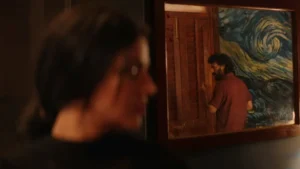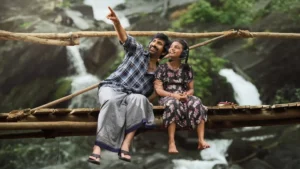
Natarajan Subramaniam, known by the single-name shorthand Natty, plays ‘Golden Star’ Kulkanth Kumar, a film star who wades into Tamil Nadu politics just as election fever boils over. There is something immediately loaded about that premise: a performer playing a performer crossing into power, at a moment when the film itself is being dragged into real-world political fire.
Natty’s casting here is not accidental. The role demands a performer comfortable with self-parody, capable of sliding between the vanity of stardom and the blunt comedy of political ambition without losing either register. From what the film’s promotional material reveals, including the retro swagger on display in the song “Kulkanth Kumar, ” voiced by Premgi Amaren, Natty appears to be leaning hard into the film star archetype, using his own industry experience as scaffolding. Whether that instinct sustains across two hours and eighteen minutes is the film’s central gamble.
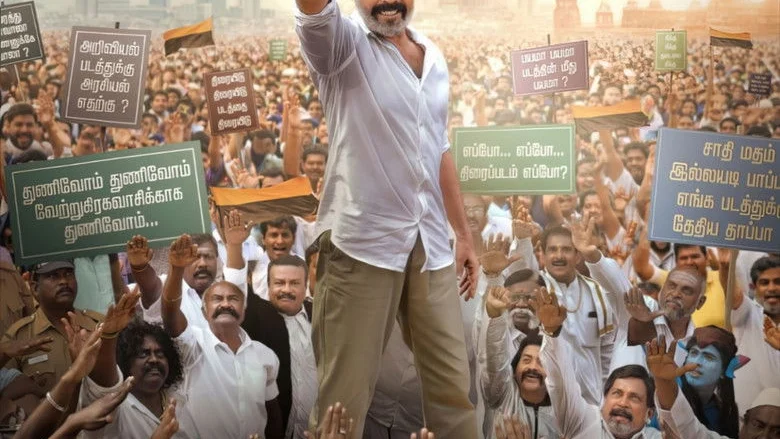
Umapathy Ramaiah Bets on Satire as a Blunt Instrument
Director Umapathy Ramaiah, who also wrote the story, is swinging at real targets here. Tamil Nadu politics in the run-up to the April 23 assembly elections gives him abundant material, and the film reportedly lands specific digs at real-life incidents. That specificity is a strength, satire without targets is merely buffoonery.
The flaw, and it is a structural one, is that political satire at this pitch often sacrifices character interiority for punchline momentum. When a film’s dramatic engine is “film star enters politics, chaos follows, ” the screenplay needs to do serious work to make us care about the individual underneath the spectacle. Whether Umapathy’s writing digs below the surface or stays comfortably at the level of caricature is the question the film cannot avoid answering.
The Satire Runs Hot, But Does It Run Deep?
Political comedy in Tamil cinema has a complicated legacy. The genre demands precise timing, cultural specificity, and a willingness to absorb backlash. TN 2026 arrives with all three conditions in play, and cinematographer Aral R. Thangam’s visual language will matter in deciding whether this feels like sharp commentary or carnival noise.
The “Kulkanth Kumar” song, with Mohan Rajan’s lyrics framing the hero in a deliberately retro filmi mythology, suggests Umapathy is conscious of the gap between screen legend and political reality. That self-awareness, if it runs through the screenplay, is where the film could separate itself from lesser Tamil political comedies.
I find myself genuinely curious whether the satire has enough structural spine to carry its runtime, or whether the comedy is doing all the heavy lifting while the drama lags behind. A 138-minute political satire needs more than topical wit; it needs an emotional anchor.
If you enjoy Tamil political and comedy films with a satirical edge, Tamil Drama reviews on this site cover the genre with the same analytical lens.
Thambi Ramaiah and a Deep Bench of Familiar Faces
The supporting cast reads like a deliberate assembly of Tamil comedy and character acting royalty. Thambi Ramaiah, M. S. Bhaskar, Ilavarasu, Redin Kingsley, Vaiyapuri, this is not a bench, it is a platoon. Casting this many established comic and dramatic actors alongside Natty signals confidence in the script’s ability to distribute weight.
Thambi Ramaiah in particular deserves attention. His presence in a political satire about Tamil Nadu is rarely decorative, he brings a groundedness that prevents scenes from floating into pure farce. The film’s tonal credibility may rest partly on how well these veterans anchor Natty’s more heightened performance. If they are used as wallpaper, it is a waste of an extraordinary resource.
A Petition, A Release, and the Politics of Release Day
The film’s most dramatic moment may have occurred before a single frame screened publicly. A petition was filed seeking the Election Commission to halt the release of TN 2026 ahead of Tamil Nadu’s April 23 assembly elections, with a decision on that petition still pending at the time of release. That the film arrived on April 10, thirteen days before polling, is a political act in itself, whether or not Umapathy intended it that way.
This kind of friction is precisely what political satire is supposed to generate. The fact that institutional pressure was mobilised against a film for its timing confirms that TN 2026 is not merely a comedy about politics, it is a film that has become entangled in the politics it is satirising. That is either a remarkable coincidence or very smart positioning.
TN 2026 is worth your time if Tamil political comedy done with specificity and a willingness to provoke is your register. Go in expecting caricature sharpened by cultural targeting, not psychological nuance. The ensemble alone makes it a reasonable theatrical proposition, and the controversy surrounding its release has already given it a life beyond the screen.
If Vignesh Shivan’s approach to performance-driven storytelling interests you, the Love Insurance review examines how star persona shapes genre differently in a romantic context.
TN 2026 is a flawed but pointed piece of Tamil political satire that earns a cautious 2.75 out of 5, the ensemble’s collective experience keeps it afloat where the screenplay leaves gaps.
For a film that balances action and drama in a similarly ambitious register, the Dacoit verdict explores how genre ambition plays out when the stakes are equally high.