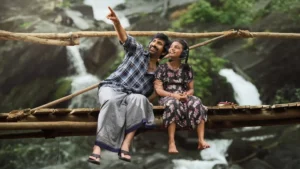
Prathap arrives at a remote village searching for reinvention, only to find himself entangled in the very traditions that guard its fragile identity. The arrival triggers a cascade of buried tensions, between those who want the village to evolve and those determined to preserve what time has left untouched.
Singeetam Srinivasa Rao constructs Sing Geetham around a deceptively simple premise: a man stepping into a closed world where music and mythology shape community bonds more than law or logic. The 137-minute runtime suggests an ambitious vision, one that refuses to resolve quickly.
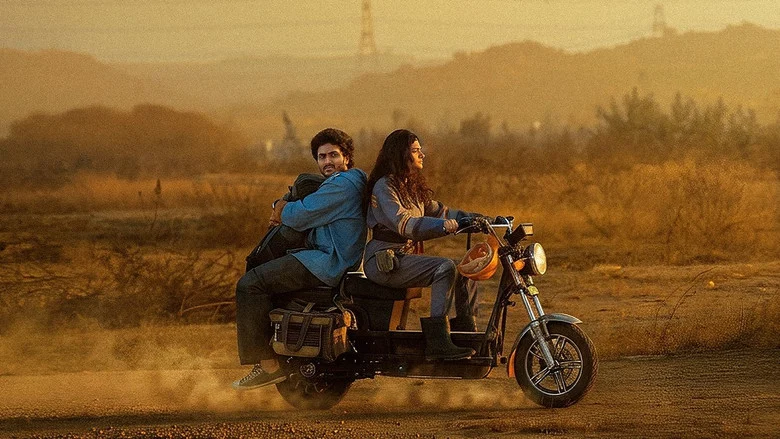
Ahilya Bamroo and Shalini Kondepudi Carry the Emotional Weight
The dual-lead structure positions Bamroo and Kondepudi as anchors for competing philosophies within the village framework. Their presence signals that Sing Geetham isn’t simply about spectacle or song, it’s built on the friction between two performers who embody conflicting worldviews. The film asks audiences to navigate their emotional arcs across its substantial length.
Rao’s Direction Balances Fantasy Worldbuilding with Social Allegory
The director frames the village as a space untouched by ordinary time, using geography and ritual as primary storytelling devices rather than relying on visual effects alone. This choice, anchoring fantasy in cultural practice, demonstrates craft discipline. However, the film’s linear structure risks predictability when dealing with secrets that audiences sense arriving long before characters acknowledge them.
The Fantasy-Musical Blend Tests Genre Boundaries
The marriage of fantasy and musical elements hinges on whether song functions as emotional punctuation or narrative engine. Sing Geetham appears to treat musical moments as carriers of tradition itself, songs aren’t performance breaks but rather expressions of community memory and resistance to external change.
The village setting becomes more than backdrop; it functions as a third character, its customs and rhythms governing how conflict unfolds. This approach demands viewers accept that resolution may come through cultural acceptance rather than plot mechanics. The film asks whether progress must mean abandonment, or whether evolution can honor roots.
At 137 minutes, pacing becomes crucial. If the musical sequences deepen emotional stakes rather than delay narrative momentum, the runtime serves intention. If they feel inserted, the length becomes a liability. The available framework suggests the former was intended, but execution determines whether audiences experience immersion or patience-testing.
For viewers seeking traditional fantasy action or spectacle, Sing Geetham clearly positions itself elsewhere. The genre conversation here is quieter, rooted in what communities choose to preserve and what they must release. That’s either deeply resonant or quietly frustrating, depending entirely on what you came to see.
Telugu fantasy cinema has explored this territory before, but rarely through the dual-lead structure or musical foundation that frames this film. The supporting cast, Agu Stanley Chiedozie, Benarjee, and P.A. Tulasi, completes an ensemble designed to represent competing village factions rather than function as traditional secondary characters. Their presence deepens the suggestion that Sing Geetham is fundamentally about collective tension rather than individual heroism.
Readers exploring how Telugu cinema wrestles with tradition and modernity will find Abadameva Jayathe review offering useful context for this film’s thematic territory.
No Clear Antagonist, Conflict Lives in Ideology, Not Character
The absence of a traditional villain removes a familiar emotional anchor. Without a person to oppose, Prathap’s struggle becomes introspective, forcing audiences to sit with ambiguity about whether the village is protecting wisdom or suffocating potential. This is either the film’s greatest strength or its most significant structural risk.
The Village Itself Becomes the Test of Audience Patience
Everything about Sing Geetham depends on whether viewers embrace slow revelation and cultural specificity or find themselves checking runtime. The musical framework promises emotional connection through song, while the fantasy premise invites wonder. The social-conflict layer demands critical engagement. Few films ask audiences to toggle between all three simultaneously.
Sing Geetham will satisfy viewers who came for meditative fantasy rooted in cultural identity and musical storytelling that serves theme rather than distraction. It will frustrate those expecting momentum-driven plotting or spectacle-oriented genre payoffs. Watch it if you prize character-centered slow cinema and find meaning in what communities value; skip it if you need clearer narrative stakes and more conventional dramatic opposition.
The film’s strength, using music and mythology as primary storytelling tools, becomes its accessibility barrier for audiences trained on faster narrative rhythms. This is cinema for patient viewers who believe tradition and progress aren’t always enemies, just conversation partners who haven’t learned to listen yet.
Consider pairing Sing Geetham with Parimala Co verdict for a fuller picture of how Telugu cinema frames community conflict.
Sing Geetham is a film for audiences willing to trade conventional drama for cultural specificity, a measured 2.5/5 experience that privileges thematic meditation over narrative momentum.