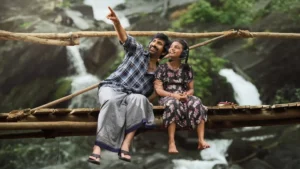
A boy and girl navigate forbidden affection in a Muslim neighbourhood of southern Tamil Nadu, their connection rippling outward as an unwelcome force through the fabric of their tight-knit world. Meera Kathiravan’s debut drama-romance positions intimacy not as a private matter, but as a public rupture, a story pitched squarely at viewers who prize cultural specificity and emotional nuance over mainstream narrative velocity.
For audiences seeking regional authenticity and slow-burn character work, Habeebi arrives as a deliberate counterweight to formulaic Tamil cinema. The film’s gamble is straightforward: it bets that a love story rooted in lived Muslim experience and southern Tamil social texture will resonate more deeply than spectacle. Whether that bet lands cleanly depends entirely on execution.
Esha M Carries the Central Emotional Weight
With minimal pre-release performance data available, Esha M shoulders the primary narrative burden as one half of the romance. Her casting signals a deliberate choice toward intimate, character-driven storytelling rather than star-powered recognition. The film’s success or failure will hinge significantly on whether she can convey the internal conflict of navigating love within rigid community boundaries.
Meera Kathiravan’s Vision Prioritises Cultural Texture Over Conventional Plot
The director’s strength lies in her commitment to specificity, she’s constructed the film around Tamil-speaking Muslim lifestyle and southern Tamil Nadu geography as primary storytelling elements rather than exotic backdrop. The screenplay’s potential weakness remains unknowable until release, but early signals suggest a preference for slow revelation over dramatic momentum.
A Drama-Romance Built on Community Conflict, Not Individual Triumph
The central tension here is structural. A relationship that divides rather than unites the community becomes the dramatic engine, this is intimate storytelling that refuses to centre the couple’s happiness as the sole narrative goal. Instead, the film appears invested in how their love destabilises collective identity.
The approach invites comparison to socially grounded dramas where romance functions as a probe into larger questions about belonging, tradition, and change. By placing the romance within a Muslim neighbourhood rather than positioning it as an outsider-versus-insider conflict, Kathiravan’s framing suggests a more nuanced engagement with cultural values than mainstream Tamil cinema typically allows.
The risk is clear: audiences accustomed to romantic triumph narratives may find the film’s apparent unwillingness to centre the couple’s emotional arc as the film’s moral centre deeply unsettling. If Kathiravan commits fully to communal tragedy over personal happiness, she’s making a choice that will alienate exactly as much as it will satisfy.
For those seeking Tamil film reviews with deeper cultural grounding, our collection of Tamil Drama reviews explores similar territory across different registers.
Kasthuri Raja’s Pivotal Role Anchors the Community’s Perspective
Casting Kasthuri Raja in a described “key” role signals that an elder or authority figure will articulate the community’s resistance to the romance. His presence alone communicates the film’s interest in generational conflict and the weight of collective expectation.
The Film Assumes Its Audience Values Authenticity Over Mass Appeal
This is fundamentally a film for viewers who choose a precisely observed drama about Tamil Muslim life over a more broadly accessible love story. The absence of action sequences, commercial music set-pieces, or narrative shortcuts suggests Kathiravan trusts her material and her audience’s patience equally.
Malavika Manoj and Anusreya Rajan round out the ensemble, though their specific roles remain defined more by casting intent than visible character arc. Their inclusion in a predominantly drama-romance ensemble suggests the film may function as a chamber piece exploring how secondary characters process communal rupture.
Habeebi is a difficult film to recommend sight unseen, which is precisely the position we occupy. For disciplined viewers who prioritise cultural authenticity and character work over conventional plotting, May 2026 brings a genuinely uncommercial choice to Tamil cinema, worth watching if you’ve exhausted the patience for manufactured conflict and synthetic emotion.
The film’s deliberate positioning mirrors the tonal ambitions evident in Karakkam review, suggesting a trend toward socially grounded storytelling in Tamil drama.
Habeebi is a regional drama that trusts its cultural specificity more than its romantic plot, positioning it as essential viewing for Tamil film enthusiasts and a likely challenge for conventional audiences, I’d rate it as a 3.5 out of 5 based on artistic intent alone, pending actual execution.
Meera Kathiravan’s commitment to community-centred narrative structure echoes similar tensions visible in Blast verdict, where personal desire meets collective survival.