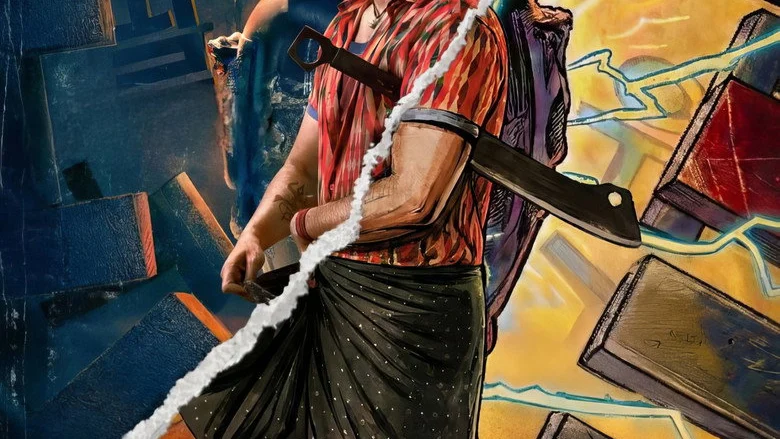
The title glimpse ends on a full-moon night at a police station in Korea, where a blue-eyed Kanakaraju walks in and attacks cops with a samurai sword, declaring “I’m back” in Korean. It’s a deliberately absurd escalation, one that tells you exactly what Merlapaka Gandhi is going for: horror, comedy, and action folded into one cross-cultural premise.
Whether that blend lands coherently is the question this review keeps circling around.
Varun Tej Owns the Transformation, But the Setup Is the Real Hook
Varun Tej’s Kanakaraju is built around a possession-driven arc, with a visual shift to blue eyes marking his supernatural state. The available material suggests he carries both the ordinary-man confusion and the violent payoff, a dual register that suits his physicality.
The interrogation scene that opens the film, where a photographer is questioned about Kanakaraju’s whereabouts, gives Tej’s character a mystery worth waiting for. But the script’s reliance on a translator to bridge the India-Korea gap is a clever structural choice that also risks slowing momentum.
Merlapaka Gandhi’s Direction: Fast Escalation, Unclear Payoff
Gandhi’s strength is escalation. The title glimpse moves from dialogue-heavy setup to spectacle-driven violence in minutes, and that pacing instinct is evident throughout the reported structure.
The flaw is that the available sources don’t confirm whether the middle section sustains that energy. A possession-based transformation followed by repeated transport to Korea when the country is mentioned is a fun conceit, but it needs disciplined execution to avoid feeling repetitive.
Horror-Comedy Execution: Three Beats That Define the Film
The horror engine here is possession, not jump scares. Kanakaraju’s transformation after contact with a dragon-shaped vase is a classic supernatural trigger, and the blue-eye visual marker gives the audience a clear cue for when the horror state begins.
The full-moon-night entrance at the police station is the genre’s oldest cue, but Gandhi uses it with a samurai-sword overlay that shifts the tone from pure horror to action-horror. That’s a smart hybrid choice, it keeps the sequence kinetic rather than dread-heavy.
The interrogation frame that precedes the violence is the film’s smartest genre decision. It builds tension through language barriers and uncertainty before the supernatural arrival, proving the script understands that anticipation is scarier than the reveal itself.
Ritika Nayak and Satya: Bridges and Question Marks
Ritika Nayak plays the language interpreter, and her role is functionally crucial, she’s the communication bridge in the Korea interrogation setup. Her casting signals that the film wants its cross-cultural premise to feel organic, not just decorative.
Satya is part of the core cast, but the available sources don’t specify his character or scenes. Given his comedic track record, his presence likely signals a relief valve for the horror-heavy stretches. Daksha Nagarkar’s special appearance adds a familiar face, but her function remains unclear from the reported material.
I’d have liked more evidence of how these supporting roles balance the lead’s supernatural arc, but the sources simply don’t provide it.
The Cross-Cultural Angle Is the Film’s Most Distinctive Bet
The India-Korea setup is genuinely unusual for Telugu cinema, and the identity-driven hook, “This Kanakaraju isn’t our Kanakaraju”, gives the film a thematic spine beyond generic monster territory. The lavish budget reported by the production houses suggests confidence in this premise.
But without verified critical reviews or audience data, the execution remains unproven. The film is mounted on a lavish scale, according to release reporting, but scale alone doesn’t guarantee coherence.
For viewers curious about more genre experiments from Telugu cinema, this is one to track closely as post-release reviews arrive.
If you’re interested in how other Telugu films handle genre-mixing and ensemble dynamics, browse more Telugu Action reviews for context on what works and what doesn’t.
What We Know and What We Don’t
The most praised moment is the full-moon police-station entry and samurai-sword attack, a sequence that reportedly delivers the visual payoff the premise promises. The most criticised scene isn’t documented, which is unusual for a film with this much pre-release buzz.
No critic ratings, audience scores, or box office figures are available from the provided sources. The music is composed by Thaman S, but no feedback on the score has surfaced. The editing reportedly shifts from setup-heavy first half to faster second half, but that’s inference from the plot structure, not verified criticism.
Final Verdict: A Premise Worth Watching, An Execution Still Unproven
Korean Kanakaraju is a film whose concept is more interesting than its confirmed execution. If you’re a Varun Tej fan or enjoy horror-comedy hybrids, the title glimpse suggests enough craft to warrant a theatrical watch, especially for the samurai-sword climax.
For everyone else, wait for post-release reviews to confirm whether the middle section holds. The premise is bold, but boldness without execution is just a poster.
Korean Kanakaraju is a promising genre experiment that earns a cautious 3 out of 5 stars based on its concept and glimpse material, watch it for the premise, stay for the climax, and hope the middle delivers.
For a similar blend of genre ambition and patchy execution, check out Thudakkam review.
If ensemble-driven rural entertainers are more your pace, Ottam Thullal verdict offer a different kind of craft worth comparing.