
A driver’s cap sits low over Tiger Muthuvel Pandian’s eyes, and the man who once ran a prison now runs errands. Nelson Dilipkumar opens his sequel in deliberate diminishment: the enforcer reduced to a steering wheel, the legend filed down to a uniform.
That image carries the film’s entire thesis. What it cannot carry is the 176 minutes draped over it.
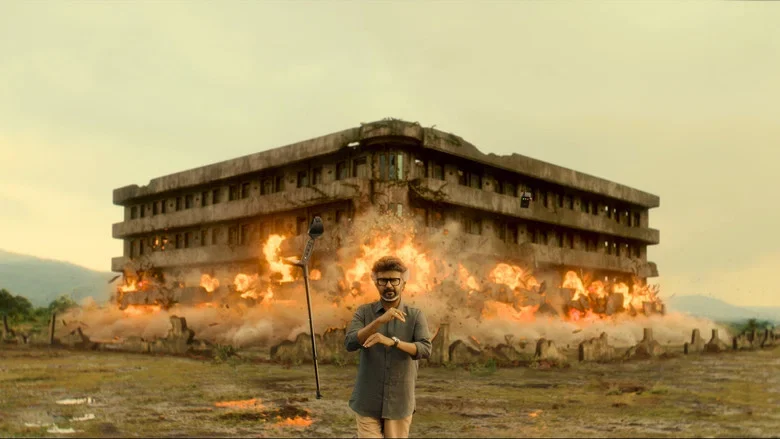
The Disguise Is The Best Idea Nelson Has Had In Years, And He Knows It
Retirement as camouflage is a genuinely elegant premise. Muthuvel isn’t hiding from his past; he’s using it, tracing the syndicate behind the idol-smuggling ring from the first film while posing as hired labor.
Nelson understands that a Rajinikanth entrance lands hardest when the star has spent twenty minutes being underestimated. The first act trades swagger for surveillance, and the patience pays off in the way the camera holds on his hands on the wheel rather than his face.
Just as the filmmaker demonstrated a leaner spatial discipline in Aakhri Mulaqat, the early stretch here strips away decorative flourishes and lets silence do the threatening.
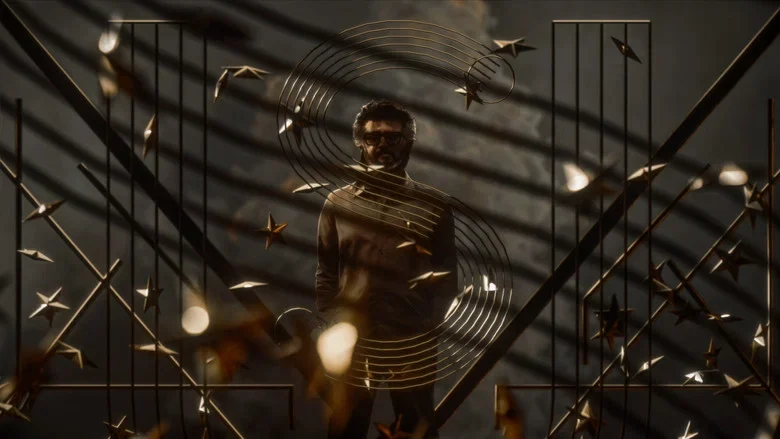
When The Villain Is A Corporation, Nobody Has A Face To Fear
Suraj Venjaramoodu’s Dileep arrives with real menace, a man asking a henchman where Muthuvel is, and the question itself functioning as a death sentence. His voice stays in a low, almost bored register that makes the violence feel administrative.
Then the film hands the antagonist role to Kalpaks, a syndicate with hidden controllers. This is where the screenplay starts leaking air. An organization cannot flinch, cannot blink, cannot share a frame with Rajinikanth and lose.
The escalation from a localized smuggling ring to a shadow network sounds bigger on paper. On screen it dilutes the pressure, because the audience never gets a body to hate.
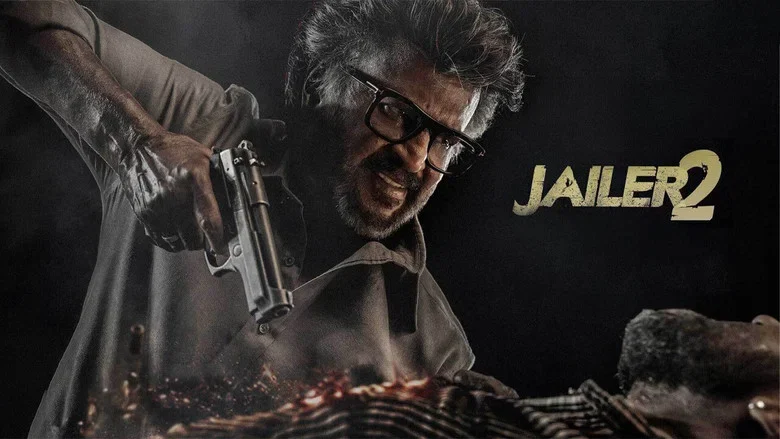
Rajinikanth Plays Two Men, And Only One Of Them Is Interesting
The performance splits cleanly. There’s the concealed driver, watchful, economical, letting his eyes travel before his shoulders move, and there’s Tiger, summoned when the family is threatened.
The first mode is the revelation. Rajinikanth has spent a decade playing invincibility; here he plays restraint, and his stillness in the early investigation scenes has a weight that his trademark gestures no longer generate.
The second mode is where the film defaults to formula. Once the coat comes off, the physical grammar reverts to the beats his fans expect, and the tension built in the first hour evaporates into choreography.
The contrast with his turn in Sardar 2 is instructive: both films ask a veteran star to double himself, and both films lose their footing the moment the louder half takes over.
Every Returning Star Costs The Plot A Little Oxygen
Ramya Krishnan holds the domestic frame together with a single withering look in the kitchen sequence, and that’s enough. She understands that Viji’s function is to remind Muthuvel what violence costs him personally.
Yogi Babu’s driver-adjacent presence keeps the undercover mechanism moving, though the comic relief sits awkwardly against Dileep’s interrogation scenes. The tonal seams show.
Mohanlal and Shivarajkumar arrive as event rather than character. Their entrances are staged for applause, and they get it, but neither is given a scene that advances Muthuvel’s investigation.
The film treats them as attractions. That’s a commercial decision, not a dramatic one, and the middle hour pays for it.
Anirudh’s Score Is Doing Work The Editing Should Be Doing
The background score is relentless in the way it insists on gravity the images haven’t earned. Anirudh returns to the franchise, but the sequel leans on stingers where the first film trusted its own rhythm.
Visually, the driver-cover material is shot in flatter, cooler light than the underworld sequences, a clean psychological divide between Muthuvel’s two lives. The IMAX presentation gives the syndicate interiors real scale.
The problem is editorial. At 176 minutes, the film cannot sustain its own patience, and the crossover appearances and network exposition slow the middle stretch in ways a tighter cut would have excised.
The screenplay’s structure stays broadly linear: aftermath, concealment, discovery, confrontation. That’s fine. It’s the middle that needed a scalpel, not a wider canvas.
Sun Pictures Is Betting A Franchise On Star Arithmetic
Sun Pictures and Kalanithi Maran are not financing a thriller here. They’re financing a crossover event, with the reported budget sitting in the ₹350 crore range and the theatrical window positioned as a tentpole covered extensively on HDHub4u rather than a quiet genre release.
That arithmetic works only if the star appearances convert to repeat viewings. The franchise model, Rajinikanth plus Mohanlal plus Shivarajkumar plus a returning director, is a hedge against a single-lead action vehicle underperforming.
But the same math that de-risks the opening weekend inflates the runtime and dilutes the protagonist’s grip on his own movie. Nelson’s first Jailer worked because it was one man’s story with guests. This one is a guest list with a story attached.
The larger question for contemporary Tamil thrillers is whether this crossover economics model can keep producing films that hold together as films.
The Verdict: A Star Vehicle That Forgets Whose Vehicle It Is
Nelson Dilipkumar has built a sequel around the best premise of his career and then spent an hour handing the movie to people who aren’t in it. The driver disguise is a genuine gift to Rajinikanth, it lets him act instead of pose, and the film keeps interrupting him to pose anyway.
That’s the residue. A retired enforcer discovers that his past methods are the only language the world still speaks to him in, and the movie around him keeps changing the subject.
Worth the ticket for the first hour. Worth the argument afterward for what the second hour reveals about how this industry now builds its blockbusters.






1 thought on “Jailer 2 (2026): Rajinikanth’s Return Buckles Under Syndicate Bloat”
Comments are closed.