Somewhere in the second hour of Mandaadi, a traditional sailboat cuts hard against the wind and the theatre goes quiet in a way no dialogue scene manages. That image is the film’s best argument for itself: a sports drama that understands the sea better than it understands its own people.
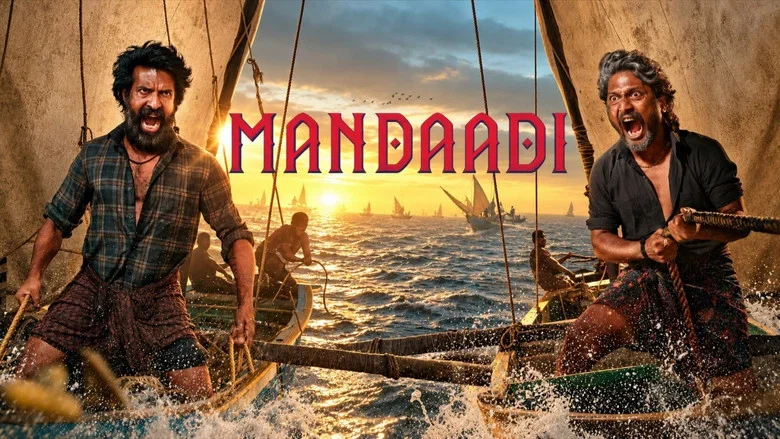
A Lifeguard’s Return Reopens a Rivalry the Village Never Buried
Kaali, once a sailboat racer, now sits in a resort chair in Hyderabad watching other people swim. Circumstance drags him back to the Kalingapatnam coast, and the film wastes no time restoring the wound he left behind.
The old rivalry with Saattaappuli is not presented as a clean villain problem. It is a friendship gone wrong, which gives the race a personal mortgage the screenplay can lean on when the plot mechanics sag.
The village treats the race as a prestige ledger, not a sporting event. That single cultural decision elevates the material above generic underdog posturing, because losing here is communal humiliation, not personal disappointment.

The Sea Is the Only Thing Here That Refuses to Follow a Rulebook
Director Mathimaran Pugazhendhi builds his drama around a six-person crew, which quietly dismantles the lone-hero fantasy most sports films default to. Coordination, trust, and physical proximity become the actual dramatic currency.
Where the film falls back on convention is everywhere else. Romance, betrayal, village elders, reconciliation, each strand arrives exactly when you expect it, with the emotional temperature of a rehearsal rather than a discovery.
The prior directorial film Mandaadi already revealed this filmmaker’s instinct for coastal texture over narrative rigour, and the same imbalance reasserts itself here.
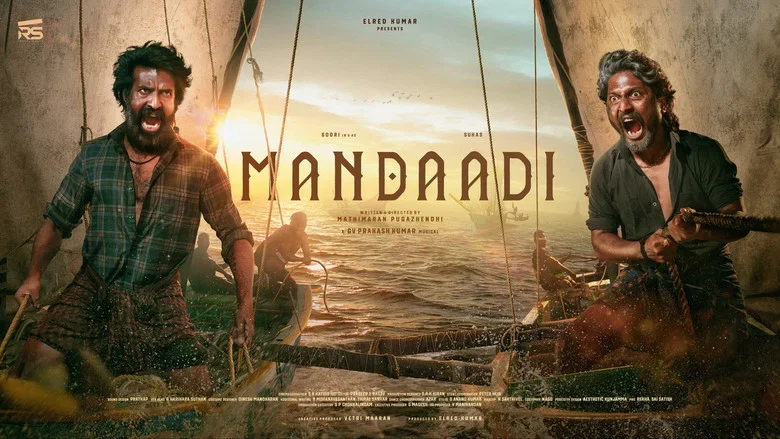
Soori’s Body Does the Work His Dialogue Cannot
Soori plays Kaali with a lifeguard’s stillness, shoulders squared, eyes tracking water before faces. The performance works best in the transition from detached outsider to involved competitor, where his posture tightens and his voice drops into the register of a man who has stopped apologising.
The physical exhaustion he carries into the final confrontation recalls the psychological weight of his turn in Epic – First Semester, though here the restraint is athletic rather than romantic.
Suhas, as Saattaappuli, gives the rivalry a spirited physicality, a half-smile that never reaches the eyes, a habit of standing a step closer than necessary. He is not a villain, just a man who chose resentment, and the performance respects that distinction.
Mahima Nambiar’s character exists mainly to react to Kaali’s choices, and the screenplay never grants her a sequence where she gets to want something for herself. That absence registers clearly on screen.
Pacing That Finds Its Rhythm Only Once the Boats Leave Shore
The first half moves from Hyderabad to the coast with a workmanlike efficiency that never quite finds a pulse. The competing strands, community honour, old friendship, romance, sport, are introduced but never braided, so the setup feels assembled rather than written.
Once the racing becomes the dominant engine, the film’s editorial rhythm tightens considerably. The camera stays close to the crew, the water fills the frame, and the physical danger of the sailboats supplies the tension the dialogue scenes kept promising and deferring.
This is the same patient, regionally rooted approach that has been quietly reshaping contemporary tamil dramas, though Mandaadi is less disciplined about it than its peers.
The Rivalry Is Predictable; the Reconciliation Is Worse
The emotional beats around Kaali and Saattaappuli are not just familiar, they are under-dramatised, arriving at the exact moments the genre template demands without earning the shift. A confrontation that should crack the film open instead plays like a scheduled appointment.
The thematic sibling Enna Vilai demonstrated how a Tamil drama can refuse raised voices and still generate pressure; Mandaadi reaches for the same dignity in its quieter passages but keeps retreating to the safety of formula.
The film’s treatment of its women is more progressive than its genre usually allows, though the credit belongs more to the screenplay’s instincts than to any sustained character work.
What the Coastal Spectacle Buys at the Box Office
Producer Elred Kumar has backed a film whose commercial identity rests almost entirely on a visual novelty, traditional sailboat racing, that no recent Tamil release has exploited this directly. That novelty is the marketing, and it is also the limitation.
The late-run cumulative estimates place the film in hit territory, which suggests the coastal sports premise found an audience beyond Soori’s core fanbase. Whether that translates into a franchise template is a harder question, because the film’s commercial pull comes from the setting, not the storytelling.
Soori’s theatrical leverage has clearly grown with this release, but the film’s success belongs more to the water than to the man standing on it. That is a fragile foundation for any star’s next project.
A Film That Wins the Race and Loses the Argument
Mandaadi is at its most alive when the wind takes the sails and the crew scrambles, moments where the film stops explaining itself and simply shows bodies under pressure. Everything around those sequences feels like scaffolding built to reach them.
The final reconciliation lands with the softness of a contractual obligation rather than a earned release, which leaves the film’s emotional residue thinner than its visual one. You leave remembering the water, not the men who raced on it.
That is the quiet disappointment of a film this well-positioned: it proves Tamil cinema can stage a sports drama on the open sea, then declines to prove it can write one.