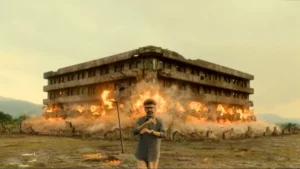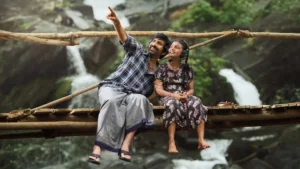
There is a moment early in Srikanth Odela’s second feature where Nani’s Jadal, still a boy, watches a man spit into the dirt his family is forbidden to own. The camera holds on his face a beat too long, and you realize the entire film is going to be built on that held breath, and the violence that follows it.

When Rage Becomes A Movement, The Body Count Gets Complicated
The Paradise opens in 1980s Secunderabad, planting its feet firmly in a settlement of people stripped of legal identity. Odela wastes no time establishing the hierarchy: Mohan Babu’s Malik runs the terrain through fear, not paperwork, while the community scrapes for recognition. The first act is a slow, deliberate tightening of the screws.
Jadal’s childhood humiliation is rendered with a bluntness that borders on cruel. The rupture with his mother Samakka, Sonali Kulkarni giving the film’s most quietly devastating turn, lands hard because Odela refuses to sentimentalize it. When the inevitable imprisonment comes, it feels less like plot mechanics than the natural endpoint of a system designed to swallow boys like him whole.
The Prison Return Is A Reset Button The Film Doesn’t Quite Earn
When Jadal walks back into the barren settlement, the screenplay shifts gears from intimate family tragedy to organized resistance. This is where The Paradise wants to be a different movie, a story about citizenship, not just revenge. The ambition is admirable. The execution is where the cracks show.
Just as Odela demonstrated a tighter spatial discipline in Irumudi, the filmmaker strips away decorative camera moves here to prioritize raw psychological friction. But the transition from Jadal’s personal vendetta to a community-wide demand for legal standing happens with a narrative lurch that the pacing never fully recovers from.
Kayadu Lohar’s Subbu exists as the emotional counterweight, the reason Jadal might choose something other than blood. She is given precious little to do beyond looking worried in doorways, a waste of a presence that the film keeps gesturing toward but never fully activates. Raghav Juyal’s Vikram Malik, meanwhile, is positioned as a threat but never gets a scene that justifies his placement in the power structure.
Mohan Babu Holds The Center While The Script Wobbles Around Him
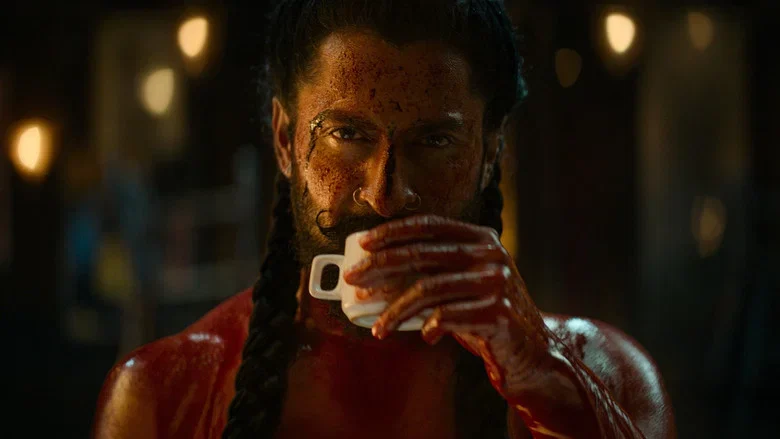
Mohan Babu’s Malik is the film’s sturdiest pillar. He doesn’t chew scenery; he occupies it. Watch the way he receives news of Jadal’s return, no raised voice, no theatrical menace, just a slow blink and a shift in posture that tells you everything about how this man has stayed in power for decades. It’s a performance built on stillness and the threat of what that stillness might become.
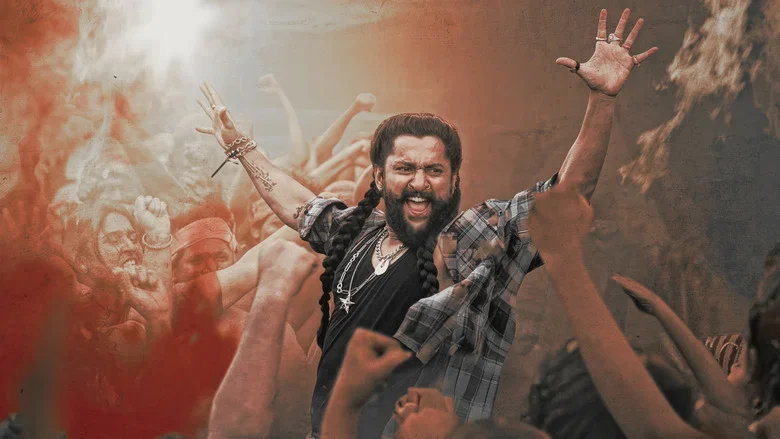
The restrained physical exhaustion Nani brings to the final confrontation recalls the psychological weight of his turn in Srinivasa Mangapuram, but here the register is angrier, more wounded. Nani’s Jadal is all coiled tension and sudden release, and when he finally lets loose, the film briefly becomes the ferocious thing it’s been promising.
The problem is that the screenplay keeps interrupting its own momentum. Scenes that should build, community meetings, whispered conspiracies, the slow gathering of allies, are staged with a flatness that suggests Odela trusts the premise more than the execution. The film knows what it wants to say about systemic oppression. It struggles to find the rhythm that would make that saying feel inevitable rather than announced.
Anirudh’s Score And The Visual Grammar Of Barren Land
Anirudh Ravichander’s music does the heavy lifting in sequences where the dialogue falters. His score knows when to swell and when to pull back, and there’s a recurring motif tied to the settlement that does more character work than several pages of exposition. The production design, all dust, rusted metal, and cramped interiors, creates a visual argument for the community’s erasure.
The film’s strongest visual idea is the contrast between the settlement’s open, sun-bleached barrenness and Malik’s controlled interiors. Every time the camera steps inside his domain, the frame tightens, the light drops, and you feel the walls closing in. It’s a simple device, but it works.
The screenplay resists the kinetic sensationalism that overtook Transfer Trimurthulu, opting instead for a deliberate, suffocating dread. That patience is a virtue in the first half. By the second, it starts to feel like hesitation.
The Climax Wants To Be A Revolution But Settles For A Speech
When the final confrontation arrives, the film has spent nearly three hours building toward a catharsis that it delivers only partially. The community’s fight for legal recognition is the right thematic destination, but the path there is cluttered with underdeveloped subplots and supporting players who drift in and out without leaving a mark.
This patient character study signals a welcome tonal maturity across contemporary telugu actions, proving that tension thrives without manufactured plot theatrics. But maturity without structural rigor becomes its own kind of indulgence. The Paradise is a film that knows exactly what it’s angry about. It just doesn’t always know how to channel that anger into something that moves.
Nani remains the reason to watch. His Jadal is a man carved from a lifetime of being told he doesn’t exist, and when he finally demands to be seen, the performance earns the film’s biggest moments. But a great central turn cannot single-handedly solve a screenplay that keeps losing its footing.
Rating: 3 / 5
The Paradise ends on a note of hard-won recognition, but the film’s own struggle to balance intimate rage with collective action leaves it somewhere between a triumph and a missed opportunity. It is a film that understands the cost of invisibility. It just doesn’t always trust the audience to feel that cost without being told.