The teaser opens with Srikanth, as a wide-eyed devotee, standing before Rajendra Prasad’s Venkateshwara Swami. It’s a moment thick with reverence, but also with the quiet desperation of a man whose dreams are slipping.
Srikanth plays the middle-class protagonist with a practiced weariness that feels genuine. He doesn’t oversell the struggle, allowing the character’s quiet resilience to carry the emotional weight. This is a performance built on empathy rather than volume.
Nageswar Reddy’s Familiar Formula
Director G. Nageswar Reddy knows his terrain, the family entertainer, and he navigates it with a comforting, if unambitious, hand. The screenplay follows an expected arc of disruption, setback, and resolution without offering any real surprises.
The film’s primary flaw is its predictability. A subplot involving a financial crisis feels borrowed from a dozen earlier Telugu films, and the resolution arrives with a convenience that undermines earlier tension. What works is the writer’s genuine affection for his protagonist’s world.
Comedy as a Coping Mechanism
The film leans heavily on its comedy sequences to mask the thinness of the central conflict. The support of Sunil, Ali, and Vennela Kishore provides a welcome release from the drama, even if their routines feel recycled from older hits. A sequence where Ali mistakes a family argument for a business deal is the only moment that lands with genuine surprise.
The genre execution is workmanlike. The family scenes are shot with a warm, flat lighting that signals “feel-good” without earning it through visual storytelling. The comedy beats follow the standard formula: setup, misunderstanding, punchline, often telegraphed seconds in advance.
But there is a single scene where the film threatens to break its mold. When the protagonist quietly explains his money worries to his wife (Laya), the camera stays on their faces, refusing to cut away. It’s a rare moment of stillness that suggests a better, more intimate film hiding beneath the broad strokes.
Rajendra Prasad and the Comic Cavalry
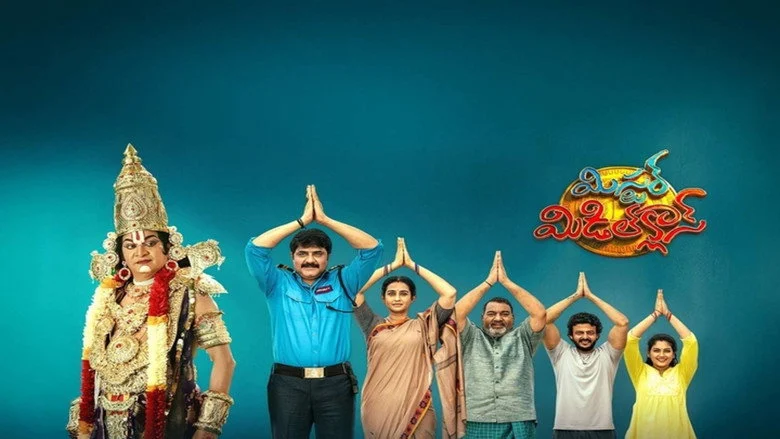
Rajendra Prasad, as Venkateshwara Swami, brings a quiet authority to his divine role. He doesn’t just bless the protagonist; he acts as a moral anchor, lending the film a spiritual weight that the screenplay otherwise avoids. His scenes with Srikanth are the film’s emotional backbone, brief but resonant.
Sunil, Raghubabu, and Vennela Kishore form a comic trio that operates like a well-oiled machine. Sunil’s street-smart friend offers the protagonist an escape, while Vennela Kishore’s bumbling neighbor provides a counterpoint of pure absurdity. Raghubabu, in a minor role, delivers a single scene of genuine pathos that hints at the actor’s range, even if the film wastes it.
I can only imagine how much sharper this comedy would have felt with tighter editing; the gags often overstay their welcome by one beat too many.
If this kind of middle-class storytelling interests you, browse more Telugu Family reviews for similar comfort-food cinema.
Audience: Who Will Love This?
This film is squarely aimed at family audiences who want a reassuring, unchallenging matinee. The core theme of perseverance through family togetherness is executed without any political or social controversy, a safe bet for a Sunday afternoon with parents.
The film’s release date placed it in the middle of a competitive season, and its lack of box office data suggests a quiet run. For those seeking a plot full of twists or high-stakes drama, this will feel too familiar by half. For those who just want to see Srikanth smile through the struggle, it delivers.
Go for the performances, especially Rajendra Prasad’s calming presence. Skip it if you demand narrative novelty. The best format for this is a comfortable streaming session at home, where its predictability feels like a feature, not a bug.
Mister Middle Class is a warm, forgettable film that earns a modest 2.5 out of 5 for its honest heart and comic relief.
For a more ambitious Tamil take on faith and family, read our review of Anbe Diana review.
If you prefer director Shaji Kailas’s territory, our review of Varavu verdict explores a very different kind of family conflict.