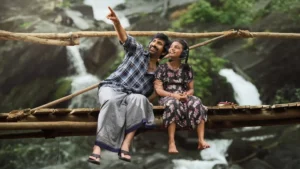
The trailer opens on a young tribal girl’s face. Krithika Balasubramanian’s character tells Arulnithi’s district collector she wants to study. Her community stands behind her, hoping education can reclaim lost respect. This isn’t a grand monologue, it’s a quiet demand, and it lands harder than any speech could. The film’s emotional core lives in that one request.

Arulnithi plays restraint, not rage
Muthuvel is a collector who fights bureaucracy with patience, not fury. Arulnithi gives the role a tired dignity, especially in the scene where he consults a teacher from a neighboring village. He doesn’t raise his voice, he just listens. It’s a controlled performance that trusts the material instead of overselling it.
Where the script lets him down is in the second act’s repetitive bureaucratic montages. We get the point early: paperwork is a villain. The film keeps reminding us anyway.
Ganesh Vinayak directs with a social realist lens
Vinayak understands that emotional drama needs stillness, not noise. The forest community feels lived-in, and the camera lingers on faces rather than landscapes. That choice gives the film a documentary texture that suits its subject. But the screenplay’s linear structure leans too heavily on the “obstacle-of-the-week” formula. Each hurdle arrives like a checklist item.
The confrontation scene, where Muthuvel faces local resistance over the child’s city education, promises a more layered conflict. Yet the film pulls back from exploring that tension fully. It resolves cleaner than real life ever does.
G V Prakash Kumar’s score underpins the drama without overwhelming it. The background music swells at key emotional beats but never turns maudlin. That restraint matches Vinayak’s visual tone.
Ramya Pandian and Kaali Venkat ground the ensemble
Ramya Pandian gets little screen time but her presence signals community solidarity. She appears in group scenes as a quiet pillar, offering small gestures of support that feel earned. Kaali Venkat, as a local elder, brings weary authority to his two scenes. His casting suggests the film wants authentic regional voices, not star cameos.
VTV Ganesh and John Vijay fill out the bureaucratic world. Ganesh plays his role with broad comic relief that occasionally undercuts the drama. John Vijay, always reliable as a menacing presence, here plays a more subdued antagonist. His resistance is systemic rather than personal, which is a smart choice even if it reduces his impact.
A film about systems, not villains
The central conflict positions a collector against his own administration. That’s a politically charged framing in a state where rural education remains a flashpoint. Arulvaan doesn’t name parties or policies, it shows a forest community waiting for a school that might never come. The absence of direct controversy is itself a choice; the film trusts the image of paperwork delays to carry its critique.
If you are looking for more stories like this, browse our Tamil Drama reviews.
A modest recommendation
Arulvaan is for the patient viewer who values intention over spectacle. It won’t jolt you out of your seat, but it might sit with you. Watch it on the big screen if you can, the forest soundscape deserves theatre speakers. If you prefer tighter plotting and sharper conflict, wait for OTT. For the viewer who loved the restrained bureaucratic drama of G.D.N, G D review will feel familiar here.
Arulvaan is a sincere, craft-first drama that earns a 3 out of 5, and it’s worth your time if you care about the story behind the school.
For another Tamil film that trusts its quiet moments, Oh Sukumari verdict offers a similar emotional register.