Christopher Nolan opens The Odyssey not with a monster, but with a monarch’s resignation. Odysseus (Matt Damon) hands his crown to his son Telemachus (Tom Holland) and walks into exile with Penelope, thinking peace awaits.
This quiet, almost domestic scene is a clever misdirect, because the journey that follows trades human drama for procedural survival, and the film never quite recovers the intimacy of that opening exchange.
Matt Damon’s Warrior Weariness
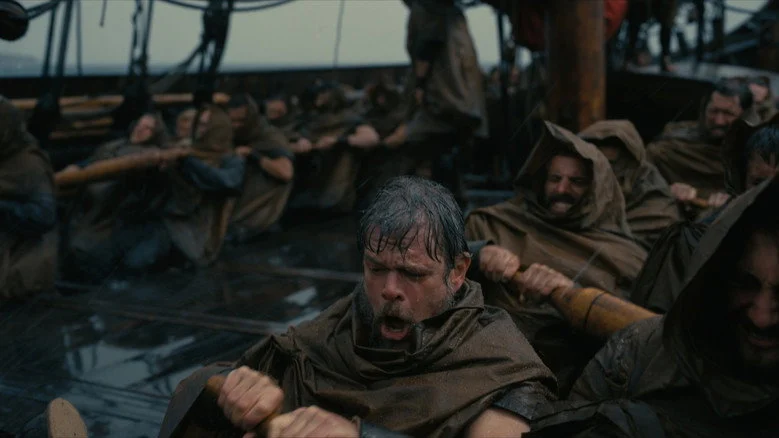
Damon plays Odysseus as a man carrying the Trojan War in his bones. There is a haunted stillness in his eyes when he faces the Cyclops Polyphemos, not just fear, but a tired calculation of survival.
What Damon lacks is the magnetic unpredictability the role demands. He is competent and stoic, but Odysseus needs a streak of mortal desperation that Damon’s steady gravitas cannot fully supply. The performance works in isolation but feels one-note across 173 minutes.
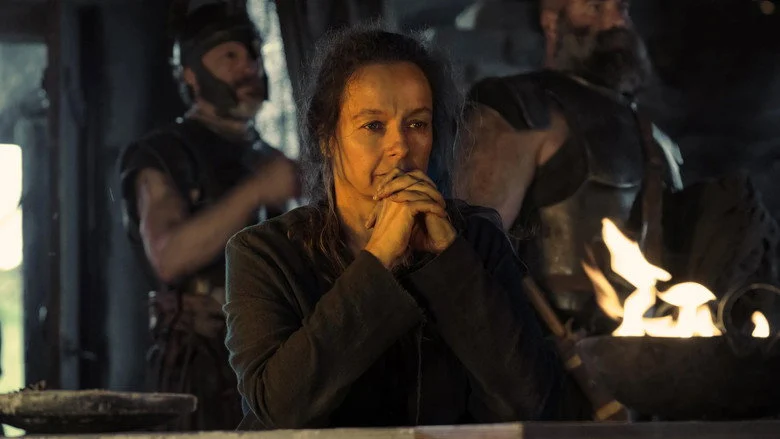
Nolan’s Mythic Machine
Nolan directs the Cyclops encounter with the spatial clarity of a Tenet setpiece: every swing of the club, every shadow in the cave, every escape route is mapped with surgical precision. The Sirens sequence, however, feels rushed, a blur of sound design and quick cuts that undermines their mythological terror.
The screenplay’s weakness is structural. The film crams encounters with Circe, Polyphemos, and the Sirens into a single act, leaving no room for the audience to breathe between horrors. Homer’s Odyssey thrives on episodic weight; Nolan’s version treats each monster as a level in a video game.
Time compression becomes the film’s enemy. The years-long voyage is communicated through voice-over and montage, stripping the journey of its accumulating fatigue. A 173-minute runtime should feel long; here, the emotional shortcuts make it feel shortchanged.
If Nolan’s ambitious craft fascinates you, browse our collection of English Action reviews for deeper insights into similar blockbusters.
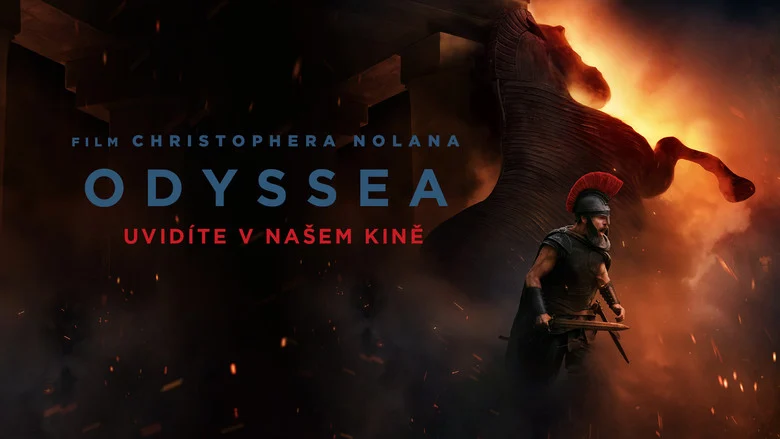
Circe and the Supporting Pantheon
Charlize Theron’s Circe is the film’s single most watchable element, a goddess of sorcery who speaks in smooth, amused cadences. She turns Odysseus’s men into pigs with a smirk that suggests she has done this a thousand times before. Theron finds comedy in malice, a rare tonal risk for Nolan’s typically solemn world.
Tom Holland’s Telemachus is underutilized to the point of waste. He appears in the throne-ceding scene and then vanishes until the final act, his character reduced to a plot function rather than a son missing his father. Holland brings puppy-dog sincerity, but the script gives him nothing to chew on.
Where the Epic Finds Its Pulse
Anne Hathaway and Robert Pattinson appear in unnamed supporting roles that feel like placeholder characters, clear signs of a cast too large for the screenplay to service. Jon Bernthal and Lupita Nyong’o are similarly stranded, their faces recognizable but their motivations invisible.
I found myself wishing the film had cut two supporting players and given Theron a longer Circe-Odysseus confrontation. That scene contains the film’s only real intellectual tension: a mortal king bargaining with a bored deity. Everything else is survival choreography, executed well but emotionally sterile.
The Verdict: Watch It for Craft, Not Heart
The Odyssey is a technical marvel searching for a soul. Nolan’s Cyclops sequence will be studied in film schools for its geography of tension, but the film’s emotional architecture, a man yearning for home, is buried beneath monster mechanics. Watch it in the largest screen available; the craft demands immensity, even if the heart stays dwarfed.
For a more grounded character study within a similar epic framework, Arulvaan review.
Christopher Nolan’s The Odyssey is a spectacle that commands respect but earns only a 3 out of 5, a mammoth achievement in scale that forgets the human cost of its journey.
If hero-worship storytelling interests you, explore G D verdict for a comparison of how epic narratives can falter on emotional grounding.