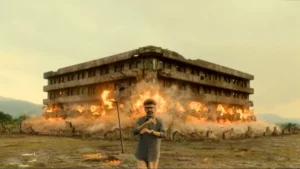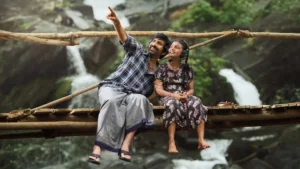
There is a moment early in Sajeev Pazhoor’s Enna Vilai when Karunas, playing the Rameswaram fisherman Thavasi, surfaces from a dive with a gold medallion clenched in his fist and does not smile. He turns it over twice, thumb scraping the rim, and looks toward shore as if calculating a debt rather than a windfall. The film’s entire moral architecture lives in that hesitation.
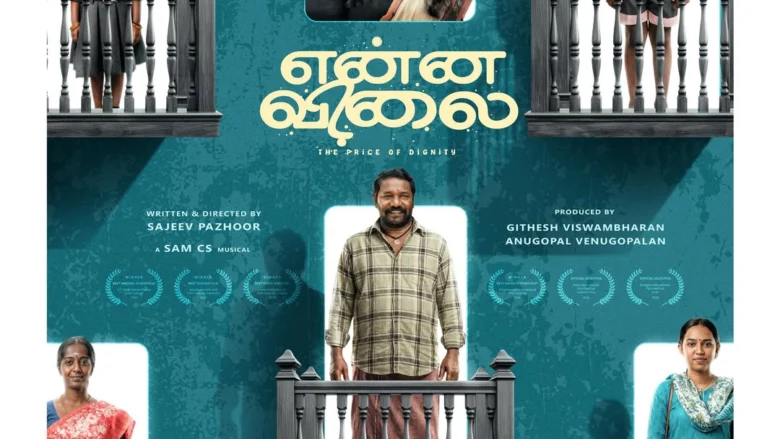
A Fisherman Finds Gold and Immediately Loses His Name
Pazhoor’s screenplay moves with the blunt efficiency of a thrown anchor. Within the first act, Thavasi’s discovery is reframed as theft, and the object that should have been a blessing becomes the state’s evidence against him. The escalation is causal rather than coincidental, which is rarer in this register than it should be.
The setting does the heavy lifting. Rameswaram’s coastline, all bleached light and salt-crusted wood, gives the legal machinery something concrete to grind against. Compare the spatial discipline on display here to the overstuffed arena choreography of Street Fighter, and you feel a filmmaker who understands that constriction generates more pressure than spectacle.
Karunas Strips Away the Comic Reflex
Karunas has spent decades as Tamil cinema’s most reliable pressure-release valve, the supporting presence who deflates tension with a raised eyebrow. Here he inverts that grammar entirely. Watch his shoulders in the accusation sequence: hunched forward, arms locked at his sides, as though physically refusing to occupy more space than the law has allotted him.
His voice stays in a low, gravelly register through the confrontations, never rising to meet provocation. The physical exhaustion he carries into the later stretches recalls the grounded, working-class weight of his turn in Gatta Kusthi 2, but stripped of that film’s broader comic framing. This is a performer finally trusted with stillness.
Nimisha Sajayan Builds a Lawyer Without a Speech
Nimisha Sajayan’s Advocate Kanchana enters the film as a procedural bridge, and she plays the role with deliberate emotional withholding. Her first meeting with Thavasi is staged across a table, and she spends most of it looking at her notes rather than at him, a choice that reads as professional caution before it reads as anything warmer.
When she finally lifts her eyes, the shift is small and unmistakable. Sajayan understands that a lawyer in a social drama earns credibility through attention, not rhetoric. Her Kanchana listens more than she declaims, and the film is better for it.
The Institutional Antagonist Is a Room, Not a Man
Pazhoor makes an unusual and largely successful structural gamble: there is no snarling villain. The opposition is paperwork, suspicion, and the ambient assumption that a poor fisherman cannot legitimately own anything valuable. The film’s menace lives in fluorescent lighting and the sound of a stamp hitting a file.
This choice gives the drama its class-conscious spine, but it also creates a vacuum. Without a face to push against, the middle stretch occasionally drifts into procedural repetition, and the courtroom scenes lean on the inherent drama of the setting rather than generating their own friction.
Pazhoor’s Camera Prefers Faces to Arguments
The visual scheme is disciplined to a fault. Pazhoor and his cinematographer hold medium close-ups during testimony, letting the frame crop out the judge and the gallery, so we sit inside Thavasi’s eyeline rather than observing the proceedings. It is an intimate strategy that pays off in the film’s quietest moments.
What it costs is momentum. The editing in the second half settles into a measured, almost liturgical rhythm, and a few sequences could lose ninety seconds without losing an argument. The film’s emotional restraint is its signature, but restraint without variation can flatten into monotony.
The Ending Asks a Question It Refuses to Answer
I will not spoil the ruling, partly because the film treats the verdict as secondary to the toll. What lingers is the image Pazhoor saves for last: a man who has won or lost something, standing in the same coastal light where he began, with a face that has aged in ways the calendar cannot account for.
The film’s deepest resonance is its refusal to separate legal ownership from lived dignity. That the question remains open feels less like evasion and more like honesty, the same unresolved ache that gives Titanic its strange afterlife, though Pazhoor trades spectacle for silence.
Kalamaya Cineverse Bets on Patience Over Product
Kalamaya Cineverse, with producers Githesh V and Anugopal Venugopalan, has backed a film that will not open like a mass entertainer. There is no item number, no interval-card punchline, no star-vehicle machinery. What the banner has purchased is Karunas’s credibility as a dramatic lead and Sajayan’s rising profile as a performer who chooses material carefully.
Commercially, this is a calculated wager on the adult-drama audience that turns out for issue-driven Tamil cinema when word of mouth cooperates. The theatrical window will be short, and the Netflix arrival will do much of the film’s actual reach. Across contemporary Tamil dramas, that pattern is now the norm rather than the exception, and Enna Vilai is built for it.
What the Film Leaves Behind
Pazhoor has made a film about the cost of proving you are not a thief, and he has made it with the patience of someone who believes the audience will sit still. Mostly, they will. Karunas’s performance alone justifies the ticket, and the film’s refusal to sentimentalize poverty is a mark of maturity.
But a drama this quiet needs one moment of rupture to justify its stillness, and Enna Vilai holds its composure a beat too long. It is a film that trusts its audience, and that trust is moving even when the film is not quite thrilling. You leave with the medallion’s weight in your own palm, wondering what you would have done.