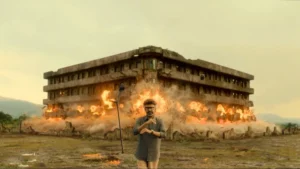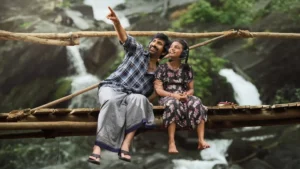
K. Bhagyaraj doesn’t so much play a character in Dark Giant as embody a walking weather system of regret. His face, etched with years of cinema and real-life weariness, becomes the film’s primary visual, a man carrying a curse in his very bone structure. It is a performance of minimal movement and maximal weight, and it single-handedly gives this supernatural family drama its emotional spine.
In a film that gestures toward generational trauma rather than fully dramatizing it, Bhagyaraj’s stillness becomes the movie’s most eloquent tool. He makes you believe in the inheritance of guilt even when the screenplay merely suggests it.
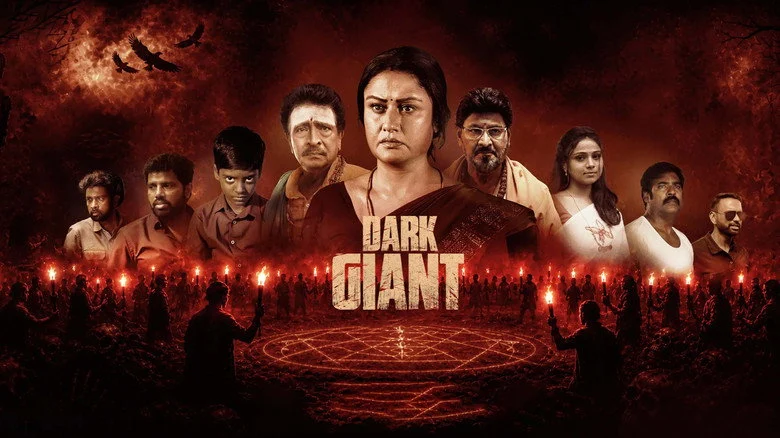
KS Kishaan’s Direction: Atmosphere Over Arithmetic
Director KS Kishaan clearly favors mood and dread over jump scares, and for the first hour, this works well. The camera lingers on shadowy corners and domestic spaces that feel slightly wrong, and the film trusts the audience to feel unsettled rather than demanding they flinch.
The problem is that this atmosphere is in service of a plot that never quite coheres. The screenplay gestures at greed, guilt, and a curse, but it rarely connects these threads into a satisfying narrative knot. You feel the shape of a story without ever being convinced by its logic.
Horror That Whispers Instead Of Roars
The supernatural horror in Dark Giant operates in the spaces between scenes rather than in the scenes themselves. Kishaan’s approach leans heavily on suggestion, an odd sound, a figure in the background, a character’s sudden stillness. This is disciplined genre filmmaking that respects the power of negative space. I found myself more absorbed by the texture than the terror, which is both the film’s strength and its limitation.
As a psychological family drama, the film aims for something thornier than standard horror. The central conflict, greed and guilt warping a family across generations, is an excellent foundation, but the execution is frustratingly vague. The curse feels more like a concept than a concrete threat, and the family’s dynamics are sketched rather than explored.
What the movie lacks in sharp, coherent plotting, it partially compensates for with tonal consistency. Dark Giant is never boring, even when it is unclear. For audiences seeking brooding Tamil horror with a psychological edge, there is something to admire here, even if the film never fully earns its ambitions. The effect is like reading half a ghost story, involving, but incomplete.
For more on the genre, browse our collection of Tamil Thriller reviews.
Sonia Agarwal And The Weight Of The Past
Sonia Agarwal is given the thankless task of playing a character whose trauma is mostly described rather than shown. In a film built on mood, she lacks a defining scene that would let her anchor the family’s emotional turmoil. Still, her casting brings a certain gravitas, she has the screen experience to suggest depths the script never fully plumbs.
Livingston and Aadharsh Madhikaandham round out the family unit, but their roles are thin. Their presence signals that Dark Giant is trying to build a multigenerational portrait of damage, but the script gives them little to work with. The film feels like a sketch of a bigger, more satisfying story about familial legacies and supernatural punishment.
A Curse Without A Climax
Because the research data lacks any controversies, the natural question becomes: does Dark Giant satisfy as a horror film for its intended audience? The answer is partly yes. Viewers who prefer psychological unease to graphic violence will find something to appreciate. But viewers expecting a payoff to match the setup will leave feeling shortchanged.
The film’s restraint, so effective in its early passages, becomes its weakness by the closing act. There is no catharsis, no revelation that recontextualizes the dread. The curse simply lingers, and so does the sense that this story needed a stronger third act to justify its two-hour length.
Dark Giant is a film for patient horror fans who don’t mind a destination that blurs into fog. It is best watched at night, with low expectations for narrative closure and high tolerance for atmosphere. If you value a performance of melancholic authority over a tidy plot, Bhagyaraj makes this worth a watch.
This is a mood piece that never quite becomes a movie. 2.5/5. For a tighter family drama, read about the direction choice in Deewana review.
For another performance-driven genre film, read our analysis of Nooru Sami verdict.