
Ullas Chemban’s Disco opens on the buzzing retro hum of a world where a quick buck feels like a birthright, and a crew of friends mistake momentum for destiny. What follows is a 158-minute descent from carefree hustling into an underworld mystery that swallows them whole.
The premise is deceptively simple: Ousu and his circle chase easy money, stumble into something far older and uglier than their petty schemes, and spend the back half improvising their way out of revenge, betrayal, and survival.
Chemban directs an ensemble rather than a solo vehicle, and that choice defines both the film’s texture and its central problem.
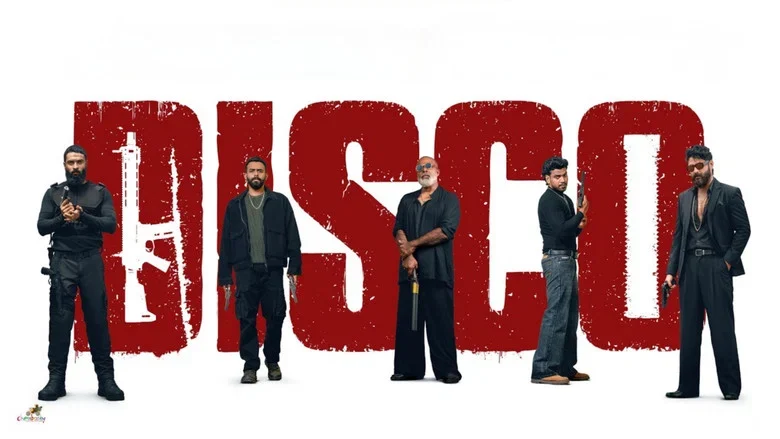
When the Hustle Becomes the Plot and the Plot Becomes the Problem
The first act hums with the casual camaraderie of men who have never been punished for their optimism. Chemban lets the group’s banter breathe, and Armo’s camera lingers on the retro-coded surfaces, neon, smoke, cluttered interiors, as if the film itself is nostalgic for a danger it hasn’t earned yet.
That tonal patience works until it doesn’t. The pivot from comic trouble to criminal jeopardy is where the screenplay reveals its structural gamble: it trusts that we’ll follow these men into hell simply because we enjoyed watching them joke around. For a while, that trust pays off.
Comparatively, the film shares DNA with the kind of tonal whiplash that undermined Scene, another recent release that mistook tonal variety for tonal control. Disco is more disciplined in its escalation, but the seams still show in the second hour.
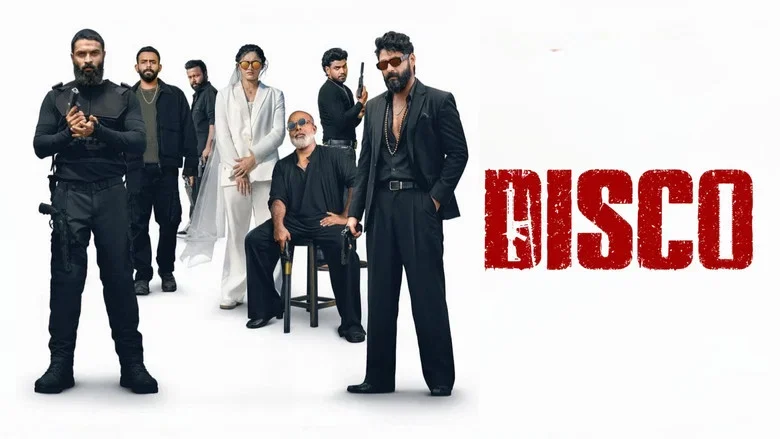
Antony Varghese Carries the Weight, But the Ensemble Doesn’t Always Share It
Antony Varghese has built a career on playing men whose bodies are always slightly ahead of their judgment, the kind of actor who makes recklessness look like a physical reflex rather than a choice.
Here, he brings that same coiled energy to Ousu, but the script asks him to shift from loose-limbed charm to cornered-animal tension without always giving him the scene work to bridge the gap.
Watch his stillness in the film’s quieter moments, a jaw held too tight, a gaze that drifts to the exit. Those micro-adjustments carry more narrative weight than some of the louder confrontations.
The physical exhaustion he brings to the final stretch recalls the psychological weariness of his turn in Kattalan, where he similarly shouldered a film that didn’t always know what to do with him.
Arjun Ashokan and Lukman Avaran fill out the group with lived-in chemistry, but the screenplay gives them little to do beyond react. Chemban Vinod Jose, as always, brings a gravitational stillness to his scenes, but his presence feels like a promise the film never fully cashes. The supporting cast functions as atmosphere rather than architecture.
The Retro Backdrop Is a Mood, Not a Mechanism
Manikandan Ayyappa’s score leans into the film’s period-coded textures, and there are stretches where the music does more narrative work than the dialogue. The problem is that the retro setting never becomes more than a visual affectation, it’s a filter, not a world.
This is where Disco diverges from the more disciplined genre experiments in Orijinal, a thriller that understood that atmosphere must serve plot rather than substitute for it. Chemban’s film wants to be both a hangout movie and a survival thriller, and those two ambitions never fully reconcile.
The editing in the second half accelerates into a blur of confrontations and reversals, but the geography of the action remains vague. Who is where, and why does it matter? The film’s climax demands spatial clarity it hasn’t established.
Chembosky Motion Pictures Bets on Familiarity in a Crowded Market
Chembosky Motion Pictures is producing a film that fits comfortably into the current Malayalam crime-thriller boom, but comfort is a double-edged sword. The ensemble cast is a commercial asset, Varghese, Ashokan, and Avaran have built loyal followings, but the film’s A certificate and 158-minute runtime narrow its theatrical reach.
In a market where contemporary Malayalam thrillers are increasingly competing on originality rather than star power, Disco feels like a bet on familiarity. The film’s retro aesthetic and ensemble structure are selling points, but they don’t constitute a distinct enough identity to break through the noise.
The franchise potential is limited by the film’s refusal to commit to a single protagonist or a single tone. It’s a calling card for Ullas Chemban’s ambition, but ambition without discipline is just noise.
The Uncomfortable Resolution: A Film That Knows What It Wants to Say But Not How to Say It
By the time the credits roll, Disco has made its point: easy money is a trap, and the men who chase it are always already caught. That’s a thesis the film states clearly, but it never quite earns the emotional devastation it’s reaching for.
The final act leans into survival-mode urgency, but the resolution feels less like a culmination than an exhaustion. The characters have been through something, but the film hasn’t fully reckoned with what.
What lingers is Antony Varghese’s face in the film’s closing moments, a man who has survived, but not necessarily learned. It’s a testament to his screen presence that the film’s ambiguities feel intentional rather than accidental.
Disco is a film that wants to be about the cost of easy money, but it’s more compelling as a portrait of men who never understood the price until it was already paid.
In a crowded field of Malayalam crime thrillers, this one is worth seeing for its lead performance and its ambition, even if it never fully earns its own runtime. It’s a film that understands the allure of the hustle, but not quite the weight of the fall.







1 thought on “Disco (2026): Antony Varghese Anchors a Sprawling Cautionary Tale That Loses Its Own Rhythm”
Comments are closed.