The opening frame lands you in a period battlefield where two cosmic forces brace for a clash that could crack the world open. Sundar C wants you to feel the weight of myth before he drops you into a police station.
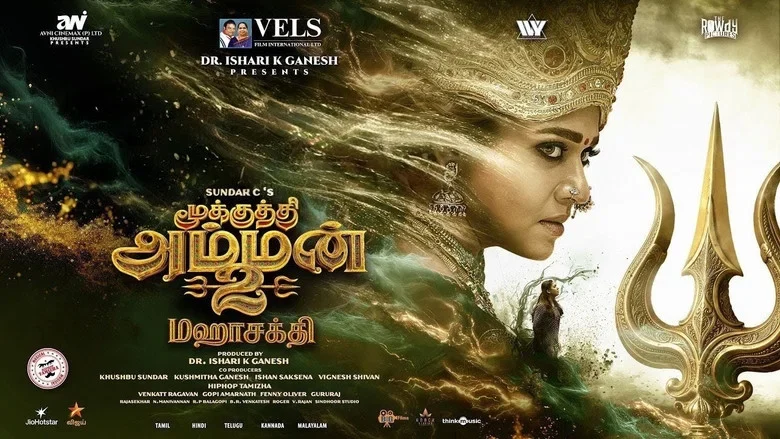
A Goddess Franchise That Forgets Its Own Mischievous Soul
The 2020 original worked because RJ Balaji treated devotion as a negotiation between a struggling mortal and a deity with a sense of humor. That film’s Mookuthi Amman arrived as a corrective to televangelist greed, and the comedy carried genuine theological teeth.
Sundar C has swapped that irreverent intimacy for a sprawling two-timeline mythological engine. An ancient queen’s sacrifice to shield her prince now anchors the entire narrative, and the present-day thread hangs off that historical debt.
The tonal shift is jarring. Where the first film trusted small human comedy to carry divine weight, this sequel reaches for scale first and asks questions later, a structural instinct that echoes the sprawl of Disco without inheriting its narrative discipline.
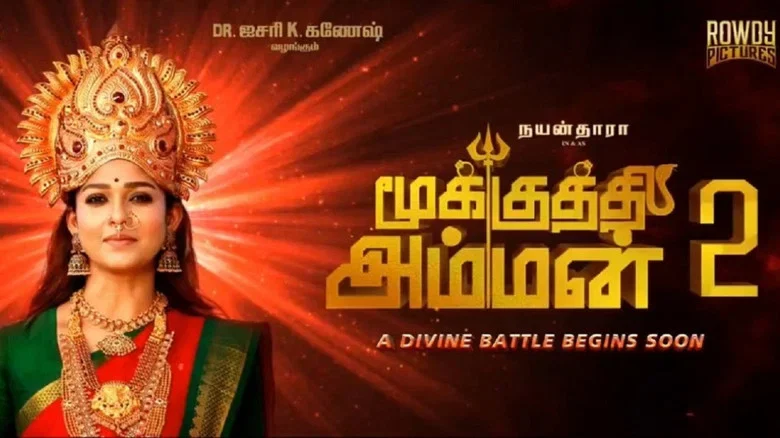
Nayanthara’s Double Duty Splits the Film Down the Middle
The central gamble is Nayanthara playing both the goddess and a terrified police constable. Watch how she handles the officer’s first supernatural encounter: shoulders hunched inward, voice thinning to a whisper, eyes darting toward exits that do not exist.
Then she straightens her spine as Mookuthi Amman and the register flips entirely. The chin lifts, the gaze locks forward, and the vocal pitch drops into a register that expects obedience rather than requests it.
That contrast is the film’s most persuasive argument for its own existence. The physical discipline she brings to the frightened constable recalls the emotional restraint of her work in Hi, though here the vulnerability is a mask rather than a destination.
What the performance cannot solve is the screenplay’s failure to bridge the two identities with genuine causal logic. The reveal arrives through exposition rather than accumulated dramatic evidence.
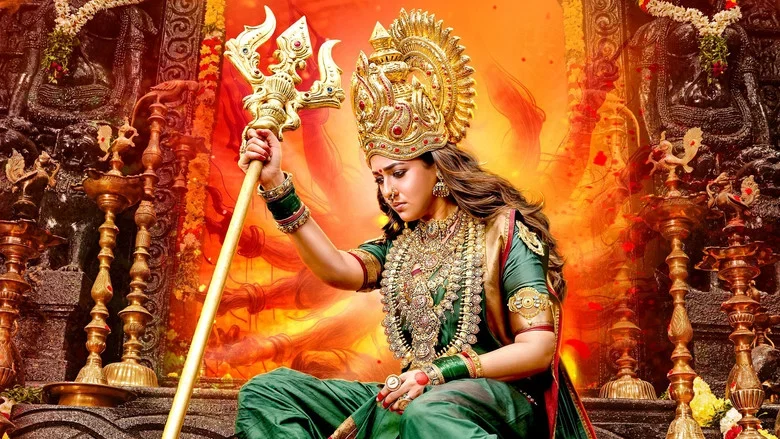
Regina Cassandra’s Villain Arrives Without a Coherent Objective
Regina Cassandra gets the film’s most striking entrance, framed in low light with her silhouette cutting against ritual fire. She holds stillness well, letting the camera find her rather than chasing it.
But the antagonist’s actual goal remains frustratingly opaque across the entire middle act. She radiates menace without articulating what she wants from the prince, the goddess, or the modern timeline.
A supernatural threat needs a comprehensible hunger. Here the screenplay treats her power as spectacle and her motivation as an afterthought, which drains tension from every confrontation she shares with the goddess.
The Comedy Contingent Gets Buried Under Mythology
Yogi Babu appears in the supporting ensemble, and there is one moment where his character’s panic during a supernatural manifestation lands cleanly. His timing is intact, but the film keeps interrupting him to service plot mechanics.
Urvashi fares worse. She has the comic instincts to steal scenes, yet the screenplay hands her reaction shots instead of set pieces, reducing a formidable performer to background texture.
The film’s comedic register never finds its footing because the dual-timeline structure demands constant tonal pivots. Every joke arrives as an apology for the mythology rather than an organic extension of it.
Sundar C Controls Scale But Loses Intimacy
Gopi Amarnath’s camera draws a clear visual line between eras. The period sequences use firelight and deep shadow, while the contemporary police scenes lean on fluorescent flatness that makes the constable’s world feel deliberately small.
That contrast is intelligent. The problem is that Sundar C rarely lets the camera sit still long enough for either world to breathe, and Hiphop Tamizha’s score pushes devotional grandeur over every transition rather than trusting silence.
The climax stages the divine confrontation with genuine visual ambition, but the arrival of three additional divine entities turns the finale into a franchise pitch rather than a resolution. The film ends by advertising its own sequel.
Avni Cinemax and Rowdy Pictures Bet Big on Diwali Devotion
Three production banners share the risk here, and the Diwali corridor is unforgiving for a film that needs both family audiences and fantasy spectacle crowds to show up.
The advance booking figure of ₹4.27 crore across six show dates, reported on 5 November 2026, signals interest but not conviction. Nayanthara’s theatrical leverage remains strong in Tamil markets, yet a two-hour-twenty-five-minute runtime tests the patience of the casual Diwali viewer.
The regional devotional fantasy pipeline is crowded, and this sequel’s reliance on franchise recognition rather than a fresh hook makes its commercial ceiling harder to predict than its predecessor’s.
A Mythology That Forgets the Human It Was Built to Protect
The film’s final image wants to be a promise of larger battles to come. Instead it reads as an admission that this story could not resolve itself without deferring to a future installment.
Devotional fantasy earns its power when the divine arrives to answer a human cry. This sequel builds temples, armies, and cosmic enemies, but the cry at its center never quite reaches the volume the spectacle demands. That gap between scale and soul is the residue you carry out of the theater.