The opening frame of Nitesh Tiwari’s Ramayana: Rise of a Legend doesn’t announce itself with a roar but with a whisper of cosmic anxiety, Brahma, Vishnu, and Shiva suspended in a celestial stalemate while the mortal world below begins to rot.
It’s a fitting overture for a film that wants to be both a devotional epic and a geopolitical fantasy, and for the most part, it succeeds at being neither entirely.

When A Liberationist Becomes A Tyrant, The Mythology Finds Its Pulse
The film’s smartest structural gamble is its refusal to introduce Ravana as a cartoonish embodiment of evil. Instead, we meet him as a young Asura prince watching his people starve under Deva sanctions, his jaw tight with a grievance that feels uncomfortably contemporary.
Yash plays this transformation with a physical discipline that borders on the architectural, his shoulders remain squared even when his character kneels, as if the body itself refuses to accept subjugation.
It’s a performance that recalls the actor’s work in Toxic, where he similarly weaponized stillness as a form of aggression, but here the register is more political than primal.
The Cosmic And The Intimate Collide, But Not Always Gracefully
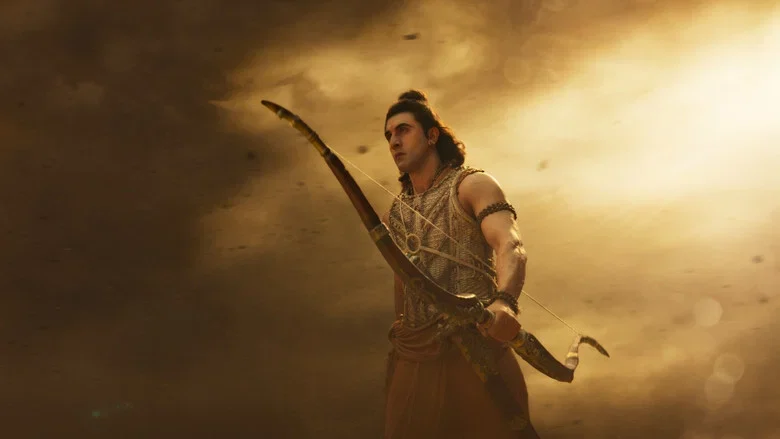
Ranbir Kapoor’s Rama enters the narrative not with a thunderclap but with a sigh, a prince who seems to carry the weight of his own divinity as a kind of chronic illness.
There’s a scene early in the Ayodhya palace where Rama receives the news of his exile, and Kapoor plays it with a devastating lack of protest; his hands fold neatly in his lap, his gaze fixed on a point just beyond the frame, as if he’s already rehearsing the loneliness to come.
It’s a choice that anchors the film’s emotional register in quiet resignation rather than heroic defiance, and it works, until the screenplay asks him to pivot into action-hero mode during the forest sequences, where the performance loses some of its internal coherence.
The film’s visual-effects ambition, while impressive in its sheer scale, occasionally overwhelms the intimate drama it’s trying to serve; the Lanka battlements are rendered with such obsessive detail that the characters standing before them begin to look like tourists in their own story.
Sai Pallavi’s Sita Is The Film’s Emotional Compass, Even When The Script Forgets Her
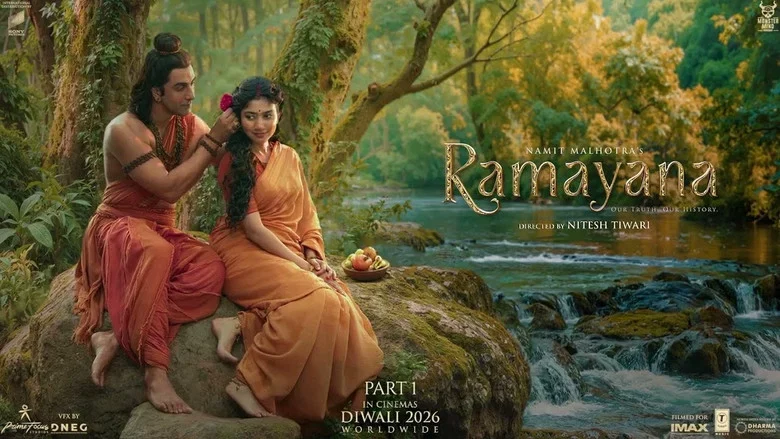
Sai Pallavi brings a grounded, almost contemporary warmth to Sita that keeps the mythological proceedings from floating away into abstraction.
Watch her in the marriage sequence: while the camera swoons around the garlands and the fire rituals, she keeps her eyes lowered, her fingers tracing the edge of her sari as if she’s memorizing the texture of the moment before it becomes legend.
It’s a small, human gesture in a film that too often mistakes grandeur for depth, and it’s telling that the screenplay gives her less to do as the running time stretches toward its three-hour mark.
The exile sequence, which should be the emotional fulcrum of the first instalment, rushes through her grief with a montage that feels like a checklist rather than a lament.
Nitesh Tiwari’s Direction Balances Spectacle With Restraint, But The Two-Part Structure Betrays Him
Tiwari, who built his reputation on character-driven dramas like Dangal, brings a welcome discipline to the mythological genre, he resists the urge to punctuate every emotional beat with a thunderous score cue, allowing silence to do the heavy lifting in several key scenes.
The sequence where Vishnu decides to incarnate as Rama is staged with a stark, almost theatrical simplicity: a single shaft of light, a whispered conversation between gods, and the quiet click of a decision being made.
But the film’s two-part architecture creates a structural problem that no amount of directorial finesse can fully solve, the narrative builds toward a confrontation that never arrives, ending on a note of anticipation rather than resolution.
It’s a gamble that mirrors the challenges faced by other recent fantasy adaptations in Don't Trouble the Trouble, where the weight of world-building similarly threatened to suffocate the story’s emotional core.
The Supporting Ensemble Delivers Texture, But The Script Leaves Them Stranded
Sunny Deol’s Hanuman appears late in the proceedings, and his introduction, a shadowed figure leaping across a chasm, carries the kind of mythic charge the rest of the film often strains for.
But the screenplay gives him little to do beyond looking reverent, and the same is true for the royal family members who populate Ayodhya’s palace corridors; they function as narrative furniture rather than living characters.
Lara Dutta’s Kaikeyi, in particular, is reduced to a plot mechanism rather than a psychological portrait, her motivations sketched in broad strokes that leave no room for the complexity the actress is capable of suggesting.
Hans Zimmer And A.R. Rahman’s Score Elevates The Spectacle But Struggles To Find The Human Pulse
The collaboration between Zimmer and Rahman is, predictably, the film’s most technically accomplished element, the score swells with appropriate grandeur during the cosmic sequences and retreats into delicate strings during the Rama-Sita courtship.
But there’s a sameness to the musical language that begins to feel oppressive by the second hour; every emotional beat is underlined with the same harmonic vocabulary, leaving little room for the kind of dissonance that might have made the film’s darker moments land with more force.
The cinematography, credited to a team of international technicians, favors wide, sweeping compositions that emphasize the scale of the production, but the film’s most memorable images are its smallest, a tear sliding down Sita’s cheek, Ravana’s fingers tightening around a throne’s armrest, Rama’s shadow stretching across a palace floor.
The Box-Office Gamble: Can A Two-Part Mythological Epic Sustain Theatrical Momentum?
Produced by Prime Focus Studios, DNEG, and Yash’s Monster Mind Creations, Ramayana: Rise of a Legend represents one of the most expensive bets in Indian cinema history, reports place the combined budget for both parts at approximately ₹4, 000 crore.
That figure is staggering, and it raises uncomfortable questions about the commercial viability of a film that, by design, offers no narrative closure; audiences conditioned by the self-contained arcs of Hollywood fantasy franchises may find the film’s cliffhanger ending frustrating rather than tantalizing.
The film’s theatrical lifecycle will depend heavily on its ability to sustain word-of-mouth through the Diwali holiday window, and on whether Yash’s star power in the Kannada market can offset the softer reception the film may face in Hindi-speaking territories.
For a genre that has historically struggled to balance devotional authenticity with blockbuster spectacle, this film’s performance will be watched closely as a bellwether for contemporary Hindi fantasy production at scale.
The Ending Offers No Resolution, Only A Promise, And That’s The Film’s Greatest Weakness
As the credits roll on Ramayana: Rise of a Legend, the overwhelming emotion is not exhilaration but exhaustion, the film has spent nearly three hours building a world it refuses to let us inhabit fully.
The final shot, which I won’t spoil here, gestures toward the epic battles to come, but it does so with a kind of coyness that feels unearned; we’ve invested in these characters, and the film repays that investment with a shrug and a “to be continued.”
This is a production that clearly aspires to the mythic grandeur of Maragatha Malai, but where that film found a way to make its fantasy elements feel organically rooted in its characters’ emotional lives, this one often mistakes scale for substance.
And yet, there are moments, Kapoor’s quiet anguish during the exile, Yash’s terrifying stillness in the throne room, Pallavi’s wordless grief, that suggest a better, more focused film buried somewhere in this sprawling enterprise.
Whether that film emerges in the second instalment remains to be seen, but for now, we’re left with a promise rather than a payoff, and a legend that feels more like a preamble than a rise.