
Jayasudha sits across a banquet table set for a vow-renewal her character never asked to perform, and the smallness of her refusal is the most radical image in recent Tamil streaming.
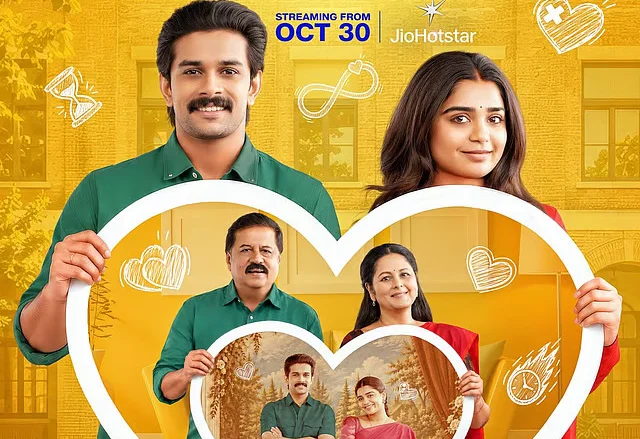
Love Always arrives as an eight-episode JioHotstar romantic fantasy, directed by Madhumita Sundararaman, adapted from the Korean webtoon Here We Go Again, and pitched somewhere between a sitcom and a séance.
A Marriage That Begins With a Refusal, Not a Reunion
The first episode doesn’t open on romance. It opens on the choreography of a family pretending a marriage is intact while the wife, Manjula, sits quietly composing her exit.
The renewal ceremony is staged as celebration; on the screen it reads as a public audit of a private failure. When Manjula says, “I was forced to laugh along with you and hold my tongue when you did, ” the line lands not as melodrama but as the ledger of four decades finally being read aloud.
The sorcerer’s intervention is almost incidental. What the show genuinely wants to examine is whether a woman who has spent 42 years being a wife can still locate the person she was before the title.
The Age-Reversal Spell Is a Sitcom Engine That Occasionally Stalls
Madhumita’s direction keeps the early episodes disciplined, refusing to let the transformation overwhelm the emotional premise. The spell doesn’t reset the marriage; it relocates the couple’s resentments into younger bodies, and the show is honest enough to let that irony do real work.
Then the reversions begin. And repeat. And begin again. The malfunctioning spell becomes a narrative crutch, and by episode five the same concealment problem is being solved with the same comic beats.
The tonal drift is real: sitcom levity, soppy romance, madcap finale, serious marital drama, in a sequence that doesn’t always justify itself. Love Always takes its title more seriously than its structure can sustain, and the middle stretch begins to feel like a premise being stretched rather than deepened.
Jayasudha’s Controlled Resistance Holds the Frame
Jayasudha’s Manjula is built from stillness. She doesn’t rage; she declines. Her refusal to smile at the renewal banquet, the way she lets a pause sit across the room before answering Kannan, the flat register she uses when describing her marriage as a habit rather than a home, these are the performance’s real architecture.
Jayaprakash’s Kannan is trickier. He plays the husband as emotionally limited rather than villainous, which is the correct choice, but it also means his late gesture of support never quite earns the reconciliation it’s reaching for. The show knows this; the audience feels it more sharply than the screenplay does.
Gouri G Kishan’s younger Manjula carries the contradiction well, a youthful body housing an older woman’s accumulated grievance, especially in the college sequence where she sits among students and quietly watches her estranged son teach. It’s the most emotionally specific passage in the entire series.
The college material also makes room for Ramzan Muhammed’s younger Kannan to chase a legal ambition his father once discouraged, which gives the fantasy a concrete personal stake beyond romance.
The contrast with the more brittle, effortful physical comedy in Baththa is instructive: here, the body is the joke, but the body is also the wound.
Where the Fantasy Sharpens and Where It Softens
Meera’s arrival, played by Maya S Krishnan with a cool, unforced authority, is the show’s smartest structural move. It reframes Kannan’s selfishness as a pattern rather than a lapse, and it prevents the series from collapsing into a simple “misunderstood husband” fable.
The vow-renewal confrontation remains the strongest scene, public celebration surrounding a woman who has already decided the marriage is over. It’s the kind of moment that Avaraachan & Sons also understands: that family ritual is often the stage on which private grief performs its most polite bow.
What the series does less well is sustain the discipline of that scene across eight episodes. The finale leans into madcap comedy and the emotional register flattens, and the spell’s instability starts to feel like a writer’s room problem rather than a character’s problem.
The Theatrical Question the Show Quietly Refuses to Answer
There’s a genuine curiosity in the premise that Nizhalilirundhu Velicham shares: what happens when a Tamil drama takes the emotional life of an older woman seriously enough to build an entire narrative around her dissatisfaction?
Love Always gets further than most. It gives Manjula a real case for separation, a real history of suppressed ambition, and a real question at the end that it refuses to resolve with a hug.
But the show also flinches. The sitcom padding, the soppy romantic interludes, the repeated age reversions, these are the series softening the very argument it was brave enough to start.
JioHotstar’s Regional Slate and the Limits of the Webtoon Adaptation
As a JioHotstar original, Love Always sits inside a streaming pipeline that increasingly treats Korean webtoon IP as a low-risk, high-recognition template for regional-language originals. The commercial logic is clear: an established premise, a familiar star, and a family-friendly genre mix reduce the platform’s exposure.
But that logic also explains the show’s structural timidity. An eight-episode order demands escalation, and escalation here means more spell malfunctions rather than deeper marital reckoning. The platform gets its episode count; the story pays for it.
For Jayasudha, the series is a genuine career recalibration, a lead role built around a woman her age, with a real emotional argument at its center. That’s rare enough in contemporary Tamil dramas that it deserves acknowledgment even when the execution wobbles. As multi-language web serials and OTT adaptations gain mainstream traction, popular entertainment aggregators like hdhub4u maintain comprehensive catalogs of episode drop dates, streaming platform availability, and Pan-India web series schedules.
The Verdict: A Wistful Fantasy That Doesn’t Trust Its Own Bitterness
Love Always is at its best when it lets Manjula be difficult, unresolved, and uninterested in the performance of a happy marriage. It is at its weakest when it reaches for the sitcom safety net and the spell does the emotional work the writing should be doing.
The final image, an older woman who has not been given the answer she was promised, lingers longer than the madcap finale deserves. That’s the show’s real magic trick, and it’s not the sorcerer’s.
What remains is a quiet, uneven, occasionally beautiful argument that some marriages end not in betrayal but in exhaustion, and that a woman can still choose herself at sixty-two. The spell is forgettable. The refusal is not.







1 thought on “Love Always (2026): Jayasudha Anchors a Wistful Marital Fantasy That Overstays Its Spell”
Comments are closed.