
The case file is already stained with failure before DSP Inbaraj even opens it. Jithu Madhavan’s Tamil debut arrives with the weight of a Malayalam comic sensibility grafted onto a major star vehicle, and the graft doesn’t always take.
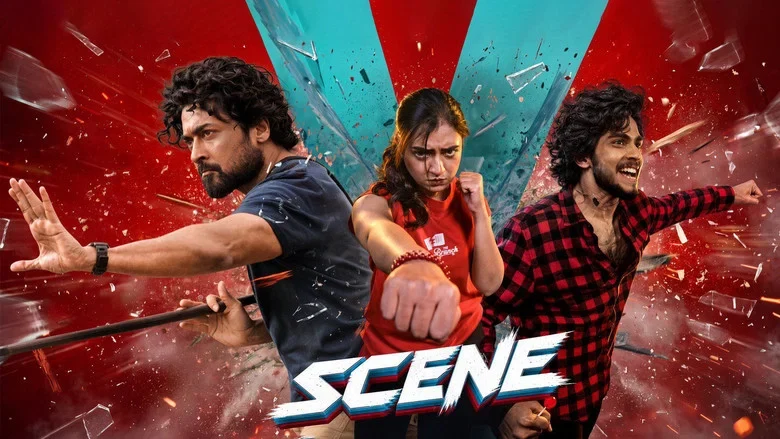
A Defiant Cop, A Dysfunctional Team, And A Case That Won’t Stay Closed
Madhavan opens on friction rather than spectacle: Inbaraj’s unconventional conduct scraping against departmental protocol until his superiors have no choice but to hand him the one investigation he never finished.
The premise is sturdy. A disgraced officer forced to reopen his own unsolved case, saddled with a chaotic team he cannot control, gives the film a procedural engine that hums from the first reel.
Where the director’s earlier work thrived on situational absurdity, here he inherits a genre apparatus that demands forward momentum. It mostly holds.
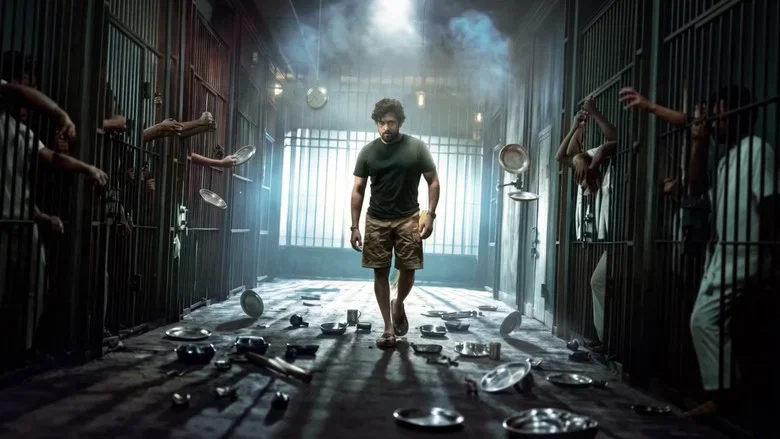
The Comedy Is Dark, The Wordplay Is Uneven, And The First Half Knows It
Dark humour is the film’s declared tonal register, and in the opening hour it pays dividends. The team’s dysfunction is played as character comedy rather than slapstick, with the mismatched working methods generating genuine friction.
But the Tamil adaptation of Madhavan’s signature verbal humour is where the machinery stutters. Jokes that would land with a Malayalam cadence arrive flattened, and some punchlines feel assembled rather than felt.
The first half establishes the second half effectively enough. Whether the second half earns that setup is a question the film answers with shrugs rather than conviction.
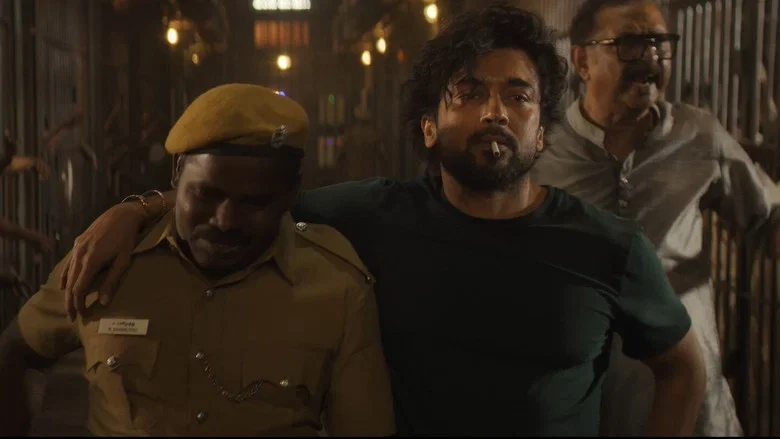
Suriya’s Inbaraj Is A Study In Controlled Insolence
Suriya plays Inbaraj with a deliberate looseness: shoulders slouched against authority, a flat vocal register that refuses to rise to provocation, and a habit of holding eye contact a beat past comfort.
It is a performance built on withheld aggression rather than released fury. The rebellion lives in small physical refusals, the way he occupies a chair, the way he lets a superior’s reprimand hang unanswered.
The restraint recalls the emotional economy he brought to Vishwanath & Sons, where domestic quiet carried more weight than any outburst. Here, that same discipline is deployed against institutional pressure.
Nazriya Nazim registers in the ensemble with a watchful presence rather than a defined function, while Naslen’s Tamil debut trades on his established comic timing without yet finding a character to anchor it.
Madhavan Builds Tension Through Silence, Not Speed
The director’s instinct for dead air is his sharpest asset. Interrogation scenes are allowed to sit in uncomfortable stillness, with Vineeth Augustian’s camera holding medium shots that let the actors’ faces do the procedural work.
When the film cuts loose into action, the editing quickens without losing spatial coherence, a discipline that distinguishes this from the kinetic sensationalism that overtook Magudam.
Sushin Shyam’s score, marking his Tamil debut, leans on low-frequency drones rather than melodic swells. It suits the material, though it occasionally overstates dread where the images already carry it.
2D Entertainment Bets On Crossover, Not Comfort
Suriya and Jyotika’s 2D Entertainment, alongside Zhagaram Studios, are wagering on a cross-industry proposition: a Malayalam director’s sensibility filtered through Tamil star machinery.
The commercial logic is legible. Suriya’s box-office leverage remains formidable, and pairing him with Madhavan’s comic pedigree targets audiences hungry for something other than the standard mass-action template.
But the regional translation problem is real, and it sits at the heart of the film’s financial risk. Wordplay that works in Kochi does not automatically travel to Madurai.
The broader appetite for contemporary Tamil action has rewarded films that commit fully to either spectacle or character. Scene tries to split the difference.
A Procedural That Trusts Its Star More Than Its Script
What lingers is the sense of a film held together by its lead’s gravitational pull. Suriya’s Inbaraj is a genuinely interesting creation, a cop whose defiance is a form of grief, but the screenplay never quite probes the wound.
The unresolved case resolves, the team coheres, and the credits roll on a note of professional reconciliation that feels earned only because Suriya wills it to be.
Madhavan’s Malayalam work, including the peer release Ramayana, understood that comedy thrives on specificity. Here, the specificity gets sanded down by the demands of a star vehicle.
Scene is a solid, watchable procedural with a commanding central turn and a comic register that never fully finds its footing. It is the work of a filmmaker learning a new language, literally and figuratively, and the accent shows.
The final image of Inbaraj walking away from a case he has finally closed carries an unexpected melancholy. Some investigations end; others just stop.






1 thought on “Scene (2026): Suriya Anchors a Darkly Comic Police Procedural That Loses Its Grip in Translation”
Comments are closed.