
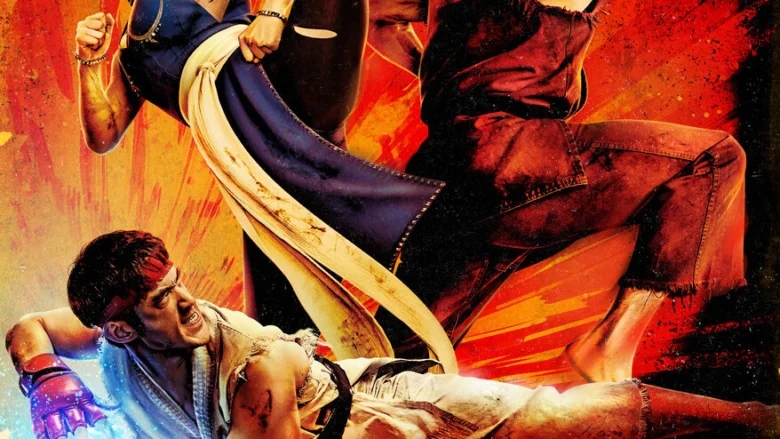
The anime prologue that opens Kitao Sakurai’s Street Fighter is the most confident sequence in the film, a stylized burst of ink and motion that compresses years of training, friendship, and quiet betrayal into ninety seconds. It is also the last time the movie feels genuinely sure of what it wants to be.
A Stylish Prologue That Sets a Bar the Live Action Cannot Clear
The prologue works because it trusts silence and gesture. Ryu and Ken’s boyhood under Gouken is rendered with clean linework and deliberate pacing, establishing the disciplined student and the restless one without a word of exposition. When the film cuts to live action in 1993, the drop in confidence is immediate.
Andrew Koji’s Ryu carries the film’s center of gravity with a stillness that recalls his work in Ranabaali, where restraint functioned as a form of pressure rather than absence. Here, his Ryu is a man who has made peace with obscurity, and Koji plays that peace as a kind of armor, shoulders squared, gaze level, voice kept at a register just above a whisper.
Noah Centineo’s Ken Is All Surface, Which Is Precisely the Point
Noah Centineo’s Ken is the film’s most interesting performance problem. He is meant to be a celebrity fighter whose public success masks private insecurity over Ryu’s superior ability, and Centineo leans into the performance of confidence with a smile that never quite reaches his eyes. The tension between the two men is best felt in a locker-room scene where Ken talks at Ryu rather than to him, filling the silence with anecdotes while Koji’s Ryu simply listens, his jaw set.
That dynamic gives the tournament its emotional engine, but the screenplay (credited to Sakurai and T. J. Fixman) keeps interrupting it. Every time the Ryu–Ken friction begins to generate heat, the film cuts away to another fighter introduction or a Shadaloo exposition beat, and the momentum dissipates like steam from an open pot.
David Dastmalchian’s Bison Is a Mechanic, Not a Menace
David Dastmalchian is a fine actor, but his M. Bison is written as a function rather than a person. He wants to harvest Hado power from the tournament’s fighters and convert it into Psycho Power, and the film explains this plan repeatedly without ever making it feel dangerous. Dastmalchian plays Bison with a clipped, bureaucratic calm, glasses, measured gestures, a voice that never rises, but the script gives him nothing to do except describe his own scheme.
The result is a villain who feels less like a threat and more like a project manager. When he finally steps into the ring for the climax, the film has spent so much time explaining his plan that the confrontation feels like a formality rather than a release.
Callina Liang’s Chun-Li Deserves More Than a Bridge Role
Callina Liang’s Chun-Li is the narrative connective tissue, she recruits Ryu and Ken, she conceals her Interpol mission, she drives the plot forward, but the film treats her as a means to an end. Her undercover work against Shadaloo should generate its own tension, yet the screenplay keeps her in the background of scenes that belong to the male leads.
There is a moment in the tournament’s second act where Liang’s face registers something like genuine calculation, a flicker of the operative beneath the recruiter. It lasts about three seconds before the film cuts away to a fight. That pattern repeats throughout: the supporting cast is introduced with fanfare and then left to stand around looking recognizable.
The 1993 Setting Is a Texture, Not a Theme
Setting the film in 1993 is a smart commercial choice, it aligns with the cultural moment of Street Fighter II, but the film never does anything with the period beyond costume and production design. There is no sense of the pre-internet world, no engagement with the specific anxieties of that moment. The year is a label on a box, not a lived reality.
Compare that to the way VISA – Vintara Saradaga uses its own cultural moment as a source of dramatic friction, and the difference is stark. Sakurai’s film treats its setting as decoration rather than as a pressure system that shapes character behavior.
The Tournament Structure Works Better Than the Conspiracy Around It
Where the film does succeed is in the tournament itself. The sequence-based framework allows for clean contrasts between fighting styles, and Sakurai stages the matches with a clarity that respects the choreography. A mid-film bout between Ryu and an unnamed opponent is the closest the movie comes to pure kinetic pleasure, the camera holds wide, the cuts are minimal, and Koji’s movements have a weight that the rest of the film lacks.
The conspiracy plot, by contrast, keeps interrupting the fights with exposition. Every time the film builds momentum in the ring, it cuts to a control room where someone explains what Bison is doing. The result is a film that keeps explaining its own stakes rather than dramatizing them.
The Ensemble Is a Roster, Not a Cast
Jason Momoa’s Blanka, Vidyut Jammwal’s Dhalsim, and the rest of the fighter lineup are introduced with the efficiency of a character-select screen and then given almost nothing to do. Momoa brings a feral physicality to his scenes, but the film never asks him to be anything other than a visual reference. Jammwal’s martial-arts precision is visible in his brief screen time, but the screenplay gives him no arc, no moment of choice, no reason to be there beyond recognition.
That is the film’s central structural problem: it has too many characters and not enough story to go around. The Ryu–Ken–Chun-Li triangle should be the spine, but the film keeps adding ribs until the skeleton collapses under its own weight.
Paramount’s Bet on Nostalgia Has Limits
Paramount is distributing Street Fighter as a tentpole, and the commercial logic is clear: the game’s fanbase is global, the cast is stacked with recognizable names, and the 1993 setting invites a nostalgia play. But the film’s inability to decide whether it is an action comedy, a martial-arts drama, or a conspiracy thriller suggests a production that never settled on a tone.
The theatrical marketplace for video-game adaptations has become crowded, and Spider-Man demonstrated that a lone hero with a clear emotional throughline can carry a franchise better than a crowded roster. Street Fighter has the opposite problem: it has too many heroes and no clear center.
A Climax That Resolves the Plot but Not the Feeling
The final act brings Ryu, Ken, and Chun-Li together against Bison, and the film dutifully checks every box: the estranged friends reconcile, the villain is defeated, the tournament is exposed. But the resolution feels mechanical, as if the screenplay were following a template rather than finding its own ending. The emotional beat that should land, Ryu and Ken finally fighting side by side, is staged with competence but without heat.
What lingers is not the climax but the prologue. The anime opening suggested a film that understood the melancholy beneath the fighting-game surface, a story about two men who loved each other and grew apart. The live-action film that follows never quite finds that melancholy again.
The Verdict
Street Fighter is a film caught between its fan-service obligations and its desire to be something more. Koji’s Ryu is a genuine anchor, and the tournament sequences have a clarity that the rest of the film lacks. But the screenplay’s inability to commit to a tone, combined with an ensemble that is introduced and then abandoned, leaves the film feeling like a proof of concept rather than a finished story.
It is not a disaster. It is a film that knows what it should be and keeps missing the mark by inches. The anime prologue will be remembered longer than anything that follows it, and that is the most damning thing I can say about a movie that had every tool it needed to be great.





1 thought on “Street Fighter (2026): Andrew Koji’s Stoic Ryu Anchors a Messy, Overstuffed Tournament”
Comments are closed.