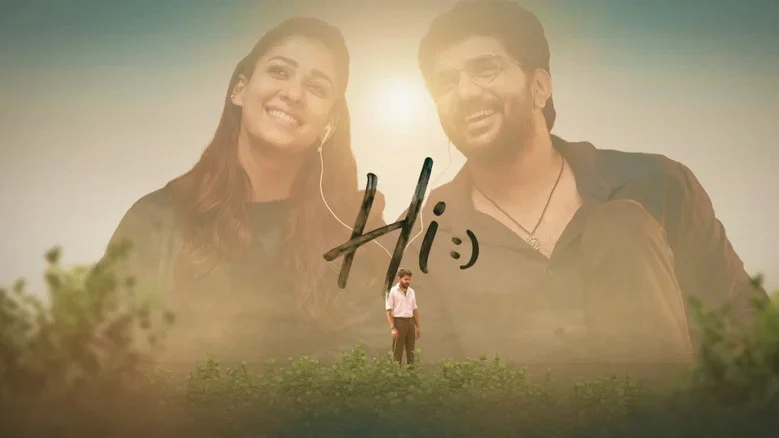
The first “Hi” lands like a door left ajar. Not a slam, not an invitation, just a monosyllable exchanged between two people in a corridor who have not yet decided whether they are strangers or something else. Vishnu Edavan builds his entire debut on that sliver of air, and for a while the gamble is genuinely beguiling: a romance that refuses to arrive on cue.
Then the film keeps saying “Hi.” Again, and again, and again, and the greeting stops being a threshold and starts being a tic. What begins as a whisper-quiet study of two people circling each other’s emotional furniture ends as a film that has said everything it has to say in the first half hour and then repeats it with more expensive lighting.
The Neighbour Premise Works Until It Has To Do Actual Work
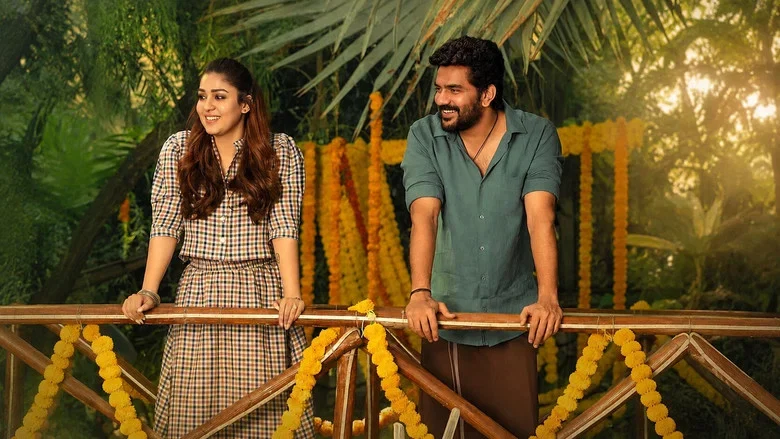
Edavan’s structural instinct is sound. A city man hunting for love, a neighbour who treats the word as a foreign object, opposing philosophies parked on the same landing, that’s a clean comic engine, and the screenplay initially respects it. The early encounters have the loose, unforced rhythm of conversations that could go anywhere, which is precisely why they work.
The problem is that the film mistakes accumulation for development. Chance encounters and shared conversations pile up like unread mail, each one pleasant, none of them escalating the stakes. Where a sharper writer would let the opposing beliefs collide, force one character to actually defend their position, Edavan keeps both parties politely circling. The tension never sharpens into an argument worth having.
This is where the film’s kinship with a certain kind of contemporary Tamil comedy becomes instructive. The best of them understand that laughter and discomfort share a nervous system. The chaotic-wedding-night empathy that animates Modha Rathri (2026) comes precisely from characters being cornered into feeling something they’d rather not. Here, nobody is ever cornered. Everybody is merely inconvenienced.
Nayanthara Holds The Frame; The Frame Doesn’t Hold Her
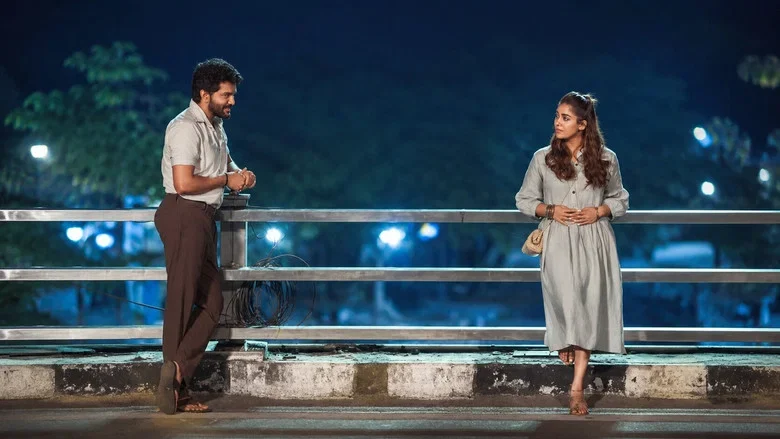
Nayanthara is the film’s most persuasive argument for itself. Watch her in the early exchanges: she keeps her hands busy, a cup, a phone, a doorframe, as if her character distrusts the word “love” enough to need something else to hold. Her vocal register stays flat and dry in scenes that a lesser performer would inflate, and the restraint reads as defense, not indifference.
There’s a moment where she listens rather than speaks, and her face does the work of a paragraph: a flicker of amusement arriving and being shut down before it reaches her mouth. That micro-discipline is the same quality that gave her turn in Toxic its unsettling aftertaste, and it remains her most underrated instrument.
Kavin, by contrast, is all forward lean. He plays the search for love as a series of small reaches, a step closer in a corridor, a question held a beat too long, and his openness is genuinely disarming in the first act. But the screenplay gives him nowhere to fall. He’s uncertain, then he’s certain, and the film treats the transition as a foregone conclusion rather than a crisis. Without a scene where his optimism costs him something, his arc is a straight line wearing a curve’s clothing.
The Supporting Cast Is Furniture, And The Room Is Overfurnished
Radikaa Sarathkumar and K. Bhagyaraj appear with the specific gravity of performers who have earned the right to complicate a scene, and the film mostly asks them to bless the proceedings. Radikaa gets a moment of sharp, sideways appraisal, the kind of look that suggests she has already diagnosed the leads’ problem and is waiting for them to catch up, but the screenplay never lets her press the advantage.
The rest of the ensemble, the relatives, the well-wishers, the comic bystanders, function as texture rather than pressure. There is no antagonist here, and that is a legitimate choice: the conflict is supposed to be internal, a collision of beliefs about love. But internal conflict still requires a visible cost. The film’s opposing philosophies never actually wound anyone, so the eventual reconciliation feels less like a victory than a scheduling decision.
Where a film like Tadviruddha buries its own mystery under structural ambition, this one buries its romance under structural timidity. Both are cautionary tales about premise outrunning execution, just from opposite directions.
Jen Martin’s Score And Rajesh Shukla’s Lens Are Doing More Work Than The Script
The technical package is the film’s most reliable ally. Rajesh Shukla’s framing keeps the leads in loose, patient compositions, the camera holds wide enough that the empty space between them becomes a character, and the Chennai, Coimbatore and Pollachi locations are allowed to breathe as ordinary places rather than postcards. When the film finally pushes in for a close two-shot, the intimacy feels earned by geography rather than by dialogue.
Jen Martin’s score is the opposite: it arrives early and often, cuing emotions the screenplay hasn’t bothered to build. There’s a stretch in the second hour where the music is essentially doing the acting, and it’s hard not to resent it. Silence would have been braver. Silence would have forced the leads to fill the gap.
That instinct, to smooth over uncertainty rather than sit inside it, is the film’s defining flaw, and it’s a shame, because the early scenes prove Edavan can hold a moment. He just doesn’t trust himself to hold a hard one.
What The Ending Resolves, And What It Quietly Avoids
The mutual romantic recognition arrives, as promised, and it’s pleasant. It’s also weightless. Two people who disagreed about love now agree about love, and the film treats this as a resolution rather than a transformation. Nobody has been changed by the relationship so much as absorbed into it.
There’s a version of this film, a tougher, more honest one, where the reconciliation is scary, where one character has to admit the other was right and lose something in the process. That version isn’t on screen. What’s on screen is a warm, well-acted, professionally mounted romance that never quite risks being disliked.
For an audience that wants exactly that, a gentle, family-friendly, conversation-driven love story with two charismatic leads and no villains, this delivers competently. For anyone who believes the best romantic comedies are comedies of discomfort first and romance second, the film’s refusal to draw blood will read as its central evasion. Across contemporary Tamil comedies, the ones that linger are the ones willing to embarrass their characters. This one only ever inconveniences them.
Rating: 2.5 / 5
The film ends on a greeting that has lost its meaning through repetition, and that, unfortunately, is the most honest thing in it.