
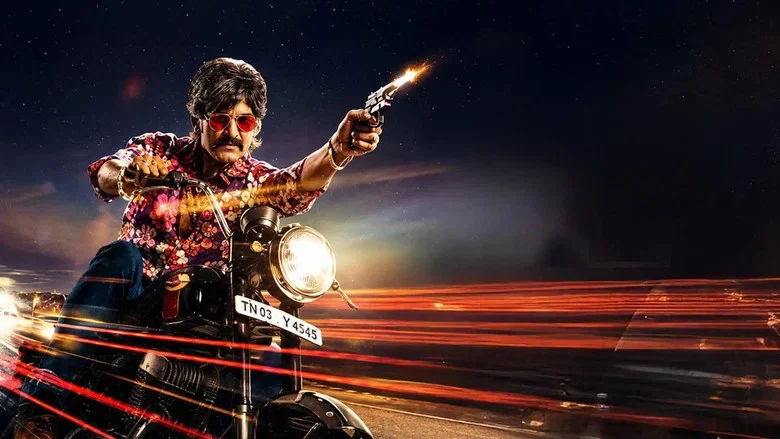
The first image that lands is a gold chain resting against a bare chest, catching coastal light while its owner holds court over a table of frightened men. Vishal Krishna Reddy, directing himself for the first time, understands exactly what that chain means. It means Linga has already won whatever argument is about to happen. It means violence here is inherited, worn against the skin, passed down whether the wearer wants it or not.
That inheritance is the film’s real subject, buried under three hours of gangster theatrics that keep threatening to smother it.
A Father’s Empire And A Son’s Grocery Bill
The opening act sets up a clean opposition. Linga lives in marble and menace, a gangster whose authority is measured in the way servants lower their eyes. His son Kripa sells medical supplies for a living, argues with his wife Jamuna about school fees, and has spent years building a life whose entire architecture depends on never becoming his father.
Dushara Vijayan plays Jamuna with a watchful stillness that gives the domestic scenes their weight. She doesn’t perform fear so much as calculate it, and in a film this loud, her quiet arithmetic stands out. The contrast between her measured presence and the film’s later escalation recalls the restrained physical exhaustion she brought to Kattalan, where she similarly anchored chaos without raising her voice.
For roughly forty minutes, this works. The film knows what it’s about. Then the gangsters arrive, and it starts forgetting.
When Every Villain Is Just A Crowd
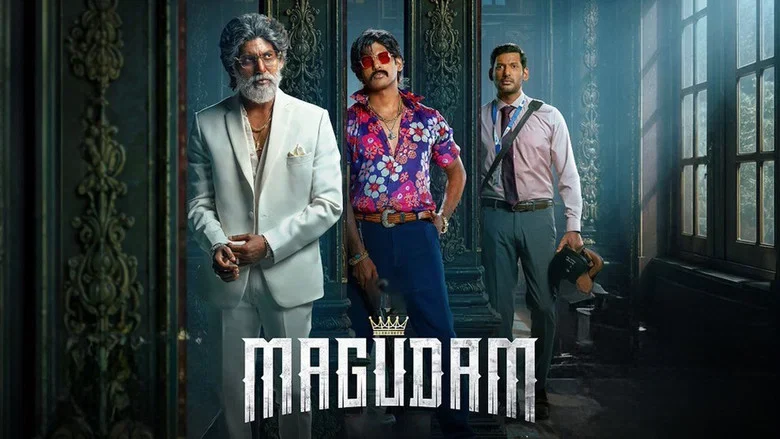
Here is the structural problem that no amount of coastal atmosphere can fix. The opposing force is a collective, a rotating cast of local thugs who threaten, retreat, threaten again, and never cohere into a single face worth fearing. The screenplay treats them as weather rather than antagonist.
Action cinema lives or dies on the specificity of its opposition. A gangster epic without a memorable villain is a sermon without a devil. Linga’s power means nothing if the men challenging it remain interchangeable. When the family attack finally arrives, it lands as plot mechanics rather than personal violation, because we never learned to hate anyone in particular.
The available critical consensus has been blunt about this gap between ambition and execution. What the film attempts and what it achieves sit uncomfortably far apart.
Vishal Against Himself, And Losing
The dual role is the film’s commercial hook and its central performance gamble. Linga requires bulk and stillness. Kripa requires the opposite: a man whose body has learned to make itself small, who flinches at raised voices, whose hands stay visible. Vishal plays both, and the contrast is legible in his posture before a single line lands.
What he cannot solve is the transition. When Kripa finally turns violent after the family tragedy, the shift happens in the screenplay rather than in the performance. There is no intermediate stage, no moment where the son recognizes his father’s blood moving in his own hands. He simply becomes capable, because the plot requires it.
This is where the direction betrays the actor. Vishal the director gives Vishal the performer no room to dramatize the inheritance he’s supposedly exploring. The film announces the theme and then skips past it. Contemporary Tamil action has been navigating similar territory with more patience, and the tonal discipline visible across Hi suggests what this material might have looked like with a tighter grip on its own emotional logic.
Three Hours Is A Confession, Not A Strategy
Nothing in this story requires a runtime past the two-hour mark. The first half spends an hour establishing what the opening ten minutes already communicated: Linga is powerful, Kripa is not, and the distance between them is the film’s engine.
GV Prakash Kumar’s score does what it can, pushing momentum through scenes the editing refuses to end. But music cannot compress a screenplay that keeps restating its own premise. By the time the revenge machinery engages, the audience has been asked to sit through the same emotional beat four separate times.
The film’s ambition is real. So is its unwillingness to trust that ambition.
The Verdict: A Debut That Fights Itself To A Draw
Magudam wants to be two things: a commercial gangster spectacle and an intimate study of inherited violence. It succeeds partially at the first and barely at the second. The father-son premise is genuinely strong, and Vishal’s dual performance contains moments of real physical intelligence. But a film about the difficulty of escaping your father’s world should not itself feel trapped in the conventions of a hundred films that came before it.
What lingers is not the action. It’s the image of Kripa standing in his father’s house, wearing clothes that don’t fit, realizing he has become the thing he spent a lifetime refusing. That moment works. The problem is that the film around it keeps trying to bury it under noise, as though afraid of what might happen if it simply stood still.
Rating: 2.5 / 5
Somewhere inside these three hours is a lean, devastating ninety-minute film about a son who learns his father’s language too late to refuse it. Vishal the director should have trusted Vishal the actor enough to find it.





1 thought on “Magudam (2026): Vishal Krishna’s Dual-Role Debut Fights Its Own Runtime”
Comments are closed.