
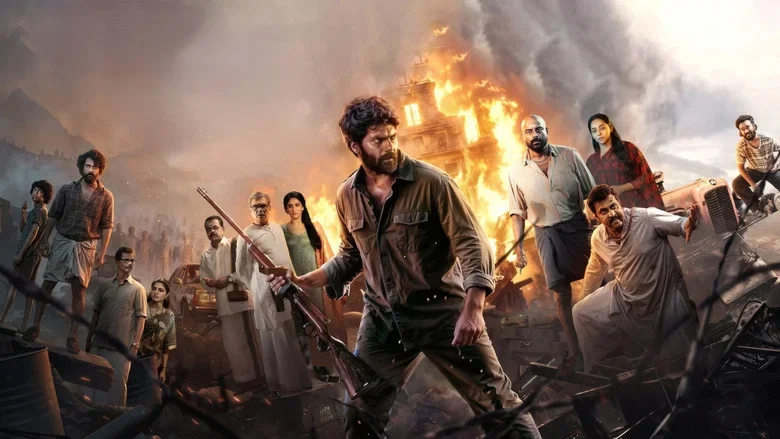
Jiyen Krishnakumar does not ease you into Ananthan Kaadu. The film drops you into a Thiruvananthapuram slum ecosystem from the late 1980s, where quotation-gang enforcers operate under the patronage of men who never show their hands. The air is thick with humidity and menace, and you can almost taste the rust and betrayal before a single punch is thrown.
That sensory immersion is the film’s strongest asset in its opening hour. Arya enters as Vetrivel Kumaran, a man whose survival depends on reading the room faster than anyone else. He moves through cramped alleyways and crowded meeting rooms with a coiled physicality that suggests violence is not a choice but a reflex.
The setup promises a study of how power corrupts the vulnerable. For a while, it delivers. The former quotation-gang quartet, Krishnankutty, Thankaraj, Murali, and Jackson, functions as the film’s social engine, showing how crime and politics merge inside a neighborhood hierarchy. This is not a neutral backdrop. It is a living organism that feeds on loyalty and excretes corpses.
A Composer’s Ambition Trapped Inside a Screenplay’s Indulgence
Murali Gopy writes with evident affection for this world. The dialogue, when it lands, carries the weight of men who have learned that survival is a debt paid in installments. The background score reinforces menace without overplaying it, and the cinematography treats the period setting as a character rather than a costume.
But somewhere in the second act, the film loses discipline. Subplots multiply like unchecked weeds. Characters appear, vanish, and reappear without clear dramatic function. The royal relatives and temple elders who populate the margins of the power struggle never quite justify their screen time, and their presence dilutes the central conflict rather than enriching it.
This is not a case of a single structural flaw. It is a pattern of overreach. The film wants to be a political epic, a revenge tragedy, and an ensemble drama simultaneously. It succeeds at none of these completely, though it comes closest to the revenge material when Arya is given room to operate.
Where the screenplay falters most is in its refusal to trust its own lead. Arya’s Vetrivel Kumaran should be the gravitational center, but the film keeps cutting away to secondary threads that never pay off. The result is a protagonist whose emotional journey feels like an afterthought in his own story. This is a structural betrayal that no amount of atmospheric staging can fully compensate for.
The Lead Carries What the Script Cannot
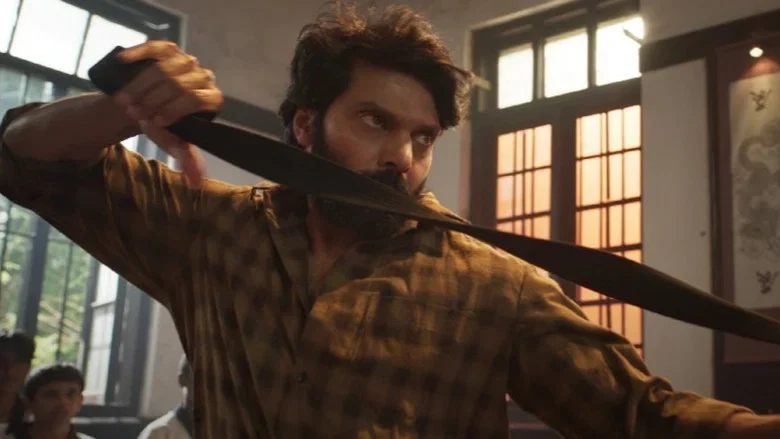
Arya has built a career on physical authority, from his early action roles to more recent dramatic turns. Here, he is at his most effective when the film strips away exposition and lets his body do the talking. Watch him in the action blocks: his posture shifts, his eyes narrow, and his movements carry the weight of a man who has learned that hesitation is fatal. He does not need dialogue to communicate threat.
When the script demands emotional depth, Arya works harder than the material deserves. There is a scene where he confronts the men who have betrayed him, and his stillness is more frightening than any raised voice could be. He holds his ground, jaw tight, hands loose at his sides, and you can see the calculation behind his eyes. This is a performer who understands that restraint is a weapon.
Murali Gopy, as Thankaraj, operates on a different register entirely. His villainy is built on quiet control rather than theatrical menace. In key exchanges, he speaks softly, never raises his voice, and lets his eyes do the threatening. It is an effective choice, and it gives the film’s political network a chilling plausibility. The antagonist works best when tied to the system rather than to any single confrontational moment.
Among the supporting cast, Indrans brings a gravity that the slum-and-gang material desperately needs. His timing is impeccable, and his presence gives the film’s moral world a weight that the screenplay often lacks. Vijayaraghavan, in limited screen time, leaves an impression through sheer economy of gesture. These are performers who understand that less is more, and the film is better for their contributions.
Where the Direction Holds and Where It Slips
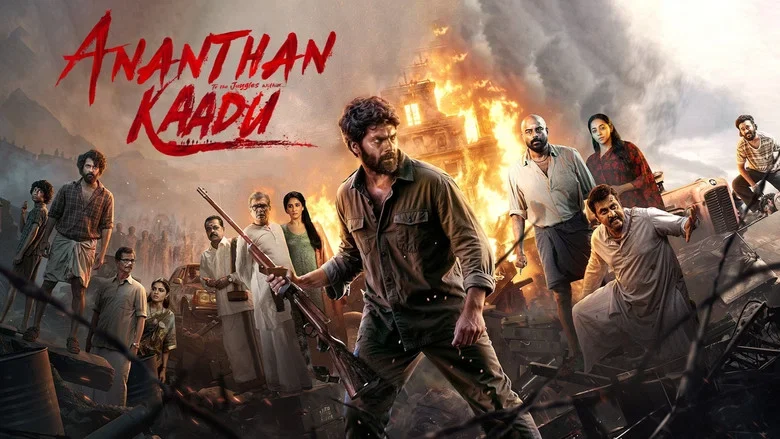
Jiyen Krishnakumar has a genuine feel for period texture. The film’s visual atmosphere, the cramped interiors, the dusty streets, the way light falls through shuttered windows, creates a world that feels lived-in rather than designed. He understands that political thrillers live or die on their sense of place, and he invests heavily in making Thiruvananthapuram’s underworld feel tangible.
The action sequences are staged with clarity and impact. Krishnakumar does not rely on shaky-cam chaos. He lets the choreography breathe, and Arya’s physical command carries the commercial beats. The background score, which reinforces menace without overwhelming the drama, is used judiciously.
But the film’s ambition exceeds its narrative control. The second half becomes burdened by revenge mechanics and side plots that slow emotional momentum. The editing, which is sharper in the first half, loses its rhythm as the film tries to juggle too many threads. By the climax, the payoff feels diluted, as if the film is checking boxes rather than building to a genuine catharsis.
This is a pattern familiar to anyone who has followed recent genre experiments in Indian cinema, where scale often overwhelms intimacy. The film’s producers are clearly betting on the mass-appeal of a period political thriller, but they have underestimated the importance of a focused emotional core. The result is a film that impresses in moments but never quite coheres as a whole.
The Uncomfortable Verdict: A Film That Forgets Its Own Protagonist
The ending of Ananthan Kaadu prioritizes karmic consequence over emotional resolution. The lead’s personal journey, which should be the film’s beating heart, is left underdeveloped. You leave the theater understanding what happened, but not necessarily why it mattered to the man at the center of it all. That is a significant failure for a revenge drama.
This is a film for viewers who value atmosphere and ensemble complexity over tight storytelling. Fans of Arya’s action work will find moments to savor, and those who appreciate period political dramas will admire the texture. But viewers seeking a focused, emotionally centered narrative should look elsewhere. The A certificate is earned, and the film’s brutality is not for family audiences.
For those who prefer content over scale, the eventual digital premiere on streaming platforms will be the better viewing option. The theatrical experience adds little beyond the communal energy of watching action beats land with a crowd. The film’s pleasures are intimate rather than spectacular, and they survive the transition to a smaller screen.
Rating: 3 / 5
Ananthan Kaadu wants to be a sweeping political epic, but it forgets that epics are built on the backs of individuals, not factions. Arya deserves a film that trusts him as much as he trusts the camera. This is not that film. It is a near-miss that will be remembered for its atmosphere and its lead’s commitment, but not for the story it failed to tell.
Readers looking for more malayalam thriller reviews can explore them on BAPPAM TV.




1 thought on “Ananthan Kaadu (2026): Arya Anchors a Sprawling Political Revenge Drama That Buckles Under Its Own Ambition”
Comments are closed.