
Kotapadi J Rajesh runs. That is the first and last thing Angikaaram asks of him, and he does it with a lung capacity and calf definition that suggest months of actual sprint training rather than the usual actor’s crash course. In the opening stretch, Thenpathiyan’s camera tracks him through the cramped lanes of a Chennai slum, the 200-metre marker painted on cracked asphalt, and for a few minutes the film breathes with the specificity of a real place. Rajesh’s Aathiran Banumathi moves like someone who has been running from something his whole life, shoulders low, arms pumping with the economy of a man who knows exactly how much fuel he has left. It is a debut performance built on physical grammar, not dialogue, and for a while that is enough.
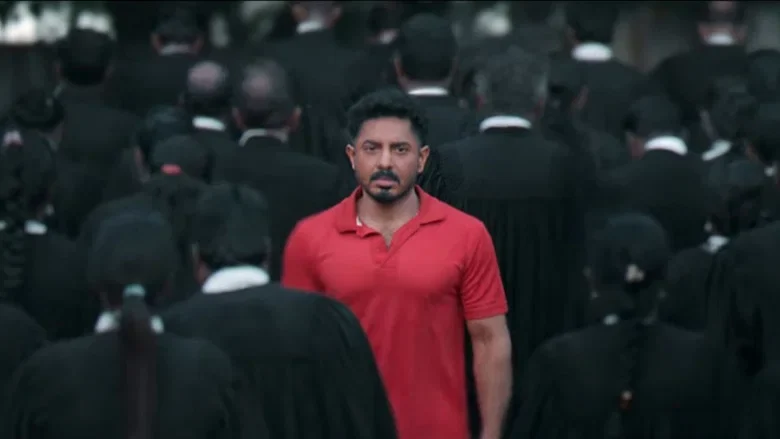
The Roster Removal Is the Film’s Only Real Dramatic Muscle
The central pivot arrives without warning: Aathiran’s name has been deleted from the Commonwealth Games roster. Not injured, not failed, erased. The scene lands with the blunt force of a bureaucratic memo, and Rajesh’s reaction is the film’s most disciplined moment. He does not shout. He does not cry. He stands in a corridor with fluorescent light bleaching his face, jaw set, eyes fixed on a middle distance that suggests he is already calculating the distance between himself and whoever signed the order. The film understands, briefly, that institutional violence is quiet. It is a shame it forgets that lesson almost immediately.
From here, Angikaaram shifts from sports drama to protest drama, and the seams show. The screenplay, rather than dramatising the machinery of selection politics, simply explains it. Characters appear in rooms to deliver exposition about quotas, influence, and backroom deals. The film tells us the system is corrupt rather than letting us feel the corruption in a single memorable gesture. This is the same trap that swallowed Ananthan Kaadu, a film with a far more sprawling political canvas but an identical weakness for substituting dialogue for dread.
Sindhoori Vishwanath and the Supporting Ensemble Are Left Adrift
Sindhoori Vishwanath appears as a presence meant to anchor Aathiran’s emotional life, but the script gives her almost nothing to do except react to his decisions. In one scene, she stands at the edge of a training ground, arms crossed, watching him run laps after everyone else has gone home. Her stillness suggests a history the film never bothers to write. Viji Venkatesh, similarly, is reduced to a face in the institutional crowd, her potential as a dramatic counterweight squandered by a screenplay that treats supporting characters as furniture.
The antagonistic force, variously embodied by Rangaraj Pandey and Mansoor Ali Khan, remains a vague cloud of authority rather than a person with a specific grievance. Pandey, in particular, has the kind of voice that can make a threat land, but Thenpathiyan films him in flat medium shots that drain the menace from his words. Compare this to the way Chinna Chinna Aasai used silence and spatial distance to build pressure between characters; Angikaaram has no such patience.
When the Film Runs, It Works; When It Talks, It Sinks
The second half abandons the track entirely for a series of confrontation scenes that feel like they belong to a different, lesser film. Aathiran shouts at officials. He gathers supporters. He makes speeches. Rajesh’s physical commitment remains undeniable, there is a shot of him sprinting through a crowded market that is genuinely visceral, the camera shaking as he weaves between bodies, but the film around him has stopped moving. It has become a lecture on meritocracy, and the lecture is not particularly illuminating.
Thenpathiyan’s direction shows a clear instinct for the texture of poverty and the weight of athletic discipline, but no corresponding instinct for escalation. The climax, built around Aathiran’s refusal to step aside, should be cathartic. Instead, it feels like a reenactment of an argument we have already heard three times. The film’s true-events framing, which should add gravity, instead exposes the screenplay’s lack of invention. Real life is messy; this film is merely repetitive.
The Verdict: A Runner’s Body, A Screenplay That Never Breaks a Sweat
Angikaaram is not a bad film so much as an unfinished one. It has a lead actor who deserves a better vehicle, a premise that deserves a sharper pen, and a director who deserves a co-writer unafraid to cut the exposition and trust the image. Kotapadi J Rajesh’s performance is the reason to buy a ticket, he runs with the desperation of a man who knows this is his only shot, and that desperation is the film’s sole source of genuine tension. But a performance cannot stitch together a narrative that keeps unravelling. The film wants to be about dignity; it ends up being about the difficulty of making dignity dramatic.
See it if you are a student of regional sports dramas and want to watch a promising debut. Avoid it if you need the second half to earn the first. The theatrical experience is adequate but not essential; this is a film that will lose nothing on a smaller screen, where its flaws will be easier to forgive and its one great asset, Rajesh’s body in motion, will still hold your attention. Rating: 2.5 / 5
There is a moment, early on, when Aathiran touches the 200-metre start line like it is a relic. That reverence is the film Angikaaram could have been. Instead, it spends the rest of its runtime explaining why that line matters rather than letting us feel its weight. The finish line is crossed, but the race was never really run.





1 thought on “Angikaaram (2026): Kotapadi J Rajesh’s Physical Commitment Can’t Outrun a Generic Underdog Template”
Comments are closed.