
We open on a 13-year-old girl, Alpha (Mélissa Boros), returning home with a crudely incised ‘A’ tattooed into her own arm. The flesh is raw, the act defiant, and in that single, visceral frame, Julia Ducournau announces a film that will scrape at the bone of adolescence. Boros, burdened with the weight of a name that is both a label and a riddle, delivers a performance of tremulous, guarded vulnerability; her eyes flicker between teenage invincibility and a terror that the film never fully lets her articulate.

A Household of Contagion: Golshifteh Farahani’s Anxious Mother
As Alpha’s mother, a doctor who immediately suspects a blood-borne virus that turns people to stone, Golshifteh Farahani is not just a guardian but a seismograph of panic. The camera lingers on her face as she quizzes Alpha, the professional mask cracking into maternal dread. Yet the screenplay sidelines her arc into repetitive anxiety loops, leaving a potentially rich character trapped in a single note of worry.

Ducournau’s Body Horror Meets Emotional Bargain
This is Ducournau’s most restrained film, which is both its strength and its challenge. The fantasy element, a petrifying disease, is a brilliantly monstrous metaphor for the fear of bodily change and the helplessness of a parent, but it’s deployed sparingly. The opening scene, with the bloody tattoo, is a masterclass in economical world-building; one cut, and the entire central conflict is laid bare.
However, the middle section suffers from a repetitious tension that feels like circular arguments rather than dramatic escalation. The script hedges on whether the virus is real or a paranoid projection, and that ambiguity, while intellectually valid, saps the emotional voltage Ducournau harnessed so effectively in *Raw* and *Titane*. Ambiguity is a fine tool, but here it often feels like a stall.
The climax, with the uncle’s arrival, leans heavily on drama over horror, a choice that will frustrate genre traditionalists while rewarding those invested in the family’s emotional collapse. The petrification metaphor remains elegantly subtle, but I wish Ducournau had let it crystallize into something more terrifying before the final credits rolled.
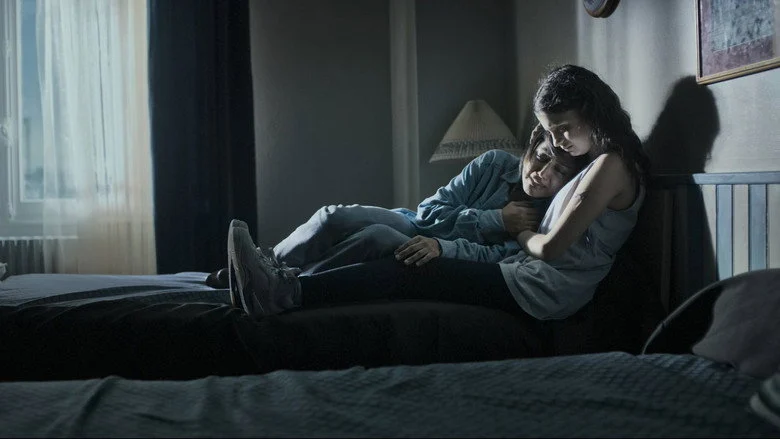
Uncle’s Compulsion: Tahar Rahim’s Vital Instability
Tahar Rahim, as Alpha’s drug-addicted uncle, enters the frame with a kinetic, almost feral energy. His performance is built on micro-expressions, a twitch, a slurred pause, that sell a man rotting from the inside out. His line, “The world is falling apart. We’re all sick, and no one wants to talk about it, ” lands with a bitter, prophetic weight, making him the film’s most potent, if underused, conscience.
An Empty Cinematic Frame: The Unfulfilled Promise
While the film explores the fragility of childhood and the terror of disease, its ambiguous resolution has left many critics cold, with complaints about pacing and secondary character development echoing across early reviews. The emotional journey is clear, but the destination feels frustratingly blurred, a problem that prevents *Alpha* from being more than a lean, interesting footnote in Ducournau’s filmography.
For a deeper dive into films that prioritize character over plot clarity, FR Drama reviews that explore similar emotional landscapes.
Ducournau is a director who makes you feel every cut, but here, her incision is exact yet shallow. *Alpha* is worth it for Boros and Rahim, but as a whole, it’s a fascinating, flawed stumble rather than a definitive step forward. Watch it for the performances and the haunting opening scene, but temper your expectations for a satisfying payoff.
For a more resolved mediation on loss within a family, read about flower she review.
Alpha is an intellectually rigorous but emotionally uneven 3 out of 5, a film to admire more than to love.
Compare this to the moral complexity of another flawed family drama by reading Lakshmikanthan Kolai verdict.