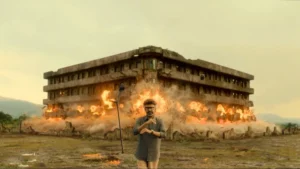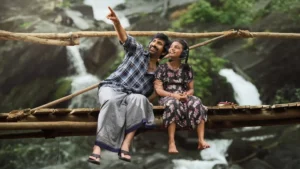
The hangman’s hand trembles. It hovers over the lever that will end a young man’s life, but the man himself seems uncertain whether he is executing a criminal or a scapegoat. This single image of hesitation, drawn out in painful silence, anchors Vetri Sudley’s Lakshmikanthan Kolai Vazhakku, a crime drama that aims for moral weight but stumbles over its own courtroom pace.
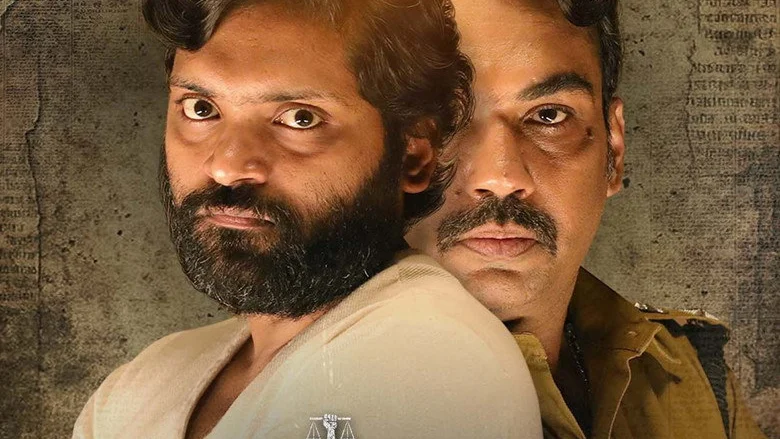
The Journalist as a Ghost: Vetri Sudley’s Hollow Presence
Vetri Sudley plays Lakshmikanthan, a journalist whose death sets the entire plot in motion. Yet the actor-director gives the role a subdued, almost spectral quality, more symbol than man.
His strongest moment arrives in the revelation scene, where his character’s past actions come to light through testimony. There is a quiet, effective menace in Sudley’s eyes, but the role feels underwritten. We never truly know Lakshmikanthan as a breathing man, only as a crime’s catalyst.
Rangaraj Pandey: A Villain Trapped Between Stardom and Guilt
As MK Thyagaraja Bhagavathar, a real-life actor accused of murder, Rangaraj Pandey delivers the film’s most layered performance. His exposure scene, where his role in Lakmikanthan’s death is unravelled, crackles with restrained fury.
Pandey plays Bhagavathar as a man shocked by his own capacity for violence, a creature of ego who cannot reconcile his public image with his private actions. It is a far better performance than the routine antagonist turn these roles usually receive. The casting signals a clear ambition: this is not a whodunit but a who-are-they.
Three Men in a Room: The Prison Scene That Stops the Film
The prison sequence, the hangman standing before the lever, the condemned man breathing in the next cell, the jailer looking away, is this film’s single genuine triumph.
Director Vetri Sudley stretches the moment without breaking it. The hangman does not speak, but his hesitation says more than any of the film’s memorably heavy dialogues. “Guilt does not sleep; it waits, ” he says later, but the visual of his trembling hand carries more weight than the words.
The scene works because it refuses to resolve quickly. Justice, the film seems to argue, is not a lever you pull, it is a weight you carry. For three minutes, this film earns its genre and its moral ambition.
If this kind of layered storytelling appeals to you, browse more Tamil Crime reviews for similar moral complexity.
The Supporting Cast: Conscience in Uniform
The judge, played by an unnamed actor, delivers the film’s most quotable line: “Justice is not blind; it is torn.” Yet the courtroom confrontation where he questions the conviction drags, a rare misstep in pacing that some critics have flagged. Slow courtroom scenes are the film’s most significant structural weakness, despite the character’s strong moral conflict.
The hangman, by contrast, needs no dialogue to command attention. His silence in the execution chamber is the film’s emotional core. The jailer, with his whispered observation “Truth is not hidden; it is buried, ” rounds out a trio of men forced to live with a decision that may be wrong. These characters are where the movie’s moral weight lives, not in the central murder plot, but in the quiet crisis of conscience among those tasked with carrying out the state’s final judgment.
Pacing Problems and a Rushed Climax
For a film that opens with such a strong prison image, the middle section suffers heavily from directorial indecision. The courtroom scenes drag, a complaint echoed by The Times of India in its 6.8/10 review, while the climax feels like it is sprinting to cover ground it ignored for an hour.
The screenplay, co-written by Vetri Sudley and Rangaraj Pandey, is linear with minor non-linear flourishes, but this structure only works if the pacing is balanced. It is not. The first half meanders; the second half rushes. I found myself wishing the hangman’s hesitation had been applied to the editing bay instead. Some plot points, particularly the young convict’s background, remain frustratingly underdeveloped, reducing his arc to a prop for the moral debates around him.
The background score is effective in building tension during the prison and revelation scenes, but the cinematography, while realistic, never transcends its functional prison-courtroom aesthetic. It looks like a true-crime re-enactment, appropriate but unmemorable.
None of these flaws destroy the film’s central ambition. Lakshmikanthan Kolai Vazhakku is a serious, deliberately paced attempt to examine what justice does to the people who administer it. But serious does not always mean gripping. Skip the multiplex; watch it on a streaming platform where you can pause and reflect. That is how this film breathes best.
The premise echoes the moral tensions of Bhaskara Bharanam review, though Sudley’s approach trades dark comedy for grim sobriety.
Lakshmikanthan Kolai Vazhakku earns a cautious 3 out of 5, a film that knows its questions far better than its answers.
Compare its slow-burn mystery with the narrative economy of Con City verdict to see how pacing determines engagement.