
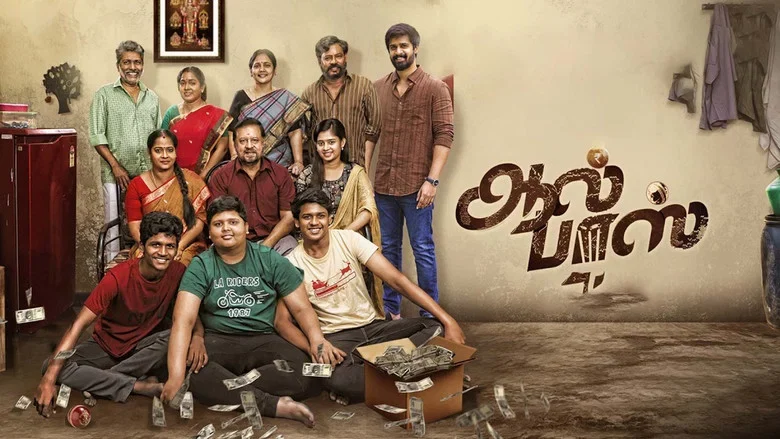
The three families of Sathya Nagar don’t share a house so much as a survival strategy, pooling rent and rice until the arithmetic of poverty starts to feel like kinship. Then someone finds five crore rupees, and the arithmetic changes.
When A Shared Kitchen Becomes A Ledger
Mydeen Pakkir Mydeen’s film opens as a study in domestic compression. Three North Chennai households, pushed together by rent and circumstance, negotiate the daily friction of one bathroom, one stove, one television. The direction keeps its camera inside these rooms and rarely leaves.
That claustrophobia is the point. When money is scarce, proximity breeds cooperation; the film understands this without ever stating it, letting the geography of the house do the arguing. It’s the same instinct that drove the ensemble dynamics in Jailer 2, though here the stakes are rent, not revenge.
The Discovery That Rewrites Every Relationship
The ₹5 crore doesn’t arrive as a windfall; it arrives as a verdict. The younger members find it, hide it, and immediately begin calculating what it means for them specifically, not for the household. The film’s second act is essentially a slow-motion audit of every relationship the first act built.
What’s smart here is the refusal to invent a villain. The antagonist is the money itself, and the suspicion it manufactures in people who were, minutes earlier, passing each other plates of rice. Sharath Lohitashwa’s presence in the ensemble adds a generational weight to the paranoia, though the screenplay never quite gives him a scene to own.
Performance Anchors In A Crowded Household
Dushyanth Jayaprakash carries the film’s emotional spine as the young man caught between loyalty to the collective and the gravitational pull of personal gain. His best work happens in stillness: a pause before answering a question about the money, a glance at a locked door that lingers a beat too long.
Janany Kunaseelan matches him in the quieter domestic register, registering the shift from trust to calculation through small physical withdrawals rather than dialogue. It’s the kind of restrained work that recalls the dual-role discipline demanded in Magudam, where performance had to do the heavy lifting the script couldn’t.
Where The Direction Loses Its Nerve
The first hour is a problem. Mydeen Pakkir Mydeen spends too long establishing the household’s rhythms before introducing the money, and the pacing sags under the weight of domestic logistics. By the time the discovery lands, we’ve already spent forty minutes watching people share a kitchen.
The second half recovers, but the recovery is uneven. The confrontation scenes are staged with a theatrical simplicity that undercuts the moral complexity the script is reaching for, and the resolution arrives with more tidiness than the setup deserved. The film wants to be a moral fable but settles for a lesson.
What The Camera Refuses To Do
There’s a deliberate flatness to the visual approach here, a refusal of stylization that keeps the drama grounded but also keeps it small. The shared house becomes the film’s entire visual vocabulary, and while that’s thematically coherent, it also means the film never finds an image that lingers after the credits.
The editing in the first half is the real culprit. Scenes run past their natural exit points, and the accumulation of domestic detail starts to feel like padding rather than texture. The second half tightens considerably, suggesting the material was always there, just buried under a slower rhythm than necessary.
The Commercial Arithmetic Of A Small Drama
One Step Entertainment and producer Mohana R. have backed a film that knows its ceiling. The ₹0.11 crore worldwide gross after seven days, per trade listings updated 15 October 2026, confirms what the release pattern suggested: this is a film made for a specific audience in a specific market, not a breakout.
The theatrical franchise math here is brutal. A 124-minute family drama with no star anchor and no franchise hook is fighting for screens against bigger releases, and the numbers reflect that fight. The film’s future is almost certainly in digital streaming spaces cataloged on Filmy4wap, where its patient character work might find the viewers who skipped it in theaters.
What’s worth noting is that this kind of modest, regionally specific drama continues to get made at all. The appetite for stories rooted in North Chennai’s social fabric, for ensemble narratives about economic precarity, remains a quiet constant across contemporary Tamil dramas even when the box office doesn’t reward it.
The Moral Is Smaller Than The Setup
The film’s final movement asks whether the household can survive the money, and the answer it offers is gentler than the conflict warranted. After all the suspicion and the locked doors and the whispered arguments, the resolution feels like a truce rather than a reckoning.
That’s the gap at the heart of All Pass. It sets up a genuinely uncomfortable question about whether solidarity is possible when resources are finite, then retreats from the discomfort. The result is a film that’s easier to admire in its parts than in its whole, a drama that understands its characters better than it understands what to do with them.
The families of Sathya Nagar will probably be fine. The film, unfortunately, doesn’t trust us to sit with the possibility that they might not be.






1 thought on “All Pass (2026): Dushyanth Jayaprakash Anchors A Modest, Muddled Money Drama”
Comments are closed.