
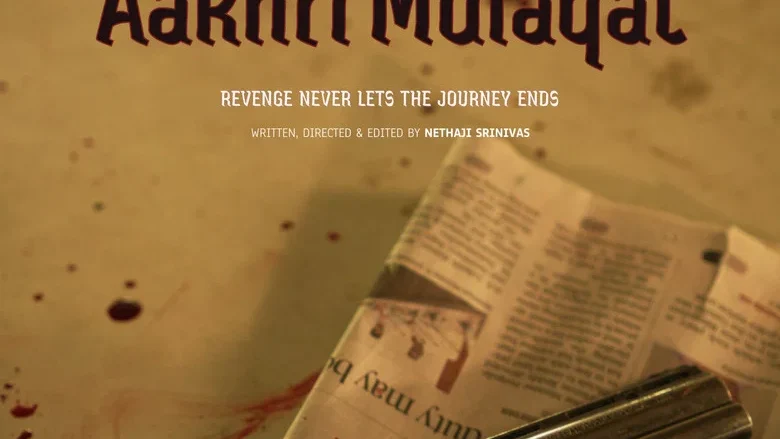
Nethaji Srinivas opens Aakhri Mulaqat on a city that feels less like a place than a police file, all fluorescent corridors, backroom deals, and the low hum of a racket nobody wants to name. The film wants to be a pressure cooker: a photojournalist, a counterfeit-antibiotics syndicate, and two gangs tearing each other apart over the spoils.
It ends twenty-seven minutes later, and the pot never quite whistles.
A Photojournalist As Plot Device, Not Person
NC plays Aravind, the lensman whose investigation into illegal fake antibiotics serves as the film’s narrative spine. The premise is genuinely promising, counterfeit medicine as a public-health crime gives the story a moral stake that most Telugu crime thrillers ignore in favour of body counts.
But Aravind never becomes a character. He becomes a function. He asks questions, he follows leads, he gets closer to the truth, and at no point does the screenplay tell us why he cares, what he risks, or what he stands to lose.
The result is an investigator without interiority, a camera with legs. When the gangs close in, the threat lands on the plot rather than on the man, and that is a structural failure no amount of tight editing can paper over.
Two Gangs, Zero Faces
The rival factions are described as being driven by greed and revenge, which is less a motivation than a placeholder. We are told there are two gangs. We are told they are violent. We are told they are escalating.
What we are not given is a single memorable face, a signature gesture, a line of dialogue that reveals how one gangster differs from another. Venkatesh Prasad and Rohan Kakani are credited as Hameed and Bashir respectively, but the film gives them no room to register as distinct threats.
Compare this to the slow-burn character architecture of Ranabaali, which understood that a revolt only matters if you know the people revolting. Here, the gang war is a rumour we are asked to fear.
The 27-Minute Problem: Compression Is Not the Same as Discipline
Short-form crime storytelling can be electric. A tight runtime forces every scene to earn its place, every line to carry weight, every cut to advance the clock. When it works, it feels like a punch.
Aakhri Mulaqat does not feel like a punch. It feels like a trailer for a film that was never made. The racket is established, the gangs are introduced, the investigation begins, and then the credits roll before any of it has had time to breathe.
The film mistakes brevity for tension. It assumes that because we are moving fast, we must be gripped. But speed without stakes is just motion, and motion without character is just noise.
What the screenplay needed was not more minutes but more specificity, one scene where Aravind’s investigation costs him something personal, one confrontation where a gangster reveals a flicker of humanity, one moment where the counterfeit medicine kills someone we have met.
Where the Camera Goes Quiet
Srinivas shows glimpses of spatial intelligence. The film favours cramped interiors and shallow depth of field, keeping faces close and backgrounds blurred, a visual strategy that mirrors Aravind’s tunnel vision.
But the technique is applied uniformly, without modulation. There is no contrast between the investigative scenes and the gang-war sequences, no shift in rhythm or palette that tells us we have crossed from one world into another.
The sound design leans on ambient hum and distant traffic, which works in isolated moments but never builds into a sustained atmosphere. The film is not badly shot. It is simply shot without a point of view.
This is a missed opportunity. The moral fallout of exposing a racket that kills people slowly is exactly the kind of unresolved tension that gave My Dear Stranger its unsettling aftertaste. Aakhri Mulaqat gestures at that discomfort but never sits in it.
The Supporting Cast as Decoration
Gorli Sai Kumar appears as Inspector Vikram Kumar, representing the law-enforcement strand, but the film never gives him an arrest, an interrogation, or a moral dilemma. He is a uniform in a frame, not a character in a story.
The same is true of the constable played by P. S. Vamsi Dheeraj, and of Harsh Raj Gond’s Sameer. These are credits, not performances. The actors are present. Their characters are not.
This is not a knock on the performers. It is a knock on a screenplay that treats its supporting cast as set dressing, bodies to fill a scene, names to pad a call sheet.
Even the devotional sincerity that anchored Hanuman Ansh, a film with its own structural problems, understood that belief requires a face to believe through. Aakhri Mulaqat never finds that face.
The Studio Calculus: A Short Film With No Theatrical Future
There is no verified production banner attached to Aakhri Mulaqat, and that absence tells its own story. A 27-minute Telugu crime thriller with no star anchor, no theatrical marketing push, and no verified box-office data is not a theatrical proposition. It is an OTT listing aimed at fast digital rotations popularized across filmyfly portals.
The film’s reported release date of 15 October 2026 places it in a crowded streaming window where it will compete not with other films but with the viewer’s thumb. And a viewer scrolling through options will not stop for a crime thriller that promises gang warfare and delivers twenty-seven minutes of setup.
The larger franchise question is whether this format, the short-form Telugu crime film, has any commercial sustainability. On this evidence, the answer is no. Not because short films cannot work, but because this one does not.
What the market needs is not more compressed crime stories. It needs more contemporary Telugu thrillers that understand the difference between a tight runtime and a thin one.
The Verdict: A Film That Ends Before It Begins
Aakhri Mulaqat is not a bad film. It is an incomplete one. It has a premise worth exploring, a genre worth respecting, and a runtime that could have been an asset if the screenplay had used it to sharpen rather than abbreviate.
Instead, it gives us a photojournalist without a past, gangsters without faces, and a public-health crisis without a single moment of human cost. It asks us to care about a racket that kills people, but never shows us the people it kills.
The final scene arrives not as a climax but as a shrug, a resolution that resolves nothing, a confrontation that confronts no one. The film ends, and the only question left is why it began.
There is a version of this story that could have been devastating. A version where Aravind’s investigation destroys his life. A version where the counterfeit antibiotics kill a child we have met. A version where the gang war has a winner and a loser, not just a fade to black.
That version is not on screen. What is on screen is a sketch. And sketches, however promising, are not films.






1 thought on “AAKHRI MULAQAT (2026): A 27-Minute Crime Thriller That Mistakes Brevity For Tension”
Comments are closed.