The son sits in the dark, voice trembling with years of silenced rage, recounting how his father hit him for every childhood mistake. The opening narration of Bhaskara Bharanam lands like a gut punch, immediately establishing a world where love and violence share the same cramped house.
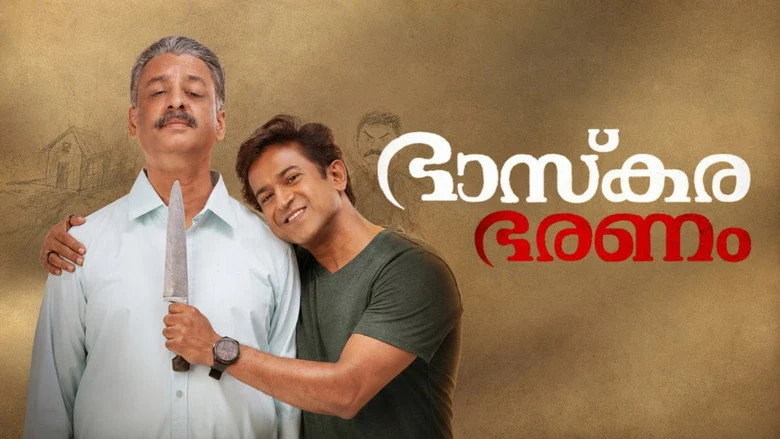
Roopesh Peethambaran as Both Father and Son
Peethambaran shoulders a staggering dual burden, directing himself as both the aging patriarch Bhaskara and the vengeance-filled son. The raw intensity he brings to the opening monologue makes you forget he is performing both sides of a trauma. His delivery of “Daddy, when I made mistakes as a child, you would scold me and hit me!” carries the weight of years.
Yet the performance never tips into melodrama. Peethambaran balances comedic and dramatic registers, especially in scenes where the son observes that no one corrects the father out of pure fear.
A Tight Directorial Hand That Needs Sharper Edges
Roopesh Peethambaran’s direction effectively blends dark comedy with thriller tension, creating a claustrophobic atmosphere where every family meal feels like a loaded gun. The screenplay’s linear focus on father-son conflict avoids unnecessary subplots.
But the limited critical feedback on pacing suggests the film could benefit from trimming. The undisclosed runtime leaves questions about whether the second half builds momentum or sags under repetitive confrontations.
Dark Comedy Meets Dysfunctional Family Drama
This is where Bhaskara Bharanam distinguishes itself from generic Malayalam family dramas. The dark comedy springs from uncomfortable truths: the son’s observation “But when you make mistakes, no one speaks up; everyone is afraid of you” is both funny and devastating. Um Kumarpuram’s cinematography emphasizes the emotional distance through cramped frames and shadowed faces.
The thriller elements emerge in the climax confrontation, where tension snaps rather than builds. Arun Thomas’s background score supports both tones, though it leans heavier on the comedic register during the first half. The thematic line “It’s all about loving your father” feels earned only if you survive the uncomfortable middle stretch.
What the film lacks in plot complexity, it compensates with emotional specificity. The son’s childhood trauma is not abstract trauma but specific, quotidian abuse that any Malayali household might recognize. That specificity is the film’s sharpest weapon.
Supporting Cast Adds Texture to Tension
Sonika Meenakshi provides a key female perspective in this testosterone-heavy dysfunction, though her role remains underwritten in available plot details. Jishnu Mohan adds depth to the Act 2 interpersonal conflicts, bringing a lighter register that prevents the film from suffocating entirely.
Ajay Pavithran and Midhun K. Das appear to function as reactive presences, their characters shaped by the father-son gravity. Ann Mol Jibeesh and Parvathy Kalarikkal round out a cast that signals the film’s intent: this is an ensemble drama about how families enable abuse through silence. For a more nuanced look at how family comedies handle structural dysfunction, browse our Malayalam Comedy reviews.
Audience Reception and the Teaser Wave
Social media sentiment around the teaser was overwhelmingly positive, particularly for the raw emotional delivery and the unusual choice of a dark comedy-thriller in mainstream Malayalam cinema. However, post-release audience reviews remain thin, and no IMDb or BookMyShow scores have registered yet.
The lack of detailed plot information before release may have limited the film’s opening, but the teaser’s “big reception” online suggests strong word-of-mouth potential. One first-person observation: this is a film that demands patience from viewers who expect tidy resolutions.
Bhaskara Bharanam is a rough, uneven watch best suited for those who appreciate dark comedy that doesn’t flinch from the ugly sides of family love. If you walked away from Peethambaran’s earlier works like Theeviram wishing for more emotional specificity, this delivers. Watch it in a regular theater where you can sit with the discomfort.
The film earns a raw, honest 3 out of 5, commendable for its nerve, frustrating for its untidy edges.
For a film that similarly examines structural dysfunction through comedy, check out Con City review.
And if uneven tonal registers interest you, Heartin verdict offers a comparable exercise in patchy audience engagement.