
A receipt printer gets struck by lightning in a bustling middle-class home, and suddenly it begins spitting out genuine ₹500 notes. That opening moment is the film’s most confident, quirky, visually specific, and tonally precise.
Arjun Das stands over the machine, confused, as a mundane appliance transforms into a family’s chaotic lifeline. Director Harish Durairaj executes this premise with the kind of grounded absurdity that promises a sharp crime comedy.
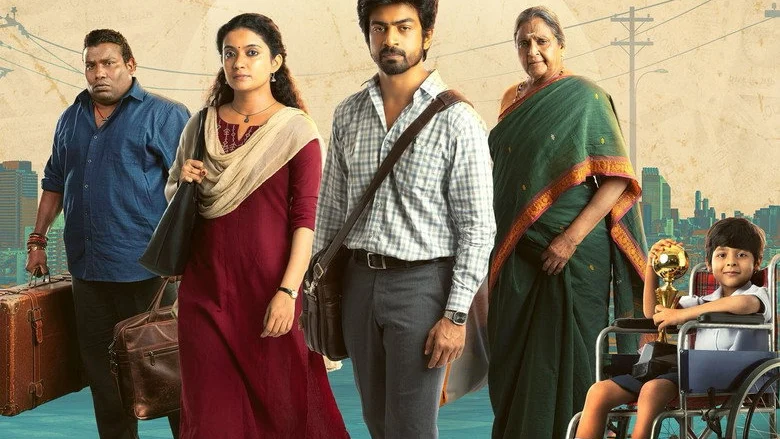
Arjun Das Makes Middle-Class Despair Feel Immediate
Arjun Das plays the struggling father with a weathered restraint that suits the film’s first hour. His emotional register shifts convincingly from bewildered amusement during the printer discovery to raw desperation when young Jeeva is kidnapped.
One scene where he examines a ₹500 note under dim kitchen light, turning it over again and again, speaks volumes about how a man processes impossible luck. Anna Ben matches him beat for beat as the family’s moral anchor, her performance carrying the weight of difficult decisions without ever feeling preachy.

Harish Durairaj’s Debut Balances Intrigue Against Inconsistency
Durairaj’s screenplay has a clear structural ambition, a linear narrative that dips into the family’s past to explain the kidnapping stakes. The first half moves briskly, building comedic momentum as society discovers the miraculous printer and descends into public chaos.
The weakness lies in the antagonist. The kidnappers remain nameless silhouettes with no distinct motivation, robbing the central conflict of dramatic friction. Without a memorable villain, the family’s rescue mission feels like a padded obligation rather than an emotional climax.
I found the mechanics of the money generation left frustratingly vague, suggesting either a deliberate supernatural shrug or a gap Durairaj couldn’t patch. Either way, it undermines the film’s otherwise grounded world-building.
When Comedy Meets Kidnapping, the Tone Breaks
The transition from the printer’s absurdist comedy to a child kidnapping plot arrives with the grace of a slammed door. One moment characters are laughing over free cash; the next, they are confronting a traumatic past.
The tonal whiplash is not inherently flawed, several films navigate such shifts, but Durairaj lacks the structural glue to make it feel organic. Scenes that should land as tense family drama instead feel disconnected from the lighter first act, as if two different movies were edited together.
Sean Roldan’s background score tries to bridge the gap, lending warmth to the comedy and urgency to the crime beats. But the writing itself doesn’t give the music enough to anchor.
For more films that dare strange premises but stumble in execution, browse our Tamil Crime reviews.
Yogi Babu and Vadivukkarasi Anchor the Margins
Yogi Babu delivers reliable comic relief, particularly in a sequence where he tries to convince the family to print more notes at night. His timing remains sharp, even when the script loses focus around him.
Vadivukkarasi gets fewer lines but contributes significantly to the emotional gravity of the family’s hidden past. Her presence in a flashback scene quietly suggests generational trauma that the plot never fully explores, a missed opportunity that signals Durairaj’s crowded screenplay.
Akhilan, as a supporting family member, registers efficiently but lacks a standout moment to elevate his role beyond narrative convenience.
Audience Reception: A Divided Room
No political controversy surrounds the film, which is refreshing given how many Tamil releases court it. Instead, public reaction has focused on the film’s identity crisis. Audiences praise the original concept and the leads’ performances, but complaints about inconsistent tone and weak villain portrayal dominate discussion threads.
The bookMyShow comments highlight how the middle act confuses more than it engages, a lethal flaw for a film that runs 2 hours 32 minutes. If the premise hooks you, the second half may test your patience.
Final Verdict: A Promising Debut That Can’t Quite Print Its Vision
Con City is worth a watch for anyone curious about what happens when a director takes a madcap idea seriously, but temper expectations for the back half. See it in a regular theatrical screening, where the sound design and Sean Roldan’s score land best, and don’t expect the consistency that a tighter edit might have delivered.
Harish Durairaj’s debut has enough craft in its first hour to earn a mild recommendation, but Con City ultimately prints more promise than payoff, a generous 2.5 out of 5.
Those who appreciate Arjun Das’s intense vulnerability might also enjoy Heartin review.
Fans of crime-tinged family dramas should check out Uyir verdict.







1 thought on “Con City (2026): A Money-Printing Printer That Can’t Fix Its Own Plot”
Comments are closed.