
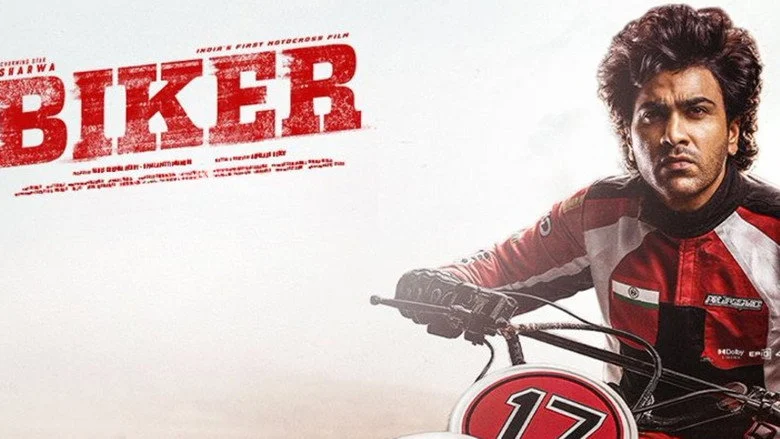
Sharwanand has spent the better part of a decade being Telugu cinema’s most reliable sad-eyed charmer, a leading man who can sell a heartbreak with nothing more than a downward glance. So there is a certain logic to casting him as Vicky, a motocross prodigy who walks away from the sport after a crash and spends the rest of the film being coaxed back onto the bike. The problem with Abhilash Reddy Kankara’s Biker is not the casting. It is that the film keeps cutting away from the one thing that justifies its existence, the racing, in favour of conversations about the racing.
For a film that staked its entire marketing identity on being “India’s first motocross-based sports drama, ” the ratio is damning. You get a strong opening act establishing Sunil Narayan (Rajasekhar) as a former rider who never got his due, and his son Vicky as the vessel for that deferred dream. You get a genuinely well-staged crash. And then, somewhere around the hour mark, the film decides it would rather be a drawing-room drama about paternal expectation, and the engines go quiet for long, punishing stretches.
Sharwanand Does The Heavy Lifting, And Then Some
What holds the middle section together, barely, is Sharwanand himself. The role demands he play two distinct modes: the coiled physicality of a rider mid-race, and the slumped, defeated posture of a man who has convinced himself he is done. He nails the second far better than the first, which is telling. Watch the scene where Vicky finally admits to his father that he is afraid of the bike. Sharwanand plays it not as melodrama but as a kind of quiet shame, shoulders dropping, eyes flicking away, voice flattening into a register that suggests he has rehearsed this confession a hundred times in his head. It is the film’s single best moment, and it belongs entirely to him.
The staging around him, though, is curiously inert. Kankara frames the father-son confrontations in flat, symmetrical two-shots that give the actors nowhere to hide and no visual tension to work with. Compare this to how the racing sequences are shot, low-angle, kinetic, with the camera mounted close enough to the handlebars that you feel the vibration. The gap between the two visual languages is so wide it starts to feel like two different films stitched together.
Rajasekhar’s Father, And The Melodrama Problem
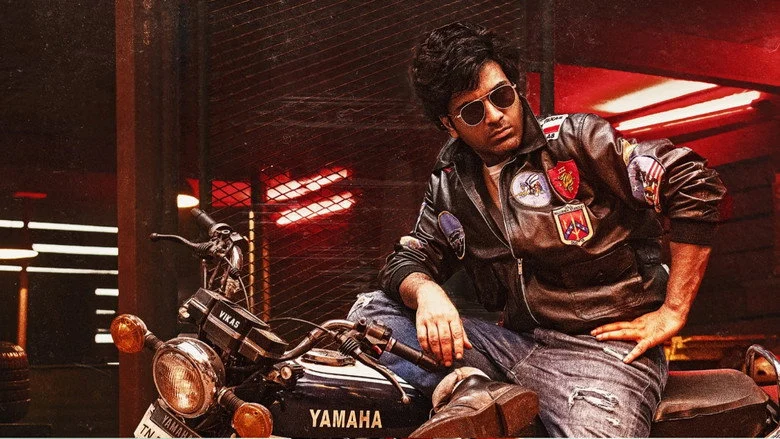
Rajasekhar, returning to a substantial screen role, does what he can with Sunil Narayan, but the script saddles him with the film’s most exhausted trope: the father who lives vicariously through his son and cannot articulate love without framing it as obligation. There is a scene late in the second half where Sunil tells Vicky that the dream was never his own, it was for the family. It is meant to land as a revelation. It lands as a line you have heard in every sports drama since Chak De India.
This is where Biker most clearly loses its nerve. The premise, a dangerous sport, a son who nearly dies, a father who cannot let go, contains genuine moral friction. But the screenplay keeps resolving that friction with speeches rather than consequences. Malavika Nair’s love interest exists almost entirely as a pressure point, a human embodiment of the “choose safety” argument, and she is given so little interiority that her scenes play like interruptions rather than stakes.
The Racing Is Good. There Just Isn’t Enough Of It.
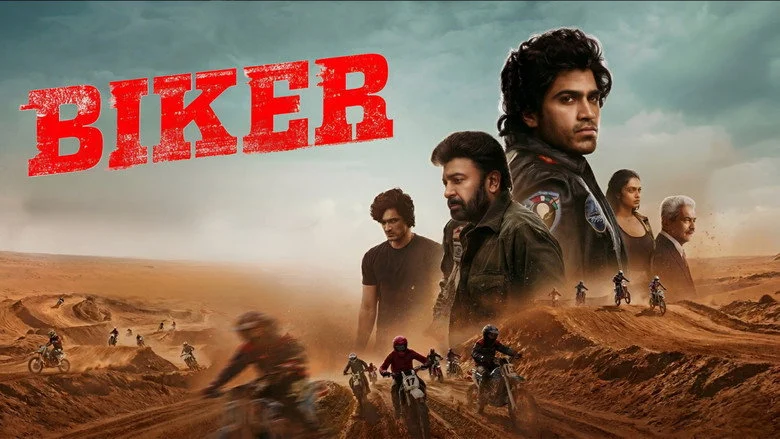
When Biker actually commits to its genre, it works. The competition sequences are shot with real physicality, dust plumes, engine roar, the specific geometry of a rider leaning into a berm at speed. There is a mid-film race that builds genuine tension through editing alone, cross-cutting between Vicky’s visor and his father’s face in the stands without a single line of dialogue. It is the film Biker could have been: lean, propulsive, emotionally legible through action rather than exposition.
Instead, the back half keeps retreating into drawing rooms. India Today’s assessment that there is “less sport and too much drama” is not just accurate, it is the film’s structural fatal flaw. A 2-hour-42-minute runtime for a sports drama is already generous. When a significant chunk of that runtime is devoted to characters discussing whether the protagonist should race, rather than actually racing, the audience’s patience becomes the real casualty.
Where The Film Sits In The Wider Landscape
It is worth noting that Telugu cinema has been unusually receptive lately to genre experiments that fold familiar emotional templates into unfamiliar milieus. For a sense of how that balance can be struck more successfully, our review of Hanuman Ansh review examined a film that understood its own register and committed to it without apology. Biker, by contrast, seems uncertain whether it wants to be a racing film or a family melodrama, and the result is a film that is never quite either.
There is also a tonal comparison to be drawn with Modha Rathri verdict, which managed to balance broad emotional beats with a clear-eyed sense of its own genre obligations. Biker has the ingredients for that kind of balance, a strong lead, a novel subject, a technically capable crew, but lacks the discipline to prioritise them. As we frequently examine across Telugu Drama reviews, the difference between a good genre film and a frustrating one is often just knowing what to cut.
Verdict
Biker is not a bad film. It is a film that keeps getting in its own way. Sharwanand delivers a genuinely committed performance, the motocross sequences are legitimately well-mounted, and the father-son conflict has enough weight to sustain a tighter, leaner version of this story. But at nearly three hours, with the drama-to-sport ratio skewed heavily toward the former, it becomes a test of endurance rather than an adrenaline rush.
Watch it if you are a Sharwanand completist, a fan of family dramas with a sports backdrop, or curious about Telugu cinema’s first serious attempt at motocross. Skip it if you want a racing film that actually races.
Rating: 2.5/5



1 thought on “Biker (2026): Sharwanand Anchors A Motocross Drama That Keeps Stalling Out”
Comments are closed.