
On its opening day, Hanuman Ansh collected roughly ₹10 lakh against a budget of about ₹2 crore. By the time its theatrical run had properly stretched its legs, trade trackers were logging figures north of ₹300 crore in India nett and an international cume brushing ₹389.85 crore. That is not a box-office trajectory; that is a theological argument. Vishal Chaturvedi’s devotional biopic, written, produced and directed by him under the Swambhu Media Network banner, did not muscle its way into the cultural conversation with a marketing blitz. It simply refused to leave, letting word of mouth do the work that a conventional launch campaign never did.
This is the rare Hindi theatrical release where the film’s commercial story and its spiritual one are structurally identical: a small, unshowy thing that keeps going because people keep feeding it.
Shobhinaw Satyaa And The Two Lives Of Lakshmi Narayan
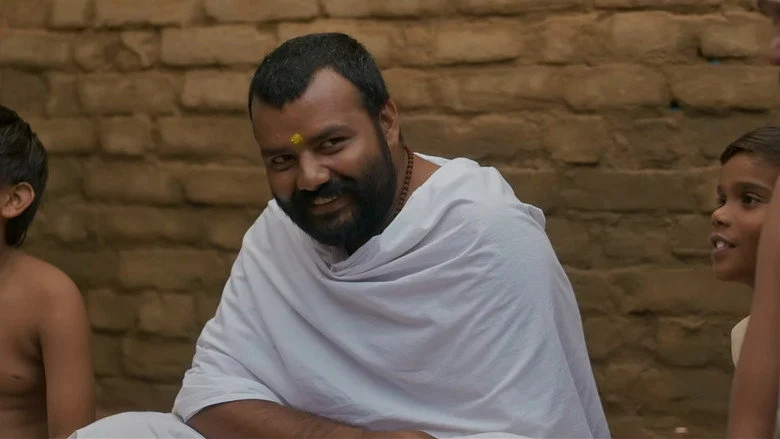
The film’s central gamble is a performance that must house two entirely different human beings inside one body. Shobhinaw Satyaa plays Lakshmi Narayan as a boy in present-day Uttar Pradesh, and Neem Karoli Baba as the revered guru he becomes. The role is built on a dual life-stage structure, and Satyaa’s work lives or dies on whether the audience believes the same soul is present in both.
He is most exposed in the opening grief sequence. The staging here is deliberately unadorned, the camera holds on the boy after his mother’s death as he begins asking questions about life, death and God that no one around him can answer. Satyaa plays the loss not as hysteria but as a kind of stalled stillness, a child who has stopped participating in the world while his mind runs somewhere else entirely. It is the correct choice. A more theatrical reading of that scene would have turned the film’s spiritual foundation into melodrama, and the rest of the runtime would have had nowhere to build from.
What Satyaa does in the back half is subtler and, frankly, harder. The transformation sequence, where Lakshmi Narayan becomes Neem Karoli Baba, is the film’s defining turn, and it is handled as an accumulation rather than an event. There is no thunderclap, no cinematic coronation. The authority arrives gradually, in the way the character begins to occupy space differently, in a settled quality that creeps into the voice. Whether that registers as revelation or anticlimax will depend entirely on how much patience you brought into the theatre.
Pilgrimage As Structure, Service As Plot
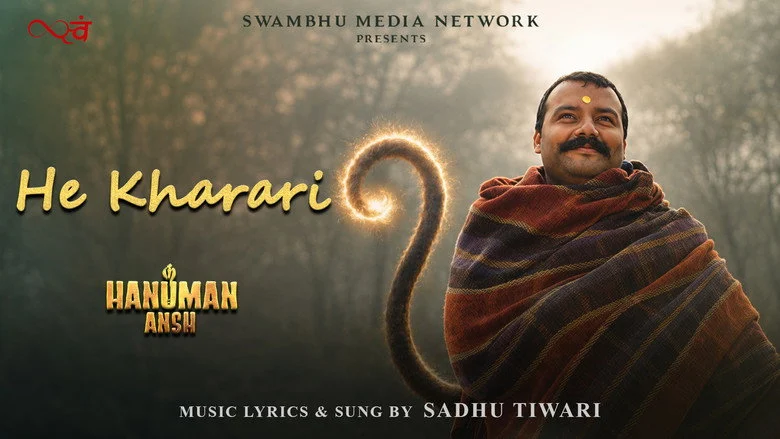
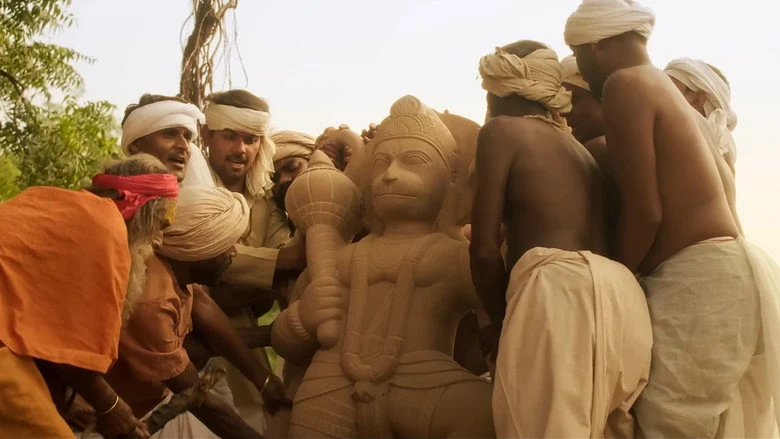
The most praised stretch of the film is also its least conventional: the sustained spiritual-travel portion, in which Lakshmi Narayan moves across North India and encounters saints, devotees and ordinary people. Chaturvedi’s screenplay is broadly linear and, crucially, encounter-based rather than confrontation-based. There is no named antagonist in this film, and that is not an oversight, it is the architecture.
Instead of a villain, the film runs on motifs: service, prayer, food-sharing, and the repeated devotional refrain of “Ram Ram.” The narrative logic is that a person is shaped by the accumulated weight of everyone he meets and feeds. The film’s stated creed, love everyone, feed everyone, chant “Ram Ram”, is not dialogue so much as a structural principle. Each encounter is a small deposit; the transformation is the interest that accrues.
This is where the film’s pacing problem lives, and it is worth being honest about it. The first half is slow in a way that shows up in the numbers: a modest opening, weak traction through the first two weeks. The second half, by contrast, benefited from markedly stronger audience engagement as the spiritual arc tightened. That split is not incidental. The early section is doing biographical setup with grief as its engine, and grief is not a plot. The later section has the payoff of an identity forming, and audiences evidently responded to the difference.
The ₹2 Crore Question
What Chaturvedi has pulled off here is genuinely unusual within mainstream Hindi theatrical releasing. A devotional biopic with no conventional commercial launch, a first-day figure that would normally signal a two-week exit, and a production budget that most films spend on their opening song, and it became a major grosser anyway. The trade coverage has consistently framed this as an underdog story, and for once the framing is accurate rather than promotional.
The film’s spiritual-biographical premise was treated as distinctive precisely because it wasn’t chasing the usual tentpole grammar. It frames its subject as a saintly life story, not a political or public-figure biography, and it reinforces its devotional identity through service and food-sharing rather than through dramatic set pieces. That restraint is the film’s identity and, depending on your disposition, either its greatest virtue or its most punishing quality.
For a different angle on how 2026’s smaller Indian releases are faring with audiences, our review desk recently looked at Modha Rathri review, which takes an almost opposite approach to earning its emotional payoffs.
What The Film Doesn’t Have
Anyone walking in expecting antagonist-driven drama should walk back out. There is no villain here because the film isn’t structured around one, and the absence is felt most acutely in the middle stretch, where a more conventional screenplay would have inserted friction to keep the engine running. The supporting cast, Chandan Anand, Vihaan Shedge, Purnima Tiwari, Anil Rastogi, Gulshan Pandey, Bhagvandas Patel, is listed in the principal credits, but the available material offers no role-specific detail on any of them, which itself tells you something about how the film distributes its attention. This is a one-performance architecture, and everything else is scaffolding.
The international rollout was delayed to 11 September 2026, with overseas distribution handled by Hombale Overseas and Phars Film. That delay is the only notable production-side development documented around the release; there is no political controversy, no censorship friction, no casting scandal. The film’s story is the film’s story.
For a counterpoint on how a 2026 youth-oriented release handled its own tonal ambitions, see our take on Epic First verdict.
Verdict: A Slow-Burn Devotional That Earns Its Second Half
Hanuman Ansh is not a film that grabs you. It accumulates you. Shobhinaw Satyaa’s dual-stage performance is the load-bearing wall, and the film’s willingness to build its spiritual arc through encounters, food and repetition rather than conflict is either its signature achievement or its chief liability, depending on the viewer. The first half drags in ways the box office numbers confirm; the second half justifies the patience it demanded.
Family audiences, class viewers, and anyone drawn to saint biographies or faith-centered cinema will find a great deal here. Viewers who need a conventional antagonist, propulsive pacing, or action will find the runtime punishing. Watch it in a regular theatrical setting, there is no IMAX advantage to chase, and the film’s intimacy plays better at standard scale.
Rating: 3.5/5





2 thoughts on “Hanuman Ansh (2026): Shobhinaw Satyaa Anchors A Devotional Biopic That Earns Its Miracles”
Comments are closed.