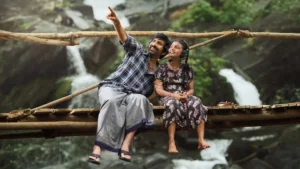
Chidambaram opens his follow-up to Manjummel Boys not with a jailbreak but with a delivery. Inside a women’s central prison, a baby is born to an inmate, and the film’s entire thesis arrives in that single image: this child’s life will be defined by walls, by watchfulness, by the constant threat of being found. It is a cold, brilliant opening gambit.
The mother, Indhu, played by debutant Farzana Palathingal, immediately becomes the film’s engine. She isn’t a heroine in the traditional Malayalam sense. She is a woman in survival mode, and the film respects her enough to never soften that into sentimentality.
What follows is a childhood spent in transit. New names, new towns, new lies. The film treats identity as a disposable garment, something you shed the moment it starts to smell like danger.
Adhisheshan K. R. And The Architecture Of Innocence
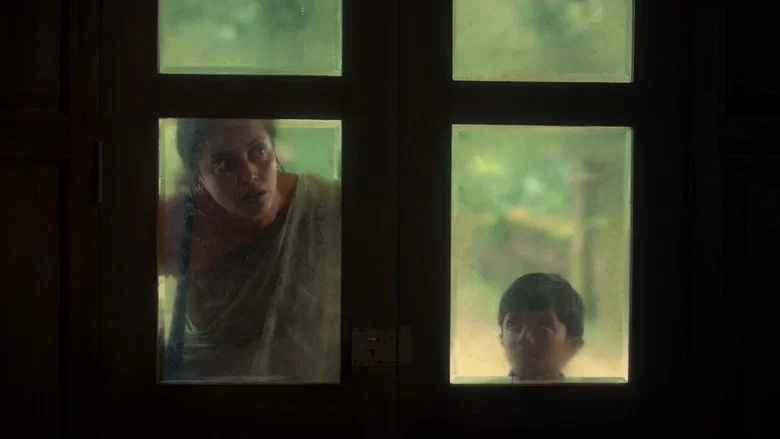
The younger Balan is played by Adhisheshan K. R., and his work here is the film’s most quietly devastating asset. He doesn’t perform vulnerability; he inhabits it. Watch the way he studies his mother’s face in the early relocation sequences, reading her fear before she has spoken a word. That is not child-actor instinct. That is craft.
When Muhammed Zinaan takes over as the older Balan after the separation, the film shifts register. The innocence curdles into something harder, more searching. The dual casting is not a gimmick. It is a structural argument about how trauma rewrites a person.
Palathingal, meanwhile, carries the emotional weight of a woman who has built her entire existence around a single imperative: keep the boy alive. Her best moments are not the big confrontations but the small ones, a hand on a doorframe, a glance over a shoulder at a bus stop.

Sushin Shyam’s Score And The Discipline Of Silence
The technical package here is formidable. Cinematographer Shyju Khalid shoots the Wayanad locations with a muted, almost documentary texture, and Sushin Shyam’s score understands when to disappear entirely. The prison childbirth sequence works precisely because Shyam withholds. No swelling strings, no manipulative crescendo. Just breath, ambient sound, and the terrible intimacy of the moment.
That restraint is the film’s signature. Chidambaram and co-writer Jithu Madhavan have built a thriller that trusts negative space. The threat is never a man in a frame. It is the absence of safety, the way a phone ringing at the wrong hour can collapse an entire life.
For a comparable study in how procedural dread can smother its own moral centre, our review of Valluvan traced a similar tension between atmosphere and resolution.

Where The Withholding Becomes A Problem
And then the film’s discipline curdles into evasion. Editor Vivek Harshan keeps the first half taut, but the back stretch, built around Balan’s search for his vanished mother, starts to feel like a mystery that has forgotten to plant its clues. The opacity that felt purposeful in Act One begins to read as indecision.
This is not a collapse. It is a drift. The film “impresses for the most part, ” as the survival-drama framing holds, but the resolution leaves questions dangling that feel less like ambiguity and more like unfinished business. A psychological thriller can withhold answers. It cannot withhold purpose.
The supporting ensemble, including Jean Paul Lal as Pavithran and Dolly June as Ammamma, is largely relegated to functional presence. They occupy frames without shaping them. The drama lives entirely in the mother-son axis, which is both the film’s greatest strength and its structural limitation.
For a contrasting case of a comedy that similarly can’t locate its own centre, see our take on Hai Jawani Toh Ishq Hona Hai.
The Verdict: A Beautifully Built House With One Missing Wall
Balan: The Boy is a genuine achievement in performance-led Malayalam cinema. Adhisheshan K. R. delivers a child performance of unusual gravity, and Palathingal announces herself as a serious dramatic presence. Chidambaram’s control of tone remains impeccable.
But the film’s refusal to close its own loops is not sophistication. It is a hole in the roof. You can admire the architecture and still feel the rain.
Watch it if you value atmospheric, performance-driven drama and can forgive an unresolved ending. Skip it if you need your thrillers to pay off their own setups.
Rating: 3/5