
David Dhawan opens his new film the way he has opened a dozen others: a domestic squabble staged as a punchline, the camera lunging in on a face mid-shout, and a soundtrack that elbows the audience in the ribs before a single joke has landed. It is a signature, and signatures calcify. Within ten minutes of Hai Jawani Toh Ishq Hona Hai, you can feel the filmmaker reaching for a comic grammar he perfected three decades ago and finding, uncomfortably, that his hand no longer closes around it.
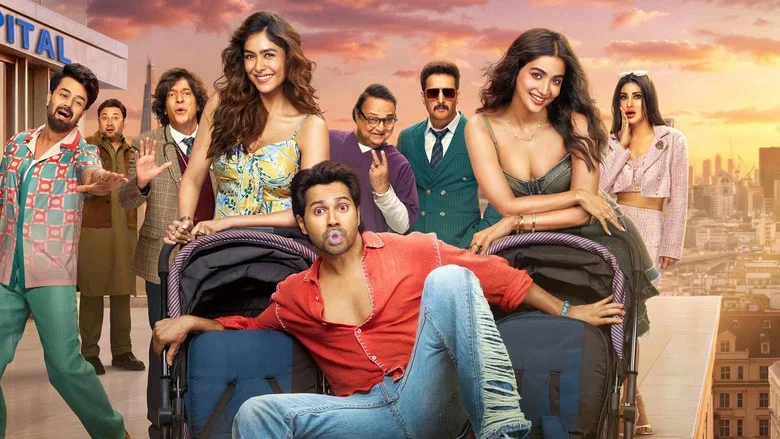
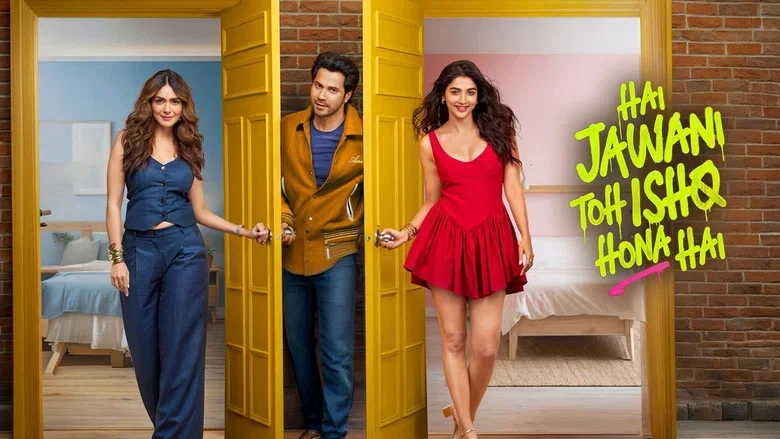
The premise is pure farce scaffolding. Jass (Varun Dhawan) and Bani (Mrunal Thakur) are newly married and already at war over family planning, he wants a child, she wants a career, and neither wants to say the honest thing. So he walks out. Abroad, he stumbles into Preet (Pooja Hegde), and the film’s middle act becomes a collision of pregnancies, half-truths, and overlapping commitments that the screenplay treats as escalating hilarity rather than the moral catastrophe it plainly is.
The Setup Has Bite, Then Loses Its Teeth
The early marriage-conflict material is the only stretch where the film has a pulse. A scene in which Bani quietly corrects Jass in front of his family, a small, precise gesture of a woman refusing to be steamrolled, lands because it is played straight, without a laugh track underneath it. Thakur gives the moment a flinty dignity that the script never returns to.
Then Jass leaves, and the film leaves with him. The shift to a foreign romance track isn’t just geographically convenient; it’s dramatically evasive. Instead of sitting with a marriage in crisis, the screenplay bolts for the sunlit comfort of a new woman, a new city, and a new set of misunderstandings. Farce needs pressure. This film keeps opening windows.
What follows, the pregnancies, the revelations, the late-film sequence where Jass is forced to reckon with “what commitment truly means”, is staged with the volume turned up and the stakes turned down. Dhawan’s comic timing was once a scalpel. Here it is a sledgehammer applied to a plot that needed tweezers.
Varun Dhawan, Working Alone
Varun Dhawan is genuinely charming in the role, and that is both the film’s saving grace and its structural problem. He plays Jass as lovable and impulsive, which is exactly the note the screenplay asks for, and exactly the note that lets the character off every hook. His best work here is physical: a scene where he tries to explain an impossible domestic situation to a stranger, his hands doing more acting than his dialogue, recalls the loose-limbed comic confidence of his earlier crowd-pleasers without ever reaching the emotional register he found in October.
The supporting ensemble is where the film’s waste becomes visible. Jimmy Sheirgill and Maniesh Paul are deployed as comic punctuation marks, reaction shots, raised eyebrows, a well-timed interruption, and neither is given a single scene that requires them to be anything other than furniture. Mouni Roy and Chunky Panday orbit the same way. For a film built on multi-character chaos, the chaos is remarkably centralized: everyone exists to service Jass’s confusion, and no one gets to have their own.
For a sharper recent example of a film that lets its ensemble carry genuine dramatic weight rather than decorative noise, our review of Mother Promise is worth revisiting. That film, too, struggled with tone, but at least its supporting players had arcs.
The Nostalgia Trap
The film’s central failure is not incompetence; it’s inertia. Every comic beat here, the misunderstanding, the slapstick chase, the aggrieved wife, the hapless husband, has been executed better, and more recently, by filmmakers who understood that the audience’s relationship with these tropes has changed. What played as subversive in 1995 now plays as default. The film isn’t stuck in the past because it references older comedies; it’s stuck because it doesn’t seem to know the past has passed.
The technical craft reinforces this. The editing is brisk to the point of restlessness, cutting away from emotional beats before they can land, as if the film is terrified of silence. The background score never trusts a scene to breathe on its own, every reconciliation, every confrontation, every punchline arrives pre-underlined. The cinematography is serviceable but anonymous, the kind of bright, flat coverage that flatters nobody and imprints nothing.
For a more instructive study in how a franchise can return to familiar territory while still finding fresh tension, see our take on Drishyam. That film understood that familiarity is a foundation, not a destination.
Verdict
Hai Jawani Toh Ishq Hona Hai is not a disaster. It is a shrug, a film assembled by people who know exactly how to make this kind of movie and have decided not to ask whether they should. Varun Dhawan’s comic energy is real, and Thakur makes the most of a thankless role, but neither can compensate for a screenplay that mistakes volume for wit and nostalgia for craft. As we frequently examine across our film desk's ongoing coverage, the difference between a homage and a retread is whether the filmmaker has anything new to say. This one doesn’t.
Rating: 2.5/5
Watch it if: You grew up on David Dhawan comedies and want a familiar, undemanding two hours; you’re a Varun Dhawan completist; you enjoy farce even when it’s fraying at the edges.
Skip it if: You want a romantic comedy with genuine emotional stakes; you’re tired of films that treat infidelity as a punchline; you believe a marriage in crisis deserves more than a song-and-dance detour abroad.





1 thought on “Hai Jawani Toh Ishq Hona Hai (2026): Varun Dhawan Can’t Rescue A David Dhawan Comedy Stuck In The Past”
Comments are closed.