
Shankar Sarathi opens Valluvan on the one promise a crime film can’t afford to break: the certainty of a body. Investigators pick up the trail of a serial killer carving through the city’s high-profile names, and the procedural machinery clicks into place with grim efficiency. Then the suspect is caught. And the murders continue.
That single structural pivot is the film’s best idea, and for roughly an hour it sustains real tension. The chase becomes a puzzle, the puzzle becomes a conspiracy, and the conspiracy, per the film’s own framing, reaches into an unspeakable crime buried under institutional silence. It is a promising architecture for a Tamil action thriller.
What Valluvan does with that architecture is where the trouble starts. The film wants to be two things at once, a lean manhunt and a moral indictment of how power and privilege distort justice, and it never quite commits to either. The result is a procedural that keeps gesturing at gravity without earning it.
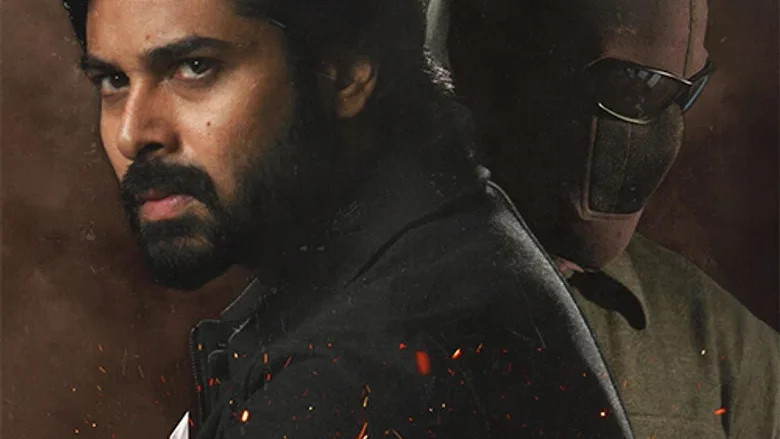
When The Twist Becomes A Trapdoor
The captured-suspect reveal is staged as the film’s engine, and structurally it works: the audience is forced to recalibrate everything they believed about the first act. But a twist only pays off if the story has somewhere to go afterward, and Valluvan spends its back half restating the same revelation in different rooms.
Investigators re-interview, re-suspect, re-explain. The conspiracy widens, but the dramatic pressure doesn’t tighten, it dissipates. By the time the film arrives at its justice-and-cover-up endgame, the stakes have been described to us so many times that they’ve stopped being felt.
This is the classic failure mode of the socially conscious thriller: treating the seriousness of the subject as a substitute for the rigor of the storytelling. Child abuse and institutional concealment are not plot devices. They are moral weight, and weight has to be carried, not merely named.
Chethan Cheenu Carries More Than The Script Does
Chethan Cheenu anchors the film as the lead investigator, and the role reportedly pushed him to his physical limits. That effort is visible. He plays the part with a clenched, forward-leaning intensity, a man who has stopped sleeping and started noticing things, and it’s the most persuasive element on screen.
But the screenplay gives him almost nothing to do with his interiority. He investigates, he reacts, he investigates again. Compare this to the work in Mother Promise, where a lead performance at least gets to wrestle with tonal chaos. Here, the chaos is the script’s, and the actor is left holding the leash.
The supporting cast is largely decorative. Sai Dheena and Ashna Zaveri are credited in principal roles, but the film reduces them to functional presences, reaction shots, procedural exposition, the occasional meaningful glance across an interrogation table. They aren’t characters so much as narrative furniture.
That’s a directing problem as much as a writing one. Shankar Sarathi, who also wrote the film, seems more interested in the machinery of the conspiracy than in the people caught inside it.
Gritty By Association, Not By Craft
The film’s marketing leans hard on the fact that crew members from Vetri Maaran’s team, the people behind Visaaranai and Paava Kadhaigal, worked on the project, lending it a gritty, hard-hitting feel. That pedigree is real, and it shows up in the film’s texture: the lighting is unglamorous, the locations are unglamorous, the violence is unglamorous.
But texture is not the same as vision. Visaaranai was brutal because it was specific, because it knew exactly whose suffering it was documenting and refused to look away. Valluvan borrows the aesthetic without the specificity. The grimness feels like a coat it put on rather than a condition it lives in.
The technical credits are competent. Suresh Bala’s cinematography keeps the frame tight and the palette muted, and San Lokesh’s editing keeps the first half moving with purpose. Ashwath’s score, including the song “Kalva Nee, ” does what it’s asked to do, though the music is more insistent than the drama it’s supporting.
For a broader look at how this year’s Tamil releases are faring at the box office, see our analysis of Hai Jawani Toh Ishq Hona Hai.
The Conscience The Film Can’t Quite Locate
Here is the central problem with Valluvan: it wants credit for its subject matter without doing the work of dramatizing it. The film invokes child abuse and institutional cover-up as the dark heart of its conspiracy, but it treats these as revelations to be uncovered rather than wounds to be examined.
There’s a version of this movie, a better one, where the investigation forces the protagonist to confront his own complicity in the systems he’s defending. That version has moral friction. This version has plot mechanics.
By the final act, when the conspiracy is fully unspooled and the deeper network is exposed, the film arrives at its conclusion without having earned the outrage it clearly wants us to feel. The ending resolves the plot. It doesn’t resolve the theme.
As we frequently examine across our film desk's ongoing coverage, a thriller can survive a weak script if its performances or its atmosphere carry it. Valluvan has neither the charisma nor the atmosphere to compensate. What it has is a good premise and a lead actor working harder than the material deserves.
The Verdict: A Procedural That Forgets The Procedure
Valluvan is not a bad film so much as an incomplete one. It has the bones of a genuinely unsettling crime thriller, the captured-suspect twist, the conspiracy of silence, the social conscience, but it never assembles them into a body that breathes.
Chethan Cheenu is the reason to watch, and he’s a real one. His intensity suggests an actor who could anchor a much sharper film. But the script keeps handing him exposition where it should be handing him conflict, and the direction keeps choosing grimness over gravity.
Watch it if you’re a devoted fan of Tamil crime procedurals and can forgive a film for mistaking its subject for its substance. Skip it if you want a thriller that respects your intelligence enough to dramatize what it’s accusing.
Rating: 2.5/5




2 thoughts on “Valluvan (2026): Chethan Cheenu’s Grim Procedural Buries Its Own Conscience”
Comments are closed.