
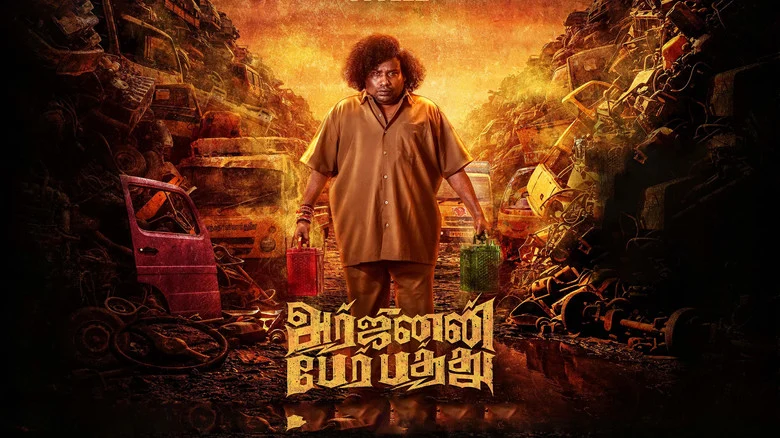
Yogi Babu walks into Arjunan Per Paththu carrying the weight of a thousand punchlines on his shoulders. The film wants us to forget the timing, the rubber face, the effortless absurdity that made him a household name. R. Rajmohan’s camera lingers on his stillness, his furrowed brow, his attempt to locate grief in a face we’ve only known for laughs. It’s a fascinating experiment. It’s also a failed one.
The opening reel establishes Arjunan’s trauma with the subtlety of a lightning strike, literally. His parents die in front of him, electrocuted by a bolt from the sky, and the film treats this as sufficient psychological foundation for everything that follows. He migrates to Chennai. He finds work in a shop. He falls in love. The screenplay moves through these beats like a checklist, never pausing to let the wounds breathe.
A Fraud Drama That Forgets The Fraud
The central mechanism arrives when Arjunan purchases an old vehicle, believing it signals his arrival into stability. The reversal, he’s been cheated, should be the film’s engine. Instead, Rajmohan rushes past the betrayal to assemble a collective of fellow victims, transforming a personal grievance into a social-justice procedural. The shift is structurally sound on paper. In execution, it’s bloodless.
Where a more disciplined filmmaker might have found tension in the slow accumulation of evidence, the screenplay skips ahead to confrontation. The dealer, the guarantor, the moneylender, the sub-inspector, these figures exist as archetypes rather than characters, each occupying a slot in the corruption chain without distinct texture. Lenin Bharathi’s Dealer Biju gets the most screen time among the antagonists, but his menace is purely transactional.
Yogi Babu’s Stillness Becomes A Cage
The performance is the film’s central gamble, and it’s instructive to compare it with his work in Con City, where comic energy masked narrative incoherence. Here, the strategy inverts: the incoherence is exposed because there’s no comic shield. Babu’s Arjunan is all furrowed concentration and swallowed frustration, but the script gives him nowhere to channel it beyond furrowed concentration and swallowed frustration.
The scene where he first drives the purchased vehicle is meant to be a moment of earned relief. Babu plays it with a tentative smile, hands gripping the wheel like he’s afraid the happiness might evaporate. When the fraud is revealed, his face collapses into a mask of betrayal. It’s a genuine moment. The film doesn’t know what to do with it.
Supporting Players As Pressure Points, Not People
Kaali Venkat’s Guarantor and Myna Nandhini’s Moneylender function as economic obstacles, their scenes built around obligation and leverage. Neither gets a moment of interiority. Aruldoss as the Sub Inspector suggests institutional obstruction, but the film treats law enforcement as a bureaucratic inconvenience rather than a systemic force. The supporting cast maps corruption’s architecture without illuminating its human cost.
This flattening extends to the collective-justice climax, where Arjunan assembles his fellow victims for a confrontation that should crackle with shared rage. Instead, it plays like a committee meeting. The film’s instinct is to explain the fraud rather than dramatize its consequences. We understand the mechanism. We never feel the weight.
Where The Camera Hesitates, The Drama Dies
D. Imman’s four songs, including the anthemic “Poru Maname Poru”, arrive at regular intervals, each one halting momentum rather than deepening it. The cinematography favors functional compositions: medium shots of Babu’s face, wide shots of Chennai streets, nothing that visualizes the psychological claustrophobia of a man trapped by his own hope. The editing in the second half rushes through alliance-building, as if the filmmakers feared the audience might lose patience with process.
Compare this to the spatial discipline Rajmohan could have borrowed from Toxic, where every frame tightens the noose around its protagonist. Here, the camera remains neutral, observational, unwilling to commit to a visual argument about Arjunan’s entrapment.
The Uncomfortable Question Of Who This Is For
The film’s target audience is clear: viewers who want issue-based Tamil drama, who appreciate Yogi Babu’s attempt to stretch beyond comedy, who find used-vehicle fraud a relatable entry point into systemic corruption. That’s a legitimate audience. They deserve a better film than this.
What they get instead is a narrative that treats trauma as plot mechanics, fraud as a puzzle to be solved, and collective action as a foregone conclusion. The emotional residue is minimal. The film ends with justice served, but the taste it leaves is not satisfaction, it’s the faint disappointment of watching a talented performer given a dramatic vehicle that stalls before it reaches the destination. The tonal ambitions of Find Me at least committed to their fragmentation. This one just idles.
The Verdict: A Dramatic Vehicle That Never Leaves The Lot
R. Rajmohan’s film wants to be a story about a man who converts private loss into public accountability. What it becomes is a lesson in how difficult that conversion actually is, not for Arjunan, but for the filmmakers. Yogi Babu deserves credit for attempting something outside his comfort zone. He deserves a script that meets him halfway.
The film’s final image, Arjunan standing among his fellow victims, having exposed the fraud, should resonate. Instead, it registers as a shrug. The fraud is exposed. The system is named. Nothing has changed, least of all our understanding of the man at the center. In a landscape where contemporary Tamil dramas are increasingly willing to sit with moral ambiguity, Arjunan Per Paththu settles for tidy resolution. It’s a film that mistakes the exposure of corruption for an exploration of it.
Rating: 2.5 / 5





1 thought on “Arjunan Per Paththu (2026): Yogi Babu’s Dramatic Gamble Comes Up Short”
Comments are closed.