A drone hovers outside a locked mansion, and a young astrophysics student watches a woman he has never met become the centre of his universe. R. Raghav Mirdath’s Drones wants to be five films at once, and for a while, the sheer nerve of that ambition is enough.
A Suspended Student, A Hijacked Drone, And A Mansion That Should Not Be Entered
Kish, played by Dravid Selvam, is an astrophysics student with more curiosity than discipline. When he and his friends Rush and Dush are suspended, they take refuge in the secluded home of Padmanaban, an eccentric scientist nicknamed the “Black Hole.”
The house is a controlled experiment in absurdity, complete with a made-to-order girlfriend project. Kish hijacks the household drone, Sampangi, and points it across town at an old mansion where Prakruthi, a miniature artist, appears at a window.
That single act of technological voyeurism opens the film’s fantasy world. It is also the cleanest idea Mirdath has, because the drone turns surveillance into romance and curiosity into trespass without the screenplay ever having to announce it.
When Every Man Recites The Same Poem, Comedy Becomes A Cage
Men who meet Prakruthi repeat an almost ritualised courtship: poems, dolls, rings, and promises to love her when her hair turns white. The repetition is deliberate, and the props do the comic work that dialogue alone could not sustain.
But repetition is a blade that cuts both ways. The gag lands the first three times and then begins to test the viewer’s patience, converting a sharp observation about instant attraction into a sketch that refuses to end.
Meanwhile, Rush carries the film’s emotional counterweight. Anjali Nair plays her as a woman who has loved Kish for years while he stares past her at a face he has decided is beautiful, and the performance finds its footing in what she withholds rather than what she declares.
The Inspector, played by Cinemawala Sathish, enters a parallel comic thread governed by a palmist’s warning that any woman he sincerely tells “I love you” to will die. It is a genuinely funny premise, and Sathish plays the desperation without begging for laughs.
What the middle stretch lacks is a plan. The scientist, the sleepwalking student, the bride-seeking Inspector, the witch, and the doll transformations accumulate without a clear route toward resolution, and the film starts to feel like a house with too many locked doors and no map. The same loss of narrative control undercut the ambition of Aroopi, where a promising genre premise also struggled to govern its own invention.
Devadarshini’s Witch Finds The Film’s Only Real Argument
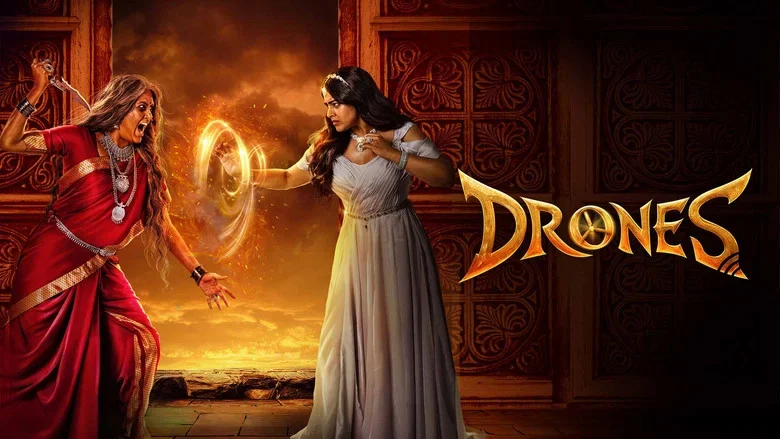
Devadarshini plays the witch with a balance of menace and comic timing that keeps the supernatural threat from collapsing into pantomime. She is the film’s antagonist, but she is also its accuser, and the screenplay knows it.
The confrontation between Rush and the witch is where Drones stops being a collection of eccentricities and becomes a film with something to say. Rush speaks about the damage caused by society’s narrow standards of beauty, and the horror staging finally carries an ethical weight.
It is the strongest scene in the film because it converts the comic-horror machinery into a direct argument. Everything before it has been building toward this release, and everything after it struggles to match the clarity of that moment.
Siddhi Idnani’s Prakruthi is defined almost entirely by her visual appeal, which is the point but also the limitation. The role asks her to appear angelic, and she does, but the character never gets a scene that lets her be anything other than the object of other people’s projections.
Where The Direction Holds And Where It Slips
Mirdath builds a spatial opposition between the locked-down scientific house and the old mansion, and that contrast gives the film separate rooms for science fiction and supernatural mystery. The drone’s remote viewpoint introduces Prakruthi without a conventional meeting, which is a smart visual choice.
But the direction loses its grip in the central stretch. Too many characters and premises accumulate without a sufficiently clear escape route, and the film’s momentum thins out just when it should be tightening.
The comparison to a certain kind of contemporary horror is instructive. Where a film like Titanic uses spectacle to serve an emotional argument, Drones sometimes lets spectacle substitute for one, and the difference shows in the pacing.
Dravid Selvam anchors the student group with a likeability that keeps Kish from becoming insufferable, even when the character’s blindness toward Rush tests the audience’s patience. His performance moves between comedy, voyeuristic curiosity, and romantic self-deception without ever quite finding a register that unifies them.
The restrained emotional exhaustion Anjali Nair brings to Rush recalls the psychological weight of the lead turn in All Pass, where a performer had to carry a messy narrative on the strength of presence alone.
What GM Morgan Films Is Betting On, And What The Bet Costs
GM Morgan Films is backing a first-time feature director with a premise that refuses easy categorisation. That is a genuine gamble in a market where Tamil horror-comedy has become a reliable pipeline, and the film’s refusal to pick one lane is both its identity and its commercial risk.
The theatrical landscape for this kind of genre-blend entertainer depends on word of mouth surviving the opening weekend. If audiences embrace the eccentricity, the film has a path; if they expect a conventional mystery or science-fiction thriller, the tonal shifts will read as indecision rather than invention.
What the film does have is a distinct identity. It signals a welcome willingness to experiment across contemporary Tamil horrors, even when that experimentation produces a film that is more interesting to describe than to sit through.
A Fantasy That Argues For Character Over Appearance, And Almost Earns It
Drones resolves its emotional argument by privileging understanding over outward appearance, and Rush’s confrontation with the witch gives that argument its clearest voice. The film’s heart is in the right place, even when its head is crowded with too many ideas.
What lingers is not the drone or the witch or the doll transformations, but the image of a woman speaking truth to a supernatural force that has been punishing men for the same blindness her best friend suffers from. That is a sharp idea.
The film around it is a madcap experiment that occasionally forgets it needs a plan. Mirdath has a voice worth developing, and Drones is the sound of that voice learning to trust its own argument instead of burying it under eccentricity.