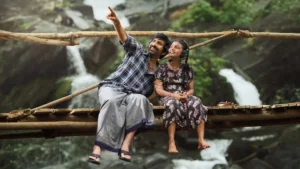
The classroom bell has barely stopped ringing when Bikshu Koyagura’s camera finds Ravi, a tenth-standard graduate stepping into intermediate, and Chitti, still tethered to her school satchel, trading glances across a village lane that suddenly feels charged. Hushar Pittalu opens on that precise threshold, the gap between childhood and consequence, and for a while, the film’s confidence in that liminal space is genuine. It is also, unfortunately, the last time the screenplay surprises anyone.
What follows is a romance built on concealment: stolen phone calls, borrowed time, and the quiet physics of two teenagers learning that desire moves faster than judgment. Koyagura stages the early courtship with an unhurried, almost anthropological patience, letting peer chatter and glowing screens do the corrupting. It’s a setup that promises moral complexity. It delivers a lecture instead.

A Director Who Trusts His Village More Than His Script
There’s a version of this film where the village itself becomes the antagonist, a living organism of gossip, expectation, and surveillance. Koyagura gestures at that idea constantly, but never commits. Just as he demonstrated a tighter spatial discipline in Hushar Pittalu, he again refuses to let the setting breathe as anything more than a backdrop for adolescent mistakes. The result is a film that knows its terrain intimately but never dares to make it dangerous.
The screenplay marches in a straight line: attraction, secrecy, discovery, defiance, reckoning. No detours, no reversals, no moment where a parent says something that reframes everything. The plot lacks fresh surprises, and worse, it seems proud of that predictability, as if clarity were a virtue and ambiguity a failing.

When Intimacy Becomes the Film’s Own Worst Enemy
Here is where the direction stumbles most visibly. The physical intimacy between Ravi and Chitti, two characters explicitly coded as school-aged, is rendered with a lingering, almost leering emphasis that sits uneasily beside the film’s stated moral purpose. The romantic track and physical intimacy between the two school-aged teenagers feel overdone in several scenes, and that excess doesn’t deepen the cautionary message. It undermines it.
A film that wants to warn parents about digital exposure and premature adulthood cannot simultaneously aestheticize that same exposure. The camera’s gaze contradicts the screenplay’s conscience, and the contradiction is never resolved. Families arriving for a grounded village drama will find themselves uncomfortable long before the parents on screen discover the truth.

Ansh Thorat Carries the Weight His Character Hasn’t Earned
Ansh Thorat, as Ravi, does the heavy lifting with a face that registers confusion before rebellion. Watch the sequence where his father’s expectations collide with his own secrecy, Thorat doesn’t play defiance. He plays the slow dawning that he has already lost an argument he never knew he was having. The restrained physical exhaustion he brings to the later confrontations recalls the psychological weight of his turn in Equal, where stillness did more than dialogue ever could.
Vasavi Ganeshan’s Chitti is the film’s quieter register, and she makes the most of a role that asks her mostly to react. Her best moment is wordless: standing in a doorway while adults argue around her, her posture shifting from defensive to resigned in a single breath. It’s a small, precise piece of acting in a film that rarely rewards precision.
The Parents Are the Only Adults Who Feel Like People
The film’s strongest passages belong not to the lovers but to the generation that raised them. The parental-emotion material carries genuine dramatic weight, particularly in the discovery sequence, where hope curdles into disappointment without a single raised voice. These performers understand that the real tragedy isn’t teenage romance, it’s the realization that love and fear can occupy the same parental sentence.
Supporting performers populate the youth social world with functional energy, but the screenplay gives them little to do beyond embodying peer pressure. They are influences, not characters, which is precisely the problem. A film about the consequences of bad decisions needs the people enabling those decisions to feel like more than plot devices.
A Message That Arrives After the Audience Has Left
The final act pivots hard toward reckoning, asking whether Ravi and Chitti can recognize their mistakes and change. It’s a noble question, and the film answers it with sincerity. But sincerity is not the same as drama. The screenplay resists the kinetic sensationalism that overtook Biker, opting instead for a deliberate, suffocating dread, yet it never finds the scene that makes that dread transform into revelation.
The message lands, but it lands softly, on an audience already predisposed to agree. This patient character study signals a welcome tonal maturity across contemporary Telugu dramas, proving that tension thrives without manufactured plot theatrics, even when the execution doesn’t fully deliver on that promise.
The Verdict: A Cautionary Tale That Forgets to Be Cautionary
Hushar Pittalu wants to be a warning and a romance simultaneously, and it never quite chooses. The young leads are honest, the parental material is affecting, and the village setting is rendered with affection. But the film’s bold intimacy undercuts its family positioning, and its linear screenplay offers no moment of genuine surprise to justify the discomfort it creates.
This is a film that understands its thesis better than its own camera does, and that gap, between what it says and what it shows, is the only thing here that feels truly unresolved. For viewers seeking a nuanced conversation about adolescent desire and parental responsibility, the film offers a starting point, not a destination. For everyone else, it’s a lesson delivered without the sting that would make it stick.
Rating: 2.5 / 5
Somewhere in this village, there’s a better film about the moment a child realizes their parents were right, Hushar Pittalu just never quite finds the courage to walk into that room and close the door.