
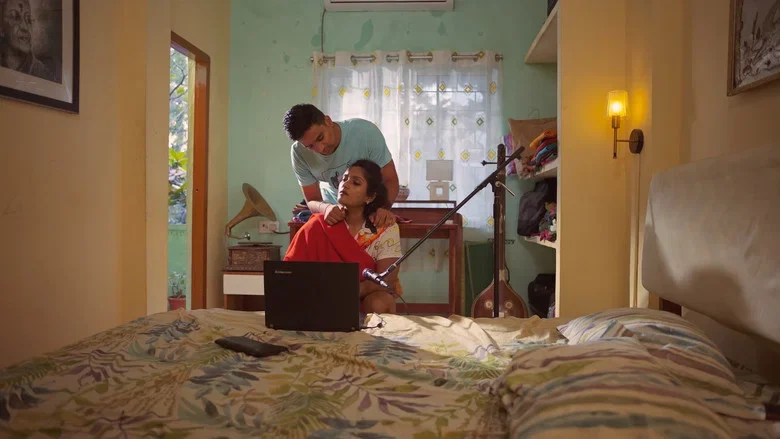
The first image that lands is a closed door with three people on the wrong side of it. A woman runs her scales in one room, a man paces through a video interview in another, and a six-year-old waits for a school event that exists only on a screen. Equal, also circulating as Samam, opens inside a curfew, and director Shiva Prasad understands that a lockdown is not a setting. It is a pressure cooker with the lid welded shut.
Vaibhav Murugesan plays Mohana, and he spends the film’s first act doing the least cinematic thing imaginable: listening. Shoulders squared toward a laptop, jaw set, hands flat on a table as if the furniture might bolt. It is a performance built on the physical choreography of waiting, and it gives the film a stillness that most Tamil family dramas are too restless to attempt.
A Household That Performs Equality While Practicing Hierarchy
The premise is deceptively clean. Arasi prepares for a long-awaited concert, Mohana faces a job interview that could reset the family’s finances, and their daughter Bhoomi has an online school event that requires an adult standing just off-camera. Three obligations, one apartment, no exit. The screenplay stacks these pressures rather than intercutting them, and the result is a domestic clock that ticks in three directions at once.
What the film is actually hunting is uglier than scheduling. The family speaks the language of equality, shared work, shared sacrifice, shared dreams, while the actual labor of holding the day together keeps falling on the same pair of hands. Prasad stages this not through argument but through blocking. Who gets the quiet room. Who answers the door. Who is expected to smile through a disruption and who is permitted to be irritated by one.
The comparative instinct is unavoidable here, and it holds up. Just as Aali trusted silence over exposition to carry its emotional freight, this film lets a curtailed day do the arguing for it. Where that film found tension in a border landscape, this one finds it in a hallway.
When The Antagonist Is A Reflex, Not A Person
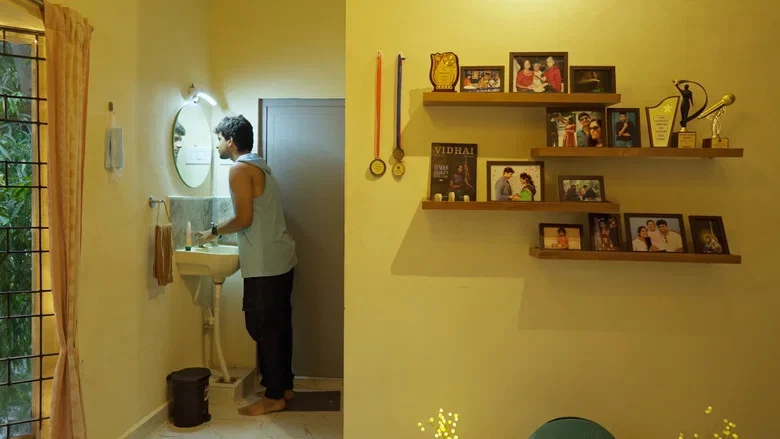
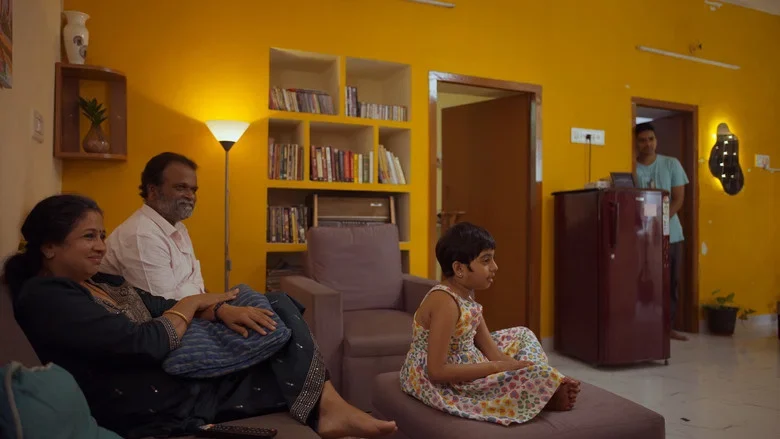
There is no villain in Equal, and the film is better for it. The antagonistic force is a reflex, the automatic assumption that some voices in a house are advisory and others are executive. It is dramatized through the parents, Thillai and Mohana, who are summoned for support and arrive carrying the same hierarchical instincts the younger generation claims to have outgrown.
This is where the screenplay takes its real risk. It refuses to let anyone in the family be a clean hypocrite. The people reproducing the hierarchy are also the people keeping the day from collapsing, and Prasad shoots their phone conversations with the camera held slightly too close, so the frame feels crowded by obligation rather than intimacy.
Arasi’s concert thread carries the film’s most interesting contradiction: an artistic ambition treated as sacred in conversation and negotiable in practice. The gap between how a family talks about someone’s dream and how it schedules around that dream is the film’s sharpest observation, and it is delivered without a single raised voice.
The Physical Grammar Of Who Gets To Be Tired
Murugesan’s work is the film’s spine, and it is a study in calibrated exhaustion. In the interview sequence, he sits with his back deliberately straight while his hands betray him, fingers pressing into the table edge, then releasing, then pressing again. It is the posture of a man performing competence for a camera that cannot see the room behind him.
The supporting turns are mostly functional rather than revelatory, and it is worth saying plainly that the older generation here is written as a position rather than a person. The restrained, inward weight Murugesan carries into the film’s second half recalls the psychological compression of Magudam, though that film spent its energy on a dual-role conceit while this one spends it on a single room. Where Murugesan’s Bhoomi scenes land is in the small stuff: a child’s online event treated as a logistical nuisance by adults who will later insist the family values nothing above its children.
What the film does not solve is the child’s interiority. Bhoomi is a scheduling problem for the screenplay more than she is a person, and the six-year-old’s perspective, the one vantage point that could expose the adults’ hypocrisy most brutally, stays largely unexplored.
A Hybrid Form That Occasionally Fights Itself
The genre tag reads like a committee drafted it: drama, family, comedy, fantasy, music. On screen, the comedy arrives in small domestic collisions and mostly works, while the fantasy element sits uneasily against the film’s otherwise rigorous realism. When the tonal register shifts, the curfew’s claustrophobia loosens, and the film briefly forgets what made it tense.
The music thread is the most rewarding of the secondary genres. Arasi’s Carnatic preparation gives the household a countdown clock with an artistic pulse, and Prasad shoots the practice sequences with the camera fixed and patient, letting the raga fill the silence that the dialogue otherwise refuses to occupy. It is the one place where the film’s formal restraint pays full dividends.
It is also where the comparison to a certain strand of contemporary Tamil drama becomes instructive. The screenplay resists the kinetic sensationalism that overtook Arjunan Per Paththu, opting instead for a deliberate, suffocating dread built out of ordinary errands. The cost of that choice is pacing: the middle stretch circles its own thesis more than it escalates it, and the film’s 117 minutes occasionally feel like a day that refuses to end.
The Irony The Title Is Quietly Smuggling
By the final stretch, the film’s thesis has crystallized into something more uncomfortable than a slogan. A mindset convinced of its own hierarchy eventually calls itself equal, and the horror is that no one in the family is lying when they say it. They believe it. The curfew ends, but the reflex doesn’t.
This patient, character-driven approach signals a welcome tonal maturity across contemporary Tamil dramas, proving that domestic tension can be sustained without manufactured plot theatrics. It is not a film that will be remembered for a single scene. It will be remembered for a feeling, the specific exhaustion of being the person in a household who is always the one adjusting.
What lingers is not the resolution but the residue: the sense that a family can agree on the word “equal” for years without ever agreeing on what it costs. Equal is a small, intelligent, quietly furious film that trusts its audience to notice who is doing the dishes while everyone else discusses fairness.
Rating: 3.5 / 5





1 thought on “Equal (2026): Vaibhav Murugesan Anchors a Curfew-Era Family Drama That Argues With Itself”
Comments are closed.