
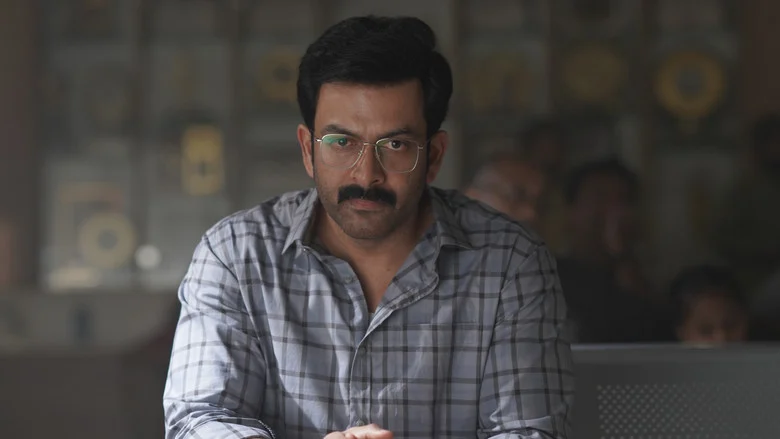
The first hour of I, Nobody is a masterclass in bureaucratic dread. Rajeevan, a mid-level government employee played by Prithviraj Sukumaran, walks into a bank robbery’s aftermath not as a hero or a victim, but as a man whose alibi is too ordinary to be believed. The camera holds on his face a beat too long during the initial questioning, not for dramatic effect, but to let us watch him realize that innocence is a narrative, not a fact.
That realization is the film’s engine. Nisam Basheer, working from Sameer Abdul’s screenplay, understands that the most terrifying antagonist isn’t a villain with a gun, but a system that has already decided what your story means before you’ve finished telling it. The opening act is tight, controlled, and genuinely gripping in a way that recalls the paranoid efficiency of Find Me, another recent thriller that understood how to weaponize institutional silence.
A Heist Thriller That Wants to Be a Social Drama, and Suffers for It
Then the film widens. The police investigation expands into political territory. Vijayaraghavan’s Chief Minister enters the frame, and suddenly we’re not watching a man fight for his name, we’re watching a film fight for its own identity. The heist mechanics that gave the first act its tension are abandoned for a broader critique of power, rumor, and institutional erasure.
It’s a noble ambition, but the execution is uneven. The middle hour sags under the weight of its own commentary. Characters who should be pressure points become mouthpieces. The screenplay, which was so precise about Rajeevan’s domestic claustrophobia, starts repeating itself, the same accusations, the same denials, the same close-ups of Prithviraj’s tightening jaw. By the time the third act arrives, the film has spent so much energy building its social thesis that it forgets to resolve its central mystery with any real urgency.
The tonal inconsistency is the most damaging flaw. One scene plays like a procedural, the next like a family melodrama, and the next like a political thriller. Basheer never finds a rhythm that lets these modes coexist. The result feels less like a layered narrative and more like three different films fighting for the same runtime.

Prithviraj Sukumaran’s Restraint Is the Film’s Only Consistent Virtue
What holds I, Nobody together, barely, is Prithviraj’s performance. He plays Rajeevan not as a man who rises to the occasion, but as a man who is slowly crushed by it. His voice drops half a register when he’s lying to his wife. His shoulders curve inward during interrogations. He doesn’t deliver monologues; he delivers fragments of sentences, as if he’s already learned that no one is listening.
It’s a performance of accumulated small surrenders, and it’s easily the best work he’s done since Rorschach. But even he can’t save the film from its own structural indulgences. The script gives him too many scenes of the same emotional beat, frustration, then resolve, then frustration again, without escalating the stakes in a way that feels earned.
Parvathy Thiruvothu, as Meera, makes the most of a thinly written role. She’s the film’s emotional anchor, but she’s given little to do beyond looking worried and delivering exposition about the family’s financial strain. One scene, where she quietly folds laundry while Rajeevan tries to explain himself, is a masterclass in domestic tension. It’s also the only time the film remembers that its protagonist has a life outside the investigation.

The Supporting Cast Exists to Apply Pressure, Not to Become People
Hakkim Shajahan’s Anas Rahman is part of the pressure network around the case, but he’s less a character than a function. The same is true for the police officers and political figures who populate the film’s second half. They exist to corner Rajeevan, to ask the same questions, to represent the same institutional indifference. It’s an intentional choice, but it leaves the film feeling airless, there’s no counterweight to Rajeevan’s paranoia, no moment of unexpected humanity from the other side.
Vijayaraghavan’s Chief Minister is the closest thing to a real antagonist, but his scenes are too few and too late. By the time he arrives, the film has already spent so much time on procedural repetition that his presence feels like an afterthought rather than a culmination.
Basheer’s Direction Is Competent, But His Instincts Betray Him
The technical craft is solid. The cinematography favors tight framing and shallow focus, keeping Rajeevan isolated even in crowded rooms. The score is used sparingly, mostly to underline moments of realization rather than to manufacture tension. The editing in the first half is sharp, cutting between the investigation and the domestic fallout with a precision that the second half completely abandons.
But Basheer’s biggest problem is his inability to trust his own premise. The film keeps reaching for bigger themes, institutional corruption, media manipulation, the fragility of truth, when it should be focusing on the smaller, more intimate horror of a man watching his life become a story he doesn’t recognize. The broader contemporary Indian cinema has seen this tension before: films that start as character studies and end as sermons. I, Nobody falls into that trap with both feet.
The comparison to Angikaaram, another recent Malayalam film that prioritized physical commitment over narrative discipline, is instructive. Both films have moments of real power, but both mistake intensity for depth. They confuse the audience’s exhaustion with engagement.
A Climax That Answers the Wrong Questions
The final act tries to tie everything together, the heist, the political conspiracy, the family strain, but the resolution feels less like a payoff and more like a surrender. The mystery is solved, but the solution doesn’t justify the two hours and forty-six minutes it took to get there. The emotional beats land, but only because Prithviraj and Parvathy are skilled enough to sell moments the script hasn’t earned.
What’s most frustrating is that the film’s central question, how does an ordinary man reclaim his story when the system has already written it for him?, is never fully answered. The ending suggests that survival is enough, that the act of enduring is its own victory. But after all that buildup, it feels like a cop-out. The film wants to be about the impossibility of justice, but it settles for the possibility of endurance.
The Verdict: A Sharp Premise Undone by Its Own Ambition
I, Nobody is a film that knows exactly what it wants to say but has no idea how to say it efficiently. The first hour is genuinely gripping, a paranoid, performance-driven thriller about a man whose ordinariness becomes his greatest liability. But the second half collapses under the weight of its own thematic ambitions, trading tension for commentary and momentum for repetition.
Prithviraj Sukumaran delivers one of his most controlled performances, and Parvathy Thiruvothu makes the most of a thankless role. But they’re fighting a losing battle against a screenplay that confuses length with depth and a director who can’t decide whether he’s making a heist thriller or a social drama. The result is a film that will satisfy those who value performance over pacing, and frustrate anyone hoping for the tight, relentless thriller the opening promised.
Rating: 2.5 / 5
There’s a great ninety-minute film buried somewhere inside I, Nobody. Unfortunately, it’s trapped under another ninety minutes of a film that doesn’t trust its own best instincts.





1 thought on “I, Nobody (2026): Prithviraj Sukumaran Anchors a Sharp Premise That Runs Out of Road”
Comments are closed.