
The most electric moment in Newton’s 3rd Law arrives roughly thirty minutes in, when Inspector Vasudev reads a post-mortem report and finds a bullet resting inside the skull of a young man who supposedly jumped from a terrace. It is a clean, brutal pivot, the kind of forensic reversal that snaps an audience upright in its seat. For a few minutes, Rajesh Karna’s film feels like it might become the taut investigative drama its premise promises.
That promise curdles slowly. What follows is a 1999 Hyderabad procedural that keeps widening its net, a missing friend, a dead mother, a road accident, a smuggling kingpin, without ever tightening the emotional noose around any of it. The film has the architecture of a thriller but the pulse of a case file.
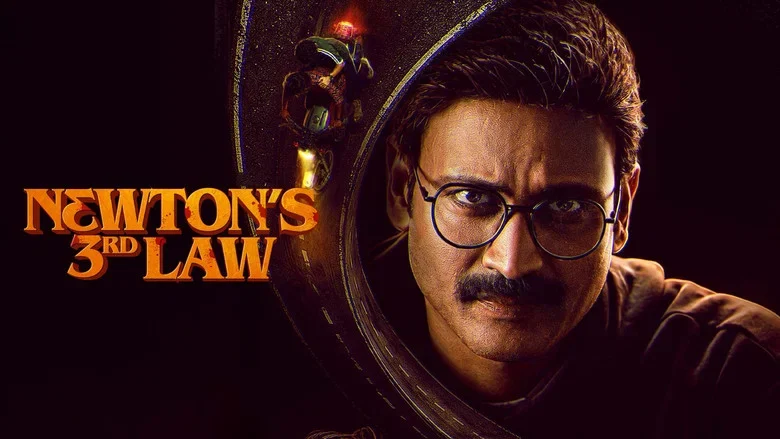
Sumanth Plays the Calm at the Center of a Storm That Never Quite Arrives
Sumanth’s Vasudev is a study in restraint. He works the case with a flat, unhurried voice and a stillness that reads as professional discipline rather than theatrical intensity. When he questions Vinay’s parents, he doesn’t lean in or raise his register, he simply waits, letting their evasions hang in the air. It is a mature, settled performance, and it suits the material’s refusal to go big.
The problem is that the film around him never generates enough pressure to justify that calm. The screenplay keeps introducing new threads, Karthik’s disappearance, Jyothi’s fatal accident, Stephen Mercury’s criminal network, as if accumulation alone constitutes escalation. It doesn’t. The restrained physical exhaustion Sumanth brought to his work in Peddi carried a sense of weight earned through visible struggle; here, the stillness often feels like the film simply hasn’t given him enough to push against.

Jagapathi Babu Enters Late, and the Film Wakes Up Just Long Enough to Notice
Stephen Mercury arrives as the underworld pressure point the narrative has been promising, and Jagapathi Babu plays him with a coiled, watchful menace. He doesn’t chew scenery; he occupies it, letting his presence do the work of threat. The film briefly remembers it is supposed to be a crime thriller whenever he is on screen.
Those moments are too few. Mercury’s criminal network is described more than it is dramatized, and the film never quite figures out how to integrate his menace into the domestic secrecy that drives the central mystery. The result is a villain who functions as a plot mechanism rather than a living antagonist, a waste of an actor who can make stillness feel like a threat when given the space.
The 2026 Frame Is a Clever Device That Never Earns Its Keep
The film opens in Zuluk, Sikkim, in 2026, where David reads a book titled Newton’s 3rd Law and recognizes its story as a mirror of his own past. It is a striking structural gambit, a book-within-the-film that promises retrospective revelation and circular meaning. Karna establishes this frame with a quiet, almost literary confidence.
But the frame never pays off with the force it needs to. The 1999 investigation proceeds largely as a forward procedural, and the 2026 material recedes into a device rather than a living narrative layer. The film resists the kinetic sensationalism that overtook VENDETTA-THE BEAST WITHIN, opting instead for a deliberate, suffocating dread, but it forgets that dread needs momentum to sustain itself. The frame becomes a promise the film cannot keep.
Family Secrets Should Cut Deeper Than This
Vinay’s parents, Gangadhar and Parvathi, are positioned as the emotional core of the mystery, a couple whose guarded behavior conceals a history that explains their son’s death. Shelly N. Kumar brings a quiet, wounded dignity to Parvathi, particularly in the scenes where she deflects Vasudev’s questions with averted eyes and clipped answers.
But the screenplay never gives these secrets the weight they demand. The revelations land as information rather than devastation. When the film finally connects Vinay’s death to Jyothi’s accident and Mercury’s criminal network, the chain of cause and consequence feels more like a diagram than a tragedy. Just as he demonstrated a tighter spatial discipline in Unmadham, Karna shows flashes of structural intelligence here, but he lacks the tonal control to make the pieces cohere into something that bruises.
The Second Half Slows to a Crawl, and the Payoff Never Arrives
The first half works because the forensic reversal gives the investigation a clear objective. The second half loses that clarity as the film piles on backstory, missing persons, and criminal connections without a corresponding escalation in tension. The pacing becomes sluggish, and the direction lacks the sharpness needed to turn plot information into dramatic momentum.
By the time the film reaches its resolution, the emotional impact it aims for has dissipated. The twists are there, but they don’t land. The film’s central thesis, that every action produces a consequence, that violence returns through an interconnected cycle, is stated rather than dramatized. Newton’s third law becomes a thematic label rather than a lived experience.
This patient, performance-led approach signals a welcome tonal maturity across contemporary telugu thrillers, proving that tension can be built without manufactured theatrics. But maturity without momentum is just stillness. Newton’s 3rd Law has the pieces of a compelling mystery, a strong hook, a committed lead, a clever frame, but it never assembles them into something that moves.
Rating: 2.5 / 5
The film’s final image, David closing the book that mirrors his past, should resonate as a meditation on inherited guilt and circular consequence. Instead, it lands as a shrug. The bullet in Vinay’s head was the film’s best idea; everything after it is a search for a reason to keep pulling the trigger.







1 thought on “Newton’s 3rd Law (2026): Sumanth Anchors a Forensic Hook That Slowly Loses Its Pulse”
Comments are closed.