
Kiran Das opens Unmadham not with a crime but with a punishment. CPO Shelly K arrives at a new posting carrying the specific exhaustion of a man who has been reassigned rather than promoted, and the film lingers on the institutional texture of that humiliation, the fluorescent hum of a rural station, the sideways glances of officers who already know his file. It is a disciplined, almost withholding piece of filmmaking, and for roughly eighty minutes it works.
Shahi Kabir’s script understands that dread accumulates through procedure, not proclamation. The early investigative beats are staged with a documentarian’s patience, letting Shelly’s professional competence and private instability bleed into each other until you cannot separate the case from the man working it.
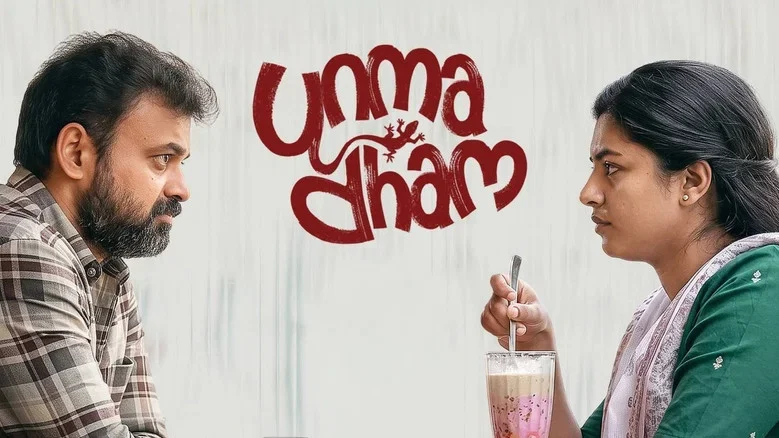
A Procedural That Refuses to Announce Its Ghosts
What distinguishes the first half is its refusal to clarify genre. Is the threat supernatural, psychological, or simply the ambient violence of a system that grinds its officers down? Das keeps all three possibilities alive through framing choices, long, static takes that hold on doorways and corridors a beat past comfort, and a camera that prefers medium distance so we are never quite inside Shelly’s head.
Mujeeb Majeed’s score does the heavy lifting here, a low-frequency thrum that swells during the interval block and then cuts out entirely at the worst possible moment. That silence is the film’s sharpest weapon, and it is deployed with real intelligence in the stretch that turns the inquiry from a missing-persons file into something considerably stranger.
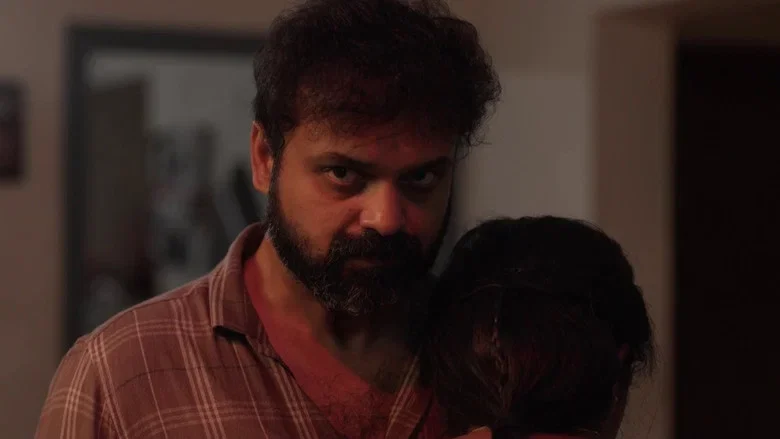
Kunchacko Boban Plays the Pressure, Not the Panic
Boban has spent the last several years building a second career out of men who look composed and are not, and Shelly K is his most controlled variation on that figure. Watch his hands during the station-house interrogations, flat on the table, fingers splayed, absolutely still, while his jaw works through a private calculation the script never fully explains. It is a performance built on withholding, and it holds the film together when the writing starts to fray.
Lijomol Jose, working in a register far removed from the trapped-wife energy she brought to Nooru Sami, gives Soumya a watchful, unreadable quality that keeps the supernatural and procedural layers from resolving too neatly. She is the film’s best argument for ambiguity, and she is underused in the final act.
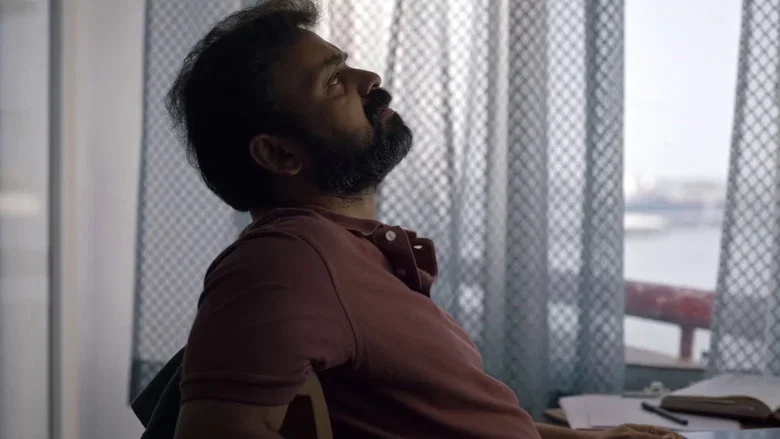
The Interval Block Earns Its Reputation
There is a reason the midpoint is the moment everyone discusses. Das stages a confrontation in near-darkness, reduces the sound design to breath and footfall, and lets the audience’s own uncertainty about what Shelly is seeing do the work. It is the rare thriller set piece that trusts its performers over its effects, and it lands because the preceding hour has been so patient.
Just as he demonstrated spatial discipline in Father’s Day, Das strips away decorative camera movement here to prioritize raw psychological friction. The problem is what happens after.
Then the Backstory Arrives and the Air Goes Out
The second half makes a fatal miscalculation: it explains. Where the first hour thrived on what Shelly could not name, the resolution offers a backstory cascade that reframes the mystery as a familiar revenge architecture. The film’s momentum shifts from psychological dread to procedural housekeeping, and the tonal control that defined the opening evaporates.
The screenplay becomes dependent on reveal mechanics rather than character consequence, and the ending settles into exactly the kind of conventional closure the premise had been quietly resisting. It is not incompetence so much as a failure of nerve, a retreat to the safety of a solved case.
This is the same trap that swallowed the back half of I, Nobody, where a genuinely unnerving setup gave way to tidier, more familiar resolutions. Malayalam thrillers keep building remarkable first acts and then apologizing for them.
What the Craft Cannot Rescue
The editing tells the story of the film’s collapse. The first half parcels information with genuine discipline; the second half dumps it, stacking exposition over atmosphere until the visual grammar that made the opening so effective, the held frames, the negative space, the refusal to cut on impact, disappears entirely.
Supporting players like Siddique and Soubin Shahir register as presences without ever becoming characters, their screen time swallowed by the machinery of explanation. The ensemble that The Week-style coverage might call exceptional never gets the room to prove it.
There is a version of Unmadham that trusts its own ambiguity all the way to the credits. This is not that version, though the shadow of it haunts every frame of the first hour.
The Verdict: A Strong Premise Undone by Its Own Explanations
Das and Kabir have made a film that is genuinely gripping for half its runtime and genuinely frustrating for the other half, and the imbalance is more disappointing than outright failure would be. Boban’s performance and the interval block are worth the ticket; the resolution is not.
What lingers is not the mystery but the waste, the sense of a filmmaker who understood exactly how to build dread and then chose, at the last moment, to explain it away. Rating: 3 / 5
The scariest thing in Unmadham turns out to be its own need to be understood.





1 thought on “Unmadham (2026): Kunchacko Boban Anchors a Thriller That Loses Its Nerve”
Comments are closed.