
The photograph is the whole film. A single image from a Paris café, tucked somewhere it shouldn’t be, detonates a family that has spent seven years pretending it isn’t already rubble. That is the promise of Paris Cafe, and for roughly forty minutes, director Saraj Seelan makes good on it, before the screenplay begins confusing what a character refuses to say with what the film itself refuses to dramatize.
Olivizhiyaal returns from America with a PhD scholar named Kavin Samson in tow and news she wants to deliver in person. What she walks into instead is an empty chair where her mother used to sit. Dr. Gautam Raja, a surgeon with the practiced calm of a man who has learned to hold instruments steady, is living alone. Thara, an activist whose politics are inseparable from her person, is simply gone. The reunion film Oli rehearsed on the flight never happens.
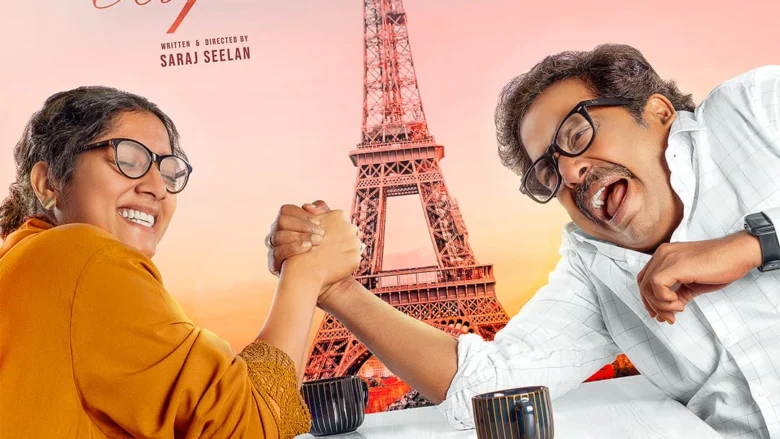
A Reunion That Never Arrives Is a Good Place to Start
Seelan’s instincts in the opening act are sound. He stages the homecoming as a slow puncture rather than a shock, Oli’s luggage still in the hallway, Kavin hovering with the awkward courtesy of a guest who has arrived at the wrong funeral. The camera holds on doorways and half-set tables, and the absence of a mother registers as architecture before it registers as plot.
The photograph then does what all good narrative objects do: it converts grief into inquiry. Oli stops mourning the family she thought she had and starts interrogating the one she actually got. It’s a clean pivot, and it gives the film its engine, a daughter as detective, a father as suspect, a mother as witness who has already delivered her verdict by leaving.
When the Secret Becomes Bigger Than the People Keeping It
Here is where Paris Cafe starts to wobble. The buried event from seven years earlier, Gautam’s concealed wrongdoing, the violation of principle that drove Thara out, is treated by the screenplay as a destination rather than a pressure system. The film withholds it so aggressively that the characters stop behaving like people protecting something and start behaving like people waiting for a page to turn.
Compare this to how a sharper cover-up drama handles the same architecture. The withholding in Pradhama Drishtiya Kuttakkar works because every scene of concealment costs someone something visible, a lie that has to be maintained, a relationship that has to be performed. Seelan’s version of concealment is largely atmospheric. Gautam looks burdened. Thara’s absence is described. The cost stays off-screen.
That’s a structural choice, and it’s a defensible one, but it hollows out the middle act. Oli and Kavin ask questions. Doors close. Someone looks away. The film mistakes the withholding of information for the generation of tension, and by the hour mark the two are no longer the same thing.
Anumol Holds the Frame Even When the Script Lets Go
Anumol is the reason the film doesn’t collapse entirely. As Thara, she plays an activist whose politics have curdled into something harder, a woman who has decided that the person she loved is not the person she can live beside. Watch her in the confrontation scenes: she doesn’t raise her voice. She lowers it. She lets her hands stay still on the table while her jaw does the work. The refusal to perform outrage is the most articulate thing in the movie.
The register recalls the controlled exhaustion she brought to Heart Beat Season 3, where the same economy of gesture carried scenes the writing couldn’t. Here she’s given less to do and does more with it, which is its own kind of indictment of the material.
Guru Somasundaram Plays a Surgeon Who Cannot Operate on Himself
Guru Somasundaram has the harder assignment. Gautam is written as a mystery rather than a man, the screenplay needs him opaque, and opacity is a trap for any actor. He resists it by grounding everything in physical habit: the way he sets down a glass, the way he stands in a doorway without entering, the way he answers questions about his work with more fluency than questions about his wife. The performance is a study in a man who has confused composure with innocence.
Vijay Vishwa’s Kavin is the film’s weakest link, though not through any failure of performance. He is written as a device, emotional support, external perspective, a body in the passenger seat during the investigation, and the screenplay never gives him a want of his own. He exists so Oli has someone to think out loud to.
The Camera Understands Silence Better Than the Script Does
Sathish G.’s cinematography is the film’s quietest asset. He favours medium-long framing in domestic interiors, keeping characters at the distance of people who have stopped touching each other, and he lights the Gautam household in a flat, overcast register that makes the rooms feel like they’ve been waiting for someone. When the film finally moves into the past, the shift is marked by a slight warming of the palette, a small, intelligent cue that the buried event was warmer than the present.
Krishna Kumar’s score is less disciplined. It arrives too early in scenes that would play better dry, and it underlines emotional beats the performances are already carrying. The editing, meanwhile, splits the film cleanly in two: a patient first half that earns its silences, and a second half that rushes toward revelation as if the runtime were closing in on it.
The Ending Asks the Right Question and Then Answers It Too Fast
The climax turns on whether the truth can repair what silence broke, and Seelan deserves credit for refusing the easy reconciliation. Thara’s decision to leave is not treated as a misunderstanding to be cleared up. It is treated as a moral position, and the film’s willingness to sit with that, at least for a few scenes, is its most mature gesture.
But the resolution arrives with a tidiness the rest of the film hasn’t earned. Forgiveness is offered as a path forward without the film having done the work of showing what forgiveness would actually cost these people. The thematic sibling here is instructive: the same problem of substituting atmosphere for consequence runs through Cuddle Café, another Tamil drama that treats reticence as a virtue in itself. Both films would benefit from trusting their audiences with more, not less.
What Paris Cafe gets right is worth noting. It puts a daughter at the center of a parental reckoning rather than making the separated couple the only story, and it treats a photograph as a moral object rather than a plot convenience. That instinct, that the smallest evidence can carry the largest accusation, is the kind of craft that signals a filmmaker worth watching across contemporary Tamil dramas, even when the execution doesn’t fully arrive.
The BookMyShow audience score of 9.7 is doing a lot of heavy lifting for a film that plays its cards this close to the chest, and it’s worth asking whether that enthusiasm reflects the movie on screen or the catharsis of a family drama that arrives at the right emotional temperature without ever truly turning up the heat. Either way, Anumol’s stillness is the thing you carry out of the theater. Everything else, like the photograph, stays in the drawer.
Rating: 3 / 5




1 thought on “Paris Cafe (2026): Anumol Anchors a Family Thriller That Mistakes Silence for Depth”
Comments are closed.