
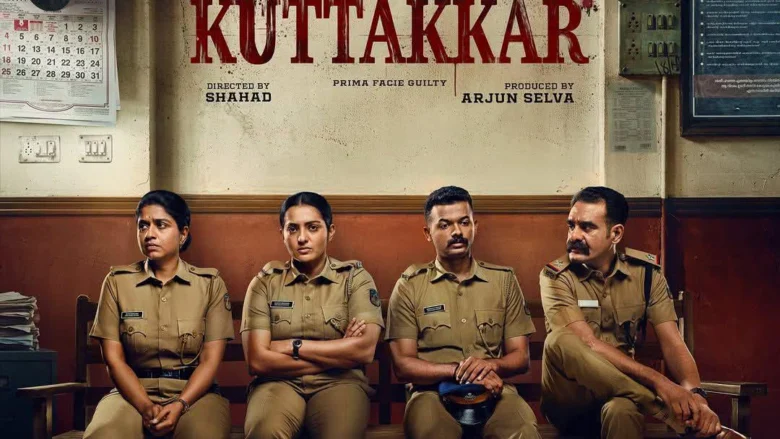
The gunshot arrives without ceremony. A night-patrol arrest turns into a scuffle inside the Nattakom station, four constables pile onto one man, and somewhere in that knot of limbs a service weapon discharges into a body. Nobody in the room will say whose finger was on the trigger. Shahad Nilambur shoots the moment flat and unglamorous, and that refusal to stylise the killing is the film’s first honest instinct.
What follows is not a whodunit. It is a what-now. CPO Aleena Abraham, played by Parvathy Thiruvothu with a widow’s guarded economy, joins three colleagues in dragging a corpse toward a story they can live with. The dead man is a stranger to them. That is the horror of it, they have killed a nobody and must now build a somebody out of him to justify the bullet.
Fourteen Days Of CCTV Backup Is A Better Clock Than Any Villain
The screenplay’s sharpest invention is administrative. The officers erase the station footage, then realise the backup purges itself in fourteen days. Their own professional literacy, retention windows, chain of custody, weapon logs, becomes the mechanism of their undoing. It is a countdown built from paperwork, and it hums louder than any score cue.
This is where the film separates itself from the kinetic sensationalism that overtook Unmadham, which reached for shock where this one reaches for dread. Nilambur understands that a police station at 2 a.m., lit by the blue wash of a monitor showing nothing, is a more frightening room than any interrogation cell. The camera stays close to hands, on keyboards, on holsters, on each other, because hands are what did this.
Parvathy Thiruvothu Plays Silence As A Survival Skill
Parvathy’s Aleena is the film’s structural centre, and her performance is built almost entirely out of withholding. Watch her in the aftermath: she does not weep, does not tremble. She straightens her uniform. She checks her daughter’s photograph. She asks a procedural question in a voice pitched one register below everyone else’s, and that lowered register is the whole character, a woman who learned in grief that visible feeling is a liability.
The contrast with her work in I, Nobody is instructive. There she played fracture outward, all exposed nerve and physical restlessness. Here she inverts the method entirely, and the result is a performance that only reveals its intelligence in retrospect, once you understand what she was calculating the whole time.
Vijayaraghavan’s Investigator Is A Wall, Not A Villain
Crime Branch DYSP Harris Meeran is the film’s most underrated piece of engineering. Vijayaraghavan plays him without menace, without tics, without a single raised voice. He sits. He reads. He asks the same question three different ways and watches which version of the answer changes. His stillness manufactures pressure more effectively than any procedural montage, and the screenplay is smart enough to make him a reader of his own published methodology, a man whose habits are documented and therefore exploitable.
That is the hinge on which the third act turns, and it is genuinely clever. Aleena studies Harris the way a student studies a textbook, and the film briefly becomes a duel between an investigator and his own printed mind. Sidharth Bharathan’s Dasan gets the one supporting role with real physical definition, a heavy, lonely bachelor whose bulk matters in the scuffle and whose awkward courtship of a schoolteacher never quite earns its screen time.
The Bullet In The Ring Is A Great Idea Executed On Faith
The climax asks a great deal. Aleena, outside a courtroom, reveals that she manipulated drug interactions to steer Harris toward recovering the wrong bullet, while the actual projectile has been melted and reforged into her engagement ring using her father-in-law’s tools. She walks past the investigator and brushes the ring with her fingers. As a closing image it lands. As a chain of physical logic it wobbles badly, and the film never bothers to shore it up.
This is the recurring weakness. The screenplay’s conveniences accumulate rather than compound. Divya’s fertility struggle, Sreenath’s anxieties about his girlfriend, Dasan’s solitude, each is introduced with care and then left to sit beside the investigation instead of feeding it. Four officers with four private reasons to lie should produce four distinct pressures on the cover-up. Instead they produce one shared mood.
What the film does achieve is a genuinely unusual position for its protagonist. Aleena begins as the most passive figure in the room, a widow given a job out of sympathy, and ends as the only one who has been actively constructing evidence from the first hour. That reversal is the point, and it is delivered without a speech.
A Contained Procedural That Trusts Procedure Over Plot
Nilambur’s direction is at its best in the unglamorous middle. The station’s fluorescent hum, the way a character’s back fills the frame while another speaks off-screen, the deliberate refusal to cut away during the scuffle, these choices keep the film anchored to bodies in a room rather than twists on a page. Compared with the broader tonal looseness of Cuddle Café, this is a tighter, more disciplined piece of construction, even if it is a less emotionally generous one.
The cost of that discipline is thinness elsewhere. Personal stakes are asserted rather than dramatised, and the film’s scientific reasoning is loose enough that attentive viewers will start doing the math and stop believing it. A thriller that makes procedure its suspense engine cannot afford to be sloppy about procedure in the final reel.
Still, there is something worth respecting in a Malayalam crime film that resists the urge to escalate. No cartel, no mastermind, no third-act shootout. Just four frightened public servants, a deleted file, and a man who reads too carefully. Within the current wave of contemporary Malayalam thrillers, that restraint reads as confidence rather than poverty of imagination.
The Verdict
What lingers is not the reveal but the ring. A woman walks past the man who could destroy her, wearing the only piece of evidence that matters, and touches it. The film’s argument is buried in that gesture: institutions do not cover up crimes because they are evil, but because the people inside them have something small and private they cannot bear to lose. Parvathy Thiruvothu carries that idea with almost no dialogue, and the performance is the reason the film survives its own implausibilities.
It is a sharper premise than it is a finished film, a strong first hour, a wobbling last act, and one actress holding the whole structure upright through sheer control. Worth the ticket for the Aleena–Harris interrogation scenes alone, which are the best-written passages in the film and the only ones that fully earn their tension.
Rating: 3 / 5
Nilambur has made a film about the unbearable smallness of guilt, and then, at the very end, handed his heroine a piece of jewellery and asked us not to look too closely at how it got there.





1 thought on “Pradhama Drishtiya Kuttakkar (2026): Parvathy Thiruvothu Anchors A Sharp Cover-Up Thriller That Runs Out Of Evidence”
Comments are closed.