
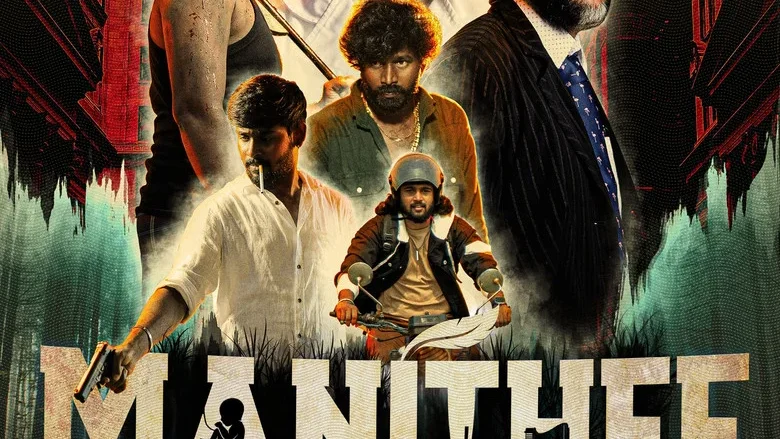
MJ Nitharsan’s Manithee: the fire bird opens with a premise so tantalising it practically dares you to lean forward: a female physicist on the verge of unleashing breakthrough technology, and a village filmmaker chasing a world-class dream, both pulled into a mysterious forest that refuses to explain itself. The film runs a lean 98 minutes, and for a good stretch, that brevity feels like discipline rather than deficiency.
The central conflict is deceptively simple: ambitious outsiders versus an environment that seems to have its own rules. Vithu Vanni’s Ranga, whose exact function in the narrative remains frustratingly opaque, anchors the human drama. The film wants us to believe that scientific ambition and artistic ambition are twin flames, both consuming, both dangerous.
When A Forest Becomes A Character, The Script Must Earn Its Mystery
Here is where Nitharsan’s screenplay stumbles. The forest is meant to be the film’s engine, a living threat that externalises the characters’ internal chaos. But mystery without rules is not mystery; it is avoidance. The film withholds the forest’s logic so aggressively that the second act begins to feel less like suspense and more like a filmmaker hoping we won’t ask questions.
Contrast this with the spatial discipline demonstrated in Paris Cafe, where the director understood that confined spaces demand precise emotional geometry. Nitharsan has the confinement but not the geometry. The forest swallows his characters, but it also swallows his dramatic momentum.
The social-injustice thread, introduced as a parallel moral conflict, never coheres with the speculative premise. An ordinary man standing against moral decay is a fine idea. Dropped into a forest-bound survival mystery, it plays like a second film trying to claw its way into the first.
Vithu Vanni’s Restraint Is Real, But The Script Gives Him Nowhere To Put It
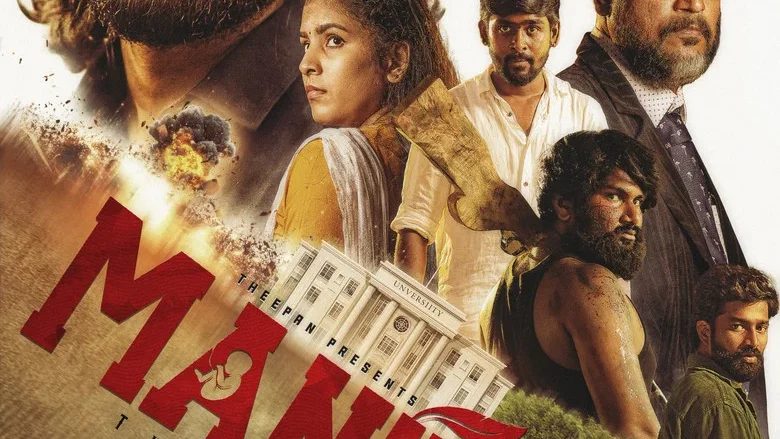
Vithu Vanni has a face built for quiet desperation. His Ranga moves through the forest with the tense, watchful stillness of a man who knows he is being observed. In the film’s better moments, Vanni communicates volumes through posture alone: shoulders pulled inward, eyes tracking the treeline, jaw set against panic.
But the screenplay never gives him a proper confrontation. There is no antagonist to push against, no human face to embody the threat. The forest is a concept, not a character, and Vanni is left reacting to atmosphere rather than opposing a will. The physical exhaustion he brings to the final act recalls the psychological weight Parvathy Thiruvothu carried through Pradhama Drishtiya Kuttakkar, but where that film gave its lead a human adversary to dismantle, Manithee leaves Vanni alone with the trees.
Rathitharan Kathiresu and Ravee Murali appear in credited roles, but their characters lack the scene-level definition that would make them feel like people rather than plot furniture. The supporting cast exists, but they do not breathe.
Nitharsan’s Camera Knows The Forest, But Not The Fear
The visual approach is competent without being inspired. Nitharsan favours medium shots that keep his actors framed against dense foliage, which should create claustrophobia but often just creates distance. The lighting is naturalistic to a fault; scenes set in shadowy undergrowth are genuinely difficult to parse, and not in a way that feels intentional.
The score, when it appears, leans on sustained strings and low-frequency drones. It is functional, but it never surprises. A film this dependent on atmosphere needs sound design that disorients, that makes the familiar strange. Manithee’s audio landscape is too polite for its own premise.
The editing tells the real story. The first half moves with reasonable purpose, establishing the dual ambitions and the forest’s pull. The second half accelerates without escalating, rushing toward a resolution that feels less like a climax and more like an escape. The film ends, but it does not conclude.
The Fire Bird Never Quite Takes Flight
What Manithee attempts is genuinely interesting: a Sri Lankan Tamil science-fiction film that refuses the kinetic sensationalism of its peers. The thematic ambition here echoes the world-building aspirations of TAXILA, another recent Tamil sci-fi that prioritised atmosphere over action. But where that film committed to its internal logic, Manithee hedges, offering mystery without payoff and ambition without architecture.
This is a film that wants to be about the cost of creation, the violence of innovation, the loneliness of those who see further than their communities. These are worthy themes. But themes are not narratives, and Manithee never finds the story that would make its ideas land.
The ending, such as it is, offers no revelation about the forest, no reckoning between the physicist’s technology and the filmmaker’s art, no resolution to the social-injustice thread. The characters simply stop being in danger. It is not an ending; it is an exhaustion.
For audiences hungry for speculative cinema emerging from contemporary Tamil sci-fis, Manithee represents both the promise and the problem: ambition without infrastructure, atmosphere without architecture, a fire bird that burns brightly for a moment and then vanishes into the dark.
Rating: 2.5 / 5
Manithee is not a failure of vision. It is a failure of follow-through, a film that trusts its mysteries more than its audience, and in doing so, leaves us stranded in the woods with no path home.



2 thoughts on “Manithee: the fire bird (2026): MJ Nitharsan’s Ambitious Sri Lankan Tamil Sci-Fi Burns on Its Own Pyre”
Comments are closed.