
The lights dim on a Chennai multiplex, and within twenty minutes P. S. Mithran has already detonated a covert heist, introduced a biochemical doomsday device, and split Karthi into two men. The problem is that Sardar 2 spends the next two hours and forty minutes trying to top that opening, and never quite does.
A Sequel That Mistakes Volume For Velocity
The premise is muscular enough: Inspector Vijay Prakash, hungry for a case that will legitimise him inside the intelligence apparatus, stumbles onto a conspiracy involving three hidden keys and a weapon called Doku capable of wiping out a village in seconds. The screenplay then does something genuinely interesting, it drags his presumed-dead father, Agent Chandra Bose, back from the shadows to confront the catastrophe he once failed to prevent. That is a strong dramatic spine.
But the film keeps interrupting its own best instincts. Every time the father-son reckoning threatens to land, Mithran cuts away to another key, another chase, another set piece. The three-key structure should tighten the noose; instead it feels like a video-game fetch quest stretched across three hours.
When A Villain’s Revenge Gets Buried Under Plot Machinery
S. J. Suryah’s Yogi, the operative known as Black Dagger, is built on personal grievance rather than ideology, which is exactly the right instinct for a spy thriller. His menace lives in the way he holds a room: shoulders squared, voice pitched just above a whisper, eyes fixed on the person he intends to destroy. In his best scene, he doesn’t raise his voice at all.
The trouble is that the screenplay never lets him breathe. He becomes a connective tissue for the three-key hunt rather than a character with his own gravitational pull. Compare that to the way the antagonist in Kitti is allowed to sit inside his own obsession until the audience feels the weight of it, a discipline this film never quite commits to.
Karthi’s Dual Role Carries The Film Until It Doesn’t
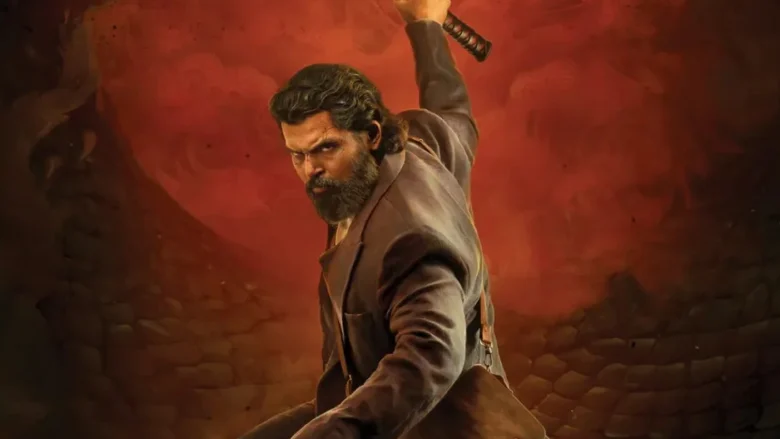
Karthi does the heavy lifting here, and for the first half he’s genuinely compelling. As Vijay, he plays the frustration of a junior officer stuck on low-profile assignments with a tight jaw and restless hands, always reaching for a file, always half a step ahead of his superiors. As Sardar, he strips the performance down to stillness: a man who has already lost too much to raise his voice.
The contrast works because Karthi resists the temptation to play the two roles as opposites. Both men are burdened; one just hides it better. It’s a more controlled turn than the romantic register he brought to Love Insurance Kompany, and it confirms he’s one of the few Tamil leads who can carry a franchise on his shoulders without mugging for the gallery.
What he can’t do is save the second half. Once Sardar returns and the film pivots to full-scale action, Karthi is reduced to running, shooting, and reacting. The remorse that gave the first act its pulse gets buried under explosions.
The Father-Son Reunion Deserved A Better Film Around It
The emotional centre of Sardar 2 is the moment Sardar steps back into the mission after Vijay uncovers the truth about Doku. The staging is simple, two men in a dimly lit room, one seated, one standing, neither quite able to look the other in the eye. For about four minutes, the film becomes the drama it should have been all along.
Then the score swells, the camera pulls back, and we’re back to the countdown. This is the film’s fundamental miscalculation: it treats its own emotional material as an obligation to be discharged before the “real” movie can resume.
The same problem afflicts the supporting ensemble. Malavika Mohanan and Ashika Ranganath are positioned as major presences, but the screenplay gives them almost nothing to do beyond standing near the mission. Rajisha Vijayan’s return to the Sardar universe is welcome for continuity’s sake, but she’s a ghost in the machine. When your female leads are functionally interchangeable with the set dressing, something has gone wrong at the scripting stage.
Scale Without Precision Is Just Noise
Mithran’s direction has always favoured operational clarity over stylistic flourish, he builds sequences like a tactician, which is why the first half’s investigation tracks so cleanly. But the sequel’s expanded canvas exposes his limits. The climax stretches past the point of tension, stacking action beats on top of each other until the audience stops caring which key is where.
Sam CS’s score, meanwhile, never finds a distinct identity. It hits the expected beats, tension, release, triumph, but rarely does anything that lingers. The reported use of AI-generated visuals in certain set pieces compounds the problem; there’s a flatness to some of the larger frames that undercuts the physical scale the film is trying to sell.
What’s frustrating is that the raw material was there. The flashback structure, the Doku-Colisten mythology, the idea of a father’s failure becoming a son’s inheritance, these are the bones of a genuinely gripping thriller. Somewhere in the edit, someone decided that more was better than tighter.
The Verdict: A Franchise Running On Fumes
Sardar 2 wants to be a father-son reckoning wrapped inside a globe-trotting spy thriller. It ends up being neither, too bloated to land emotionally, too predictable to thrill. Karthi remains the reason to watch, and S. J. Suryah deserved a sharper script to menace his way through. But a nearly three-hour runtime, a climax that refuses to end, and a screenplay that keeps confusing escalation with drama leave the film stranded somewhere between ambition and execution.
What the sequel ultimately reveals is a franchise that has mistaken scale for substance. The first Sardar worked because it was lean, focused, and trusted its star to carry the emotional weight. This one keeps reaching for a bigger canvas without asking whether the story needs one. For a genre that has recently produced genuinely tense, character-driven work across contemporary Tamil thrillers, that’s a step backwards.
Rating: 2.5 / 5
The tragedy of Sardar 2 is that its best scene, two men in a room, finally telling the truth, lasts four minutes. The other hundred and seventy-five are spent trying to forget it.




1 thought on “Sardar 2 (2026): Karthi’s Dual-Role Spy Saga Buckles Under Its Own Spectacle”
Comments are closed.