
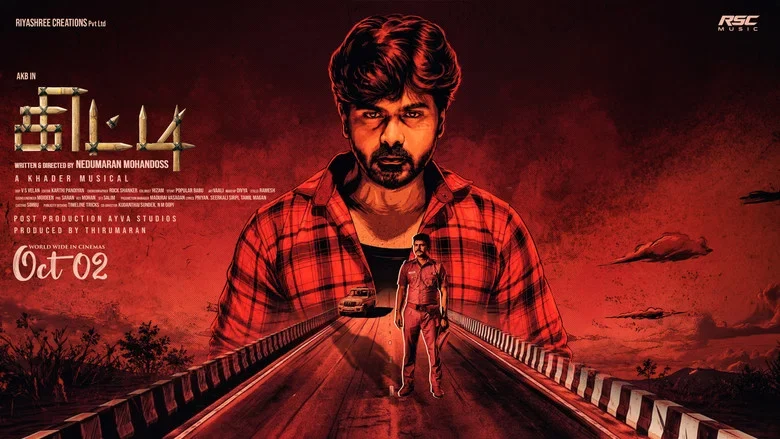
Nedumaran Mohandoss opens his film not with a murder but with a surrender. An auto driver walks into a Cuddalore police station and claims responsibility for two killings, a local rowdy and a college student, and the camera, to its credit, refuses to editorialize. There is no flashback sting, no ominous score cue telling us whether this man is a killer or a casualty of his own misfiring synapses. The premise lands as a clean, uncomfortable question mark.
That restraint is the film’s most disciplined instinct. Kitti understands that a confession is only as interesting as the mind behind it, and for its first hour it treats Vijay’s claim as a puzzle box rather than a plot engine. The trouble is what happens once the box is opened.
When Every Witness Becomes a Competing Version of the Same Truth
Inspector Rajapandiyan’s investigation unfolds through triangulation: the confession, the friend’s testimony, the doctor’s diagnosis. Thirumaran Mohandoss plays the inspector with a flat, procedural stillness, he sits rather than stands during interrogations, lets silences stretch past comfort, and treats Vijay’s account as a document to be cross-referenced rather than a man to be pitied. It’s a canny choice, and it gives the middle section a genuine gravitational pull.
The structural pivot arrives when Raja, Vijay’s friend, is questioned and Doctor Aravindraj confirms a psychological condition. This is where Kitti wants to live, in the gap between legal guilt and perceptual unreliability. The screenplay, though, treats that gap as a destination rather than terrain. Once the diagnosis lands, the film stops asking questions and starts arranging answers, and the second half’s twist machinery begins to whir with a mechanical insistence that betrays the ambiguity the first half so carefully cultivated.
The tonal discipline Mohandoss shows here, the refusal to decorate a confession scene with stylistic flourish, echoes the stripped-back spatial logic that anchored Selvi, where exhaustion was rendered through architecture rather than exposition. Kitti aims for something similar with perception, but it lacks the earlier film’s confidence in letting the audience sit inside discomfort without a rescue chute.
Ashok Kumar Balakrishnan Carries the Weight Until the Script Stops Trusting Him
Ashok Kumar Balakrishnan’s performance is the film’s load-bearing wall. In the surrender sequence, he keeps his voice at a register just below hysteria, not shouting, not whispering, but speaking with the flattened affect of someone who has rehearsed his own guilt until it sounds like fact. His hands stay still. His eyes don’t dart. It’s a performance built on the terrifying possibility that a man can believe his own confession and still be wrong about what he did.
That restraint is what makes the film’s later indulgences so frustrating. When the screenplay starts handing him emotional beats designed to clarify rather than complicate, Ashok obliges with visible effort, but the role stops requiring the thing he does best: withholding. The physical exhaustion he brings to the final interrogations recalls the psychological weight carried through Hushar Pittalu, where a young performer anchored a cautionary narrative through sheer presence rather than plot mechanics. Here, Ashok is asked to do both, and the script only supports one.
The Supporting Frame Does Its Job, Then Disappears
Arjoona Duraisamy’s Raja functions as the film’s most effective destabilizer, his testimony is delivered with a nervous specificity that makes you question whether he’s protecting Vijay or protecting himself. Aravindraj’s doctor, by contrast, is a plot device in a white coat, delivering diagnosis with the clinical flatness of a man reading from a manual. The film needs him to be an interpretive wild card; instead, he’s a exposition delivery system.
Y. G. Mahendran’s judge appears late and briefly, representing legal consequence without dramatic texture. The women in the cast, Nisha Ishmeet and Sangavi Dharmaraj, are credited in principal roles but given almost no scene-level function, which is a structural failure rather than a performance one. When your psychological thriller has no room for its own female characters to matter, the interiority you’re claiming to explore starts to look suspiciously narrow.
Where the Camera Looks When It Should Be Looking Somewhere Else
The film’s visual grammar is functional in the least interesting sense: it frames faces, holds them, and waits for dialogue to do the work. There’s no attempt to externalize Vijay’s fractured perception through lensing or composition, no distorted depth of field, no deliberate spatial dislocation. The camera trusts the script to carry the ambiguity, and when the script starts resolving rather than deepening, the visuals have nothing to fall back on.
The editing tells the real story of the film’s priorities. The first half moves with investigative patience, letting scenes breathe through interrogation and observation. The second half accelerates into twist delivery, compressing emotional beats into montage and treating revelation as a rhythm rather than a consequence.
This is the same tension that undermines Valluvan, where a grim procedural buries its own moral conscience under the mechanics of plot. Kitti doesn’t bury its conscience, it misplaces it, mistaking ambiguity for depth and confusion for complexity.
What the Film Believes About Memory Is More Interesting Than What It Does With It
The central thesis, that trauma and mental instability can dissolve the boundary between factual memory and subjective perception, is genuinely fertile ground. The film’s best moments are the ones that let Vijay’s account stand unchallenged, forcing us to sit with the possibility that his reality is coherent to him even if it’s wrong. That’s the psychological thriller’s highest calling: making us doubt our own interpretive authority.
But Kitti doesn’t trust that discomfort. It wants to resolve, to explain, to deliver the twist that reframes everything. And in doing so, it reveals that it never really believed in its own ambiguity, it was just holding it in reserve until the third act needed a payoff.
The film’s commercial fate remains unwritten, but its artistic one is clearer: this is a psychological thriller that flinches at the last moment. It signals a certain ambition across contemporary Tamil thrillers, but ambition without conviction is just a premise waiting for a better script.
The Verdict: A Confession the Film Itself Doesn’t Fully Believe
Kitti ends not with a revelation but with a shrug, the kind that comes when a filmmaker has built a labyrinth and then decided to install a fire exit. Ashok Kumar Balakrishnan’s performance deserves a film that trusts him to carry the weight of not knowing, but the screenplay keeps handing him answers he doesn’t need and explanations that shrink the mystery rather than deepen it.
There’s a version of this film, leaner, more patient, more willing to let the audience sit in the discomfort of unresolved perception, that would be genuinely unsettling. What we get instead is a thriller that mistakes its own confusion for complexity and its late twists for insight. The confession was never the question. The question was whether we could trust the man making it. Kitti never quite decides, and that indecision is the only thing it commits to fully.
Rating: 2 / 5







2 thoughts on “Kitti (2026): Ashok Kumar Balakrishnan’s Psychological Gamble Runs Aground on Its Own Ambiguity”
Comments are closed.