
The bull crosses the boundary line at dusk, and the village goes quiet in a way that no jump scare could manufacture. Deepak Kumar Mishra understands that dread lives in the space between a warning and its violation, for about an hour.
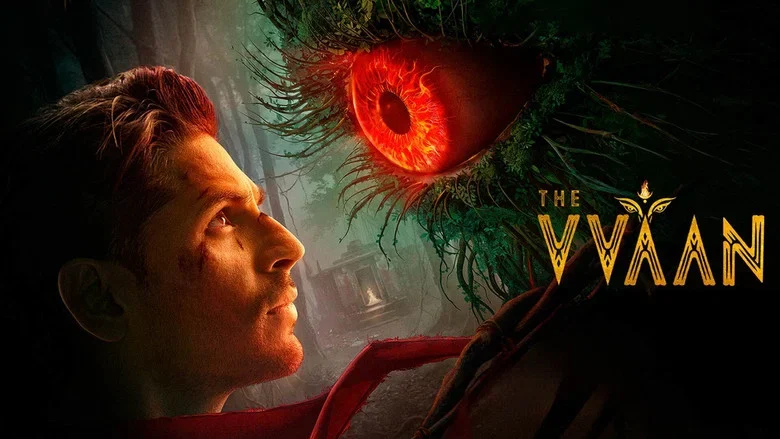
The Legend Arrives Before The Man, And That’s The Smartest Thing Here
Mishra opens with an animated prologue detailing the Van Devi mythos, sketching Dev Van as sacred ground rather than generic haunted woods. It’s a deliberate choice: the forest earns its cultural weight before Sidharth Malhotra’s Rishi ever steps into frame, dismissing the taboo as backward superstition.
That structural patience pays off in the first act. The film moves from mythic time to Mumbai’s concrete rationality, then deposits Rishi back in Devanchal during Chhath Puja for an ancestral-land dispute he’d rather resolve than inherit. The collision is set: engineer versus ecosystem, diaspora versus duty.
Rishi’s transgression arrives with clean economy. A bull wanders into the forbidden zone, and he follows, not out of heroism, but stubborn empiricism. The scene works because Mishra keeps the camera low and patient, letting the treeline swallow the frame before anything supernatural occurs.

When A Rationalist Loses His Footing, The Film Finds Its Pulse
The second act’s central mechanism is Rishi’s epistemological collapse, and Malhotra plays it with commendable restraint. His early scenes carry a specific physical vocabulary, squared shoulders, direct eye contact, a voice that never rises because certainty doesn’t need volume.
After the seal breaks, that posture erodes. His gaze starts drifting past whoever’s speaking to him, fixing on mid-air points just outside the frame. It’s a smart performance choice: the haunting happens in his eyeline before it happens in the edit.
Tamannaah Bhatia’s Mamta functions as more than a wife tagging along. She’s the film’s emotional tether, and their chemistry, noted even in mixed notices, gives the supernatural escalation something domestic to threaten. When she watches him unravel, her stillness carries more weight than any vision sequence.
The inheritance subplot, though, is where the machinery starts grinding. Shweta Tiwari’s Sushila confronts Rishi over his absence and demands he surrender his land share, and the scene is sharply played. But it sits awkwardly beside the Van Devi mythology, as if two different films are competing for the same runtime.
The Road Project Is The Villain, And That’s Both Bold And Blurry
Mishra’s most interesting gamble is refusing a conventional human antagonist. The opposing force is Van Devi herself, and the secondary pressure is the road-development project that Sunil Grover’s Deepak represents. It’s an ecologically conscious framing that recalls the thematic tensions running through contemporary Hindi thrillers that treat infrastructure as moral terrain.
But the film never decides how much weight Deepak’s position deserves. He appears, he advocates, he recedes. The development conflict becomes background noise rather than a genuine dramatic engine, which wastes the premise’s sharpest political edge.
Maniesh Paul’s Ved Prakash, Rishi’s vlogger friend, arrives as an outsider-media perspective, and the casting is intriguing on paper. In practice, he’s underused, his camera-eye potential never fully integrated into the film’s visual grammar. The performance itself has a loose, improvisational energy that briefly punctures the solemnity.
Compare this to how Hai Jawani Toh Ishq, and a pattern emerges: talented ensembles adrift because the screenplay can’t decide whose story this is.
The Second Half Buries The Film Under Its Own Ambitions
Here’s where The Vvaan loses its footing. The visions of King Vikramaditya should deepen the mythology, but they arrive without sufficient setup, functioning more as plot mechanics than organic escalation. The film keeps adding threads, family trauma, land dispute, ecological threat, supernatural vengeance, without pruning any of them.
Mishra’s direction in the first half shows real discipline: the forest sequences are shot with an eye for negative space, letting shadows do the work that lesser films assign to CGI. But the later set pieces grow busier, the editing more frantic, as if the filmmakers lost faith in the slow-burn tension they’d carefully built.
The climax gestures toward Rishi accepting his role as protector, but the transformation feels asserted rather than earned. We’re told he’s reconnected with his roots; we don’t feel the internal shift because the screenplay skipped the intermediate steps.
This is the same trap that ensnared recent franchise-driven spectacles, where ambition outpaces execution and the final act becomes a checklist of resolved plot points rather than a dramatic culmination.
What The Film Gets Right About Folk Horror, And What It Fumbles
The genre mechanics are solid on paper. A forbidden zone, a time-based rule, a broken seal, a rationalist protagonist whose disbelief becomes the audience’s entry point, these are the building blocks of effective folk horror, and the first hour deploys them with confidence.
The animated prologue deserves specific praise. It creates visual separation between mythic and contemporary time, and its stylized imagery carries more dread than the live-action supernatural sequences that follow. There’s a lesson there the film doesn’t learn: suggestion outperforms exposition.
Manu Anand’s cinematography finds genuine texture in the forest locations, particularly in the dusk sequences where the treeline becomes a character. But the visual language grows inconsistent in the second half, alternating between patient wide shots and choppy close-ups that undercut the accumulating tension.
The sound design, too, does heavy lifting early, rustling leaves, distant animal calls, the absence of ambient noise when Rishi crosses into forbidden ground. By the climax, the mix grows cluttered, as if the filmmakers feared silence.
Sidharth Malhotra Carries More Than The Script Deserves
Malhotra’s performance is the film’s sturdiest element. He plays Rishi’s initial rationalism without smugness, which is harder than it sounds, the character could easily become a strawman for the film’s supernatural thesis. Instead, his skepticism feels earned, rooted in a specific urban professional identity.
The shift to destabilization requires him to communicate internal fracture through physical detail: a hand that reaches for walls, a gait that loses its confident stride, eyes that start searching rather than observing. He does this with minimal dialogue, and the restraint serves the film better than any monologue could.
But the screenplay doesn’t give him enough scenes to dramatize the reconciliation with his ancestral legacy. The final transformation happens in a narrative leap, and Malhotra fills the gap with sheer conviction. It’s a performance doing work the script should have done.
The Verdict: A Folk Thriller That Forgets Its Own Folklore
The Vvaan contains a genuinely fascinating film about rationalism confronting inherited belief, about development threatening sacred landscapes, about a man learning that some boundaries exist for reasons his engineering degree can’t explain. That film is visible in the first hour, in the animated prologue, in Malhotra’s carefully calibrated unraveling.
But the second half loses the thread, piling mythology upon mythology until the central conflict drowns in competing ideas. The road project never becomes the antagonist it should be. The visions arrive without sufficient grounding. The climax resolves through assertion rather than dramatic logic.
For audiences hungry for Indian folk horror that treats its source material with respect, there’s enough here to warrant a theatrical viewing, the forest sequences benefit from a big screen, and Malhotra’s performance deserves the undivided attention that home viewing rarely provides. As viewers tracking the Filmyfly 2026 theatrical slate have noted, just temper expectations for the back half.
The film’s final image, Rishi standing at the forest’s edge, neither fully inside nor outside, captures what The Vvaan could have been: a story about the impossibility of returning to a place you’ve already left. That it doesn’t fully earn that image is the disappointment.
Rating: 2.5 / 5
Some films haunt you because of what they achieve. The Vvaan haunts because of what it almost did.



1 thought on “The Vvaan (2026): Sidharth Malhotra’s Folk Thriller Loses Its Forest For The Trees”
Comments are closed.