The sea crossing in Thaainilam lasts only a few minutes of screen time, but it contains the entire thesis of Abhilash G. Devan’s film: a father gripping his daughter’s wrist on an open boat, the water indifferent to both of them. What follows that crossing is a quieter, more difficult story about what happens after survival.

When The War Ends But The Displacement Doesn’t
Sethuraman loses his wife in the final phase of the Sri Lankan civil war and redirects every remaining instinct into keeping his daughter Tamizhini alive. The film’s smartest structural choice is refusing to treat the sea journey as a climax. Arrival in Rameswaram is not resolution; it is the beginning of a different kind of crisis.
The failed handover to relatives is where the screenplay finds its real dramatic engine. Sethuraman expected family to absorb his daughter into safety, and when that arrangement collapses, the film shifts from escape thriller to something closer to Mandaadi, a coastal drama where community kindness and social friction determine whether a displaced person can rebuild.
A Father’s Grief Redirected Into Physical Labor
Amar Ramachandran plays Sethuraman with a body that never fully relaxes. His shoulders stay raised through the Rameswaram sequences, even when the immediate threat has passed. The performance communicates that this man has forgotten how to be off-duty.
His protective urgency is most legible in the small physical negotiations: the way he positions himself between Tamizhini and strangers, the way his hand hovers near her shoulder without quite landing. These are not grand gestures. They are the muscle memory of a man who has learned that safety is temporary.
What Ramachandran resists is the temptation to play grief as visible suffering. His Sethuraman is too busy for catharsis. The performance recalls the psychological weight Karthi carried through Sardar 2, where the physical demands of the role outweighed the emotional interiority. Here, the balance tilts differently: Ramachandran’s body tells the story his dialogue cannot.
Neha Amar’s Innocence As Structural Counterweight
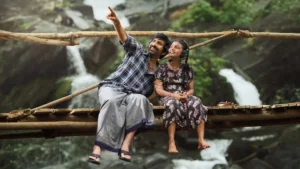
Neha Amar’s Tamizhini functions as more than emotional relief. Her childlike spontaneity, the way she reaches for unfamiliar objects, the way she asks questions her father cannot answer, creates a visible gap between what the child experienced and what she understands.
The performance avoids the trap of precocious trauma. Tamizhini does not perform her suffering. She simply continues being a child in circumstances that should have foreclosed childhood. That contrast gives the film its most reliable emotional current.
Bala Singh and Nimisha Nambiar populate the resettlement sequences with enough specificity to suggest a functioning social world. Singh in particular carries an authority that makes the community feel inhabited rather than staged. Their contributions are modest but necessary.
Where The Direction Loses Its Nerve
Devan’s camera stays close during the escape sequences, prioritizing faces over geography, which keeps the focus on Sethuraman’s fear rather than the spectacle of war. The approach works because it refuses to aestheticize violence. The sea crossing is shot with functional restraint, no heroic angles, no swelling music to tell us how to feel.
That discipline evaporates in the climax. The final developments have been criticized as overly cinematic, and the criticism lands. What was grounded becomes contrived. Characters who behaved with psychological consistency suddenly act to serve emotional resolution rather than dramatic logic.
The tonal shift is jarring enough to retroactively weaken earlier scenes. If the film can cheat at the end, what else was it willing to manipulate? The climax doesn’t ruin Thaainilam, but it exposes the screenplay’s reluctance to trust its own restraint.
What The Film Knows About Refugee Experience
Thaainilam understands that displacement is not a single event but an ongoing condition. The film’s treatment of post-arrival life, the failed family support, the unfamiliar social codes, the difficulty of finding stable ground, reflects a reality that The Vvaan also attempted to capture in its own folk-thriller register, though with less emotional directness.
Where Devan’s film succeeds is in refusing to sentimentalize the Tamil Nadu that receives Sethuraman and Tamizhini. The community is neither villain nor savior. It is simply a new context in which survival must continue. That refusal to flatten the receiving society into either threat or refuge is the screenplay’s most mature instinct.
The emotional emphasis can become direct to the point of sentimentality, particularly in the film’s final third, but the underlying observation remains valid: arrival does not erase the homeland left behind, and safety does not resolve grief.
The Limits Of Good Intentions
Thaainilam arrives at a moment when contemporary Tamil dramas are increasingly willing to sit with difficult historical material without the insulation of commercial spectacle. The film’s willingness to center a child’s perspective on war and displacement is genuinely ambitious.
But ambition is not execution. The screenplay relies on familiar displacement-drama mechanics, failed family support, successive hardships, gradual emotional recovery, that give the narrative a predictable rhythm. The post-arrival section becomes episodic, stacking obstacles without escalating stakes.
The film’s reported theatrical performance has been minimal, with early trade figures suggesting a very limited opening. That outcome is not surprising. Thaainilam lacks the star power or genre hooks that might draw audiences to such heavy material, and its emotional directness may have limited its critical crossover.
The Uncomfortable Resolution
What lingers after Thaainilam ends is not the climax but the sea crossing, the image of Sethuraman and Tamizhini on open water, moving toward a country that will not fully become home. The film’s final developments may strain credibility, but that earlier image retains its power.
Devan has made a film that understands parental love as a form of relentless labor rather than a feeling. Sethuraman does not protect his daughter because he loves her; he loves her by protecting her. That distinction gives the performance its weight and the film its occasional grace.
The problem is that grace is not sustained. Thaainilam is a film of genuine moments that never quite coheres into a sustained achievement. It asks us to care about a father and daughter, and for long stretches, we do. It asks us to believe in its ending, and there, it loses us.
Rating: 2.5 / 5
The sea does not care whether Sethuraman reaches the other side. The film, unfortunately, cares too much about making sure we feel something about it, and in that overreach, it forgets the restraint that made us feel anything at all.