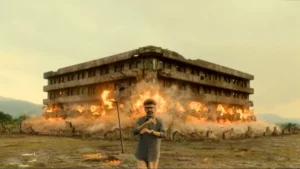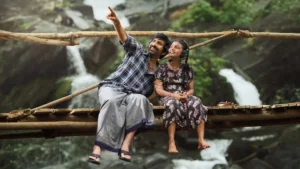
Ashok Galla spends the first act of VISA – Vintara Saradaga talking directly to the camera, narrating his romantic misadventures as if the audience were his therapist. The film wants us to believe this confessional framing is intimacy, but it’s really a crutch, a way to explain feelings the screenplay can’t dramatize.

When A Romantic Comedy Refuses To Commit To Its Own Romance
Udbhav Raghu’s film opens on a Telugu student cohort navigating American campus life, their ambitions tangled with relationship complications and friendship loyalties. The premise has promise: migration reshapes identity, and young love rarely survives the pressure of building a future in a foreign country.
What we get instead is a film that treats its overseas setting as a postcard rather than a pressure cooker. The USA isn’t a place where these characters face real consequences, it’s a backdrop for song sequences and scenic establishing shots that could have been filmed anywhere.
The central conflict, such as it is, emerges from romantic misunderstandings rather than any external threat. There’s no antagonist here, no institutional force pushing against these students, no family opposition with teeth. Just young people making choices that feel weightless because the film never shows us what they stand to lose.
The Lead’s Comic Timing Carries What The Script Cannot
Galla has a natural ease in the lighter sequences, his comic delivery relaxed enough to suggest he understands the rhythm of awkward romantic encounters. There’s a moment in the second teaser material where he recounts a complication with a slight shrug and a half-smile, the physical grammar of someone who knows he’s the architect of his own chaos.
But the film asks him to shift into emotional sincerity without earning the transition. When the screenplay demands vulnerability, Galla’s face registers the effort of reaching for a register the material hasn’t prepared us for. He’s playing a character who learns lessons, but we never see him actually struggle to learn them.
The film’s promotional material emphasized his comic timing, and that’s fair, he can land a punchline. What remains unproven is whether he can hold the screen when the jokes stop and the consequences begin. On the evidence here, the answer is: intermittently.
Sri Gouri Priya Reddy Deserves More Than Being The Romantic Objective
Sri Gouri Priya Reddy, who showed a willingness to sit inside discomfort in Chennai Love Story, is given almost nothing to do beyond looking conflicted at appropriate intervals. Her character exists to be misunderstood, pursued, and eventually reconciled with, a narrative function rather than a person.
The screenplay never grants her an independent objective. We don’t know what she wants from America, from her education, from her future. She’s defined entirely by her proximity to the male lead, which is a waste of an actress whose stillness can communicate volumes when the writing allows it.
Rahul Vijay and Shivathmika Rajashekar round out the ensemble with similarly thin material, their characters orbiting the central couple without generating their own gravitational pull. Harsha Chemudu appears as comic relief, doing what he can with scenes that require him to be loud rather than funny.
Udbhav Raghu’s Direction Chooses Comfort Over Complexity
Just as Ranabaali director Vijay should understand by now, a film’s visual language reveals its priorities. Raghu favors bright, even lighting and medium shots that keep his actors comfortable, no shadows to suggest interior conflict, no cramped framing to evoke the claustrophobia of being young and far from home.
The American locations are photographed with the enthusiasm of a tourism commercial. Wide shots of campuses and streets exist to establish production value, not to create meaning. There’s no sense of these characters being displaced, alienated, or transformed by their environment.
The editing in the first half moves briskly through campus energy and ensemble comedy, but the second half loses momentum when it needs to escalate. The emotional complications pile up without accumulating weight, and the resolution arrives because the runtime demands it rather than because the characters have earned it.
The Comedy Is Gentle, The Drama Is Muted, The Impression Is Faint
Vijai Bulganin’s score keeps things lively during comic sequences, and the song “Anaga Anaga America” is pleasant enough in its melodic framing of the overseas setting. But the music is doing work the screenplay should be doing, manufacturing energy where the scenes themselves lack it.
This is a film that mistakes pleasantness for depth, that believes showing young people smiling in foreign locations constitutes an examination of migration and ambition. The contrast with how contemporary Telugu comedies have begun to sharpen their edges is instructive, audiences are increasingly willing to sit with discomfort, and this film offers none.
The screenplay, credited to Raghu, operates in a linear fashion that never surprises. Complications arrive on schedule, misunderstandings resolve on cue, and the emotional beats land exactly where you expect them. There’s no formal ambition here, no attempt to structure the story in a way that might illuminate its themes.
What Sithara Entertainments Is Actually Betting On
Sithara Entertainments and Fortune Four Cinemas have invested in Ashok Galla’s commercial rehabilitation after earlier theatrical underperformance. Naga Vamsi and Sai Soujanya are producing a film designed to reposition their lead as a viable romantic-comedy presence, a safer bet than action, but not necessarily a smarter one.
The theatrical marketplace for youth romances has become crowded and unforgiving. Audiences who once turned out for overseas-set love stories now have streaming options that deliver similar pleasures without the ticket price. The film’s ensemble structure and USA visuals are meant to justify theatrical exhibition, but they don’t offer anything a viewer couldn’t find on a streaming platform.
Galla’s box-office leverage remains unproven, and this film does little to establish it. The romantic-comedy lane requires either genuine star charisma or genuinely sharp writing, this has neither in sufficient quantity to break through the noise of a crowded release calendar.
The Uncomfortable Truth About Pleasant Mediocrity
The film’s resolution, without spoiling specifics, arrives at a point of emotional reconciliation that feels predetermined rather than earned. These characters haven’t been tested in ways that would reveal their depths, so their final choices carry no weight. We watch them arrive at conclusions we never doubted they would reach.
The comparison to how Least Eligible Bachelor Season 1 trapped its protagonist in a limbo of his own making is instructive, that show understood that character revelation requires genuine stakes. Here, the stakes are romantic inconvenience, and the characters emerge unchanged because they were never really challenged.
What lingers after the credits roll isn’t a scene or a performance or a moment of unexpected insight. It’s the vague sense of time passed pleasantly enough, of a film that asked nothing of its audience and received nothing in return. VISA – Vintara Saradaga wants to be a portrait of young love abroad but settles for a slideshow of attractive people in attractive locations, mistaking the postcard for the journey.