
The first image Rahul Sankrityan gives us is not a face but a shadow, a horseman cutting across the drought-scorched spine of Rayalaseema, dust swallowing his outline before we ever hear him breathe. It is a promise the film spends two and a half hours honouring, and occasionally betraying.
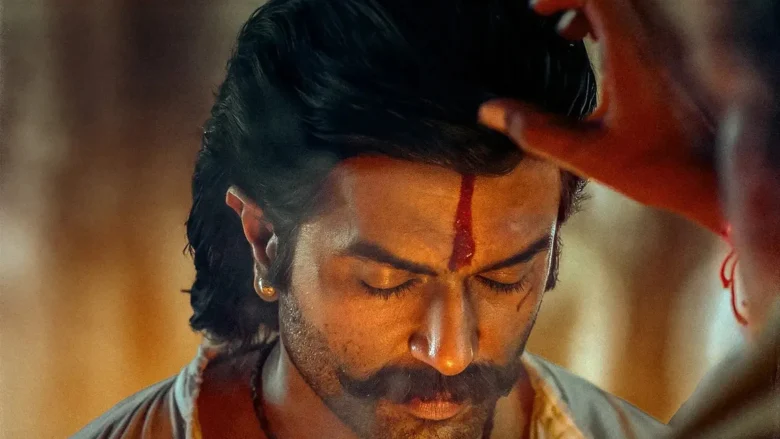
Vijay Deverakonda plays Singanamala Bobbili Ranabaali, a warrior whose birth arrives wrapped in prophecy and whose life is dismantled by the Great Madras Famine of 1876–1878. What follows is less a revenge saga than a slow, grinding study of how hunger converts a private man into a public insurrection.
A Prophecy That Never Earns Its Keep
The film opens on myth, a child born under portent, raised in the hills, married to Jayamma (Rashmika Mandanna) before the world caves in. Sankrityan stages this pre-famine stretch with deliberate, almost stubborn patience, letting us sit inside village rhythms and marital ease.
The problem is the prophecy itself. It sits on the narrative like a decorative object, gestured at, never integrated. Every time the screenplay reaches for destiny, it retreats from the far more interesting proposition underneath: that a man becomes a rebel because his neighbours are starving, not because the stars said so.
Just as he demonstrated a tighter spatial discipline in Ranabaali‘s earlier promotional framing, Sankrityan clearly wants historical texture over mythic shorthand. The instinct is right. The execution keeps tripping over its own ornamentation.
When Hunger Becomes The Only Motive That Matters
Once the famine takes hold, the film finds its engine. Sir Theodore Hector, played by Arnold Vosloo with a clipped, bureaucratic cruelty, controls grain the way other villains control armies, through ledgers, seizures, and the quiet violence of paperwork.
This is where Ranabaali sharpens. The raids on colonial grain stores are not staged as heroic spectacle but as desperate arithmetic: how much food can a community steal back before the administration notices.
Vosloo’s finest moments are his stillest, a man signing orders with the same expression he might use to approve a road repair. The horror lives in that flatness, and Sankrityan wisely lets the camera hold on it.
Rashmika Mandanna Refuses To Be Decoration
Jayamma could have been a waiting wife. She isn’t. Rashmika Mandanna plays her with a practical, unsentimental steadiness, hands busy, eyes calculating, never waiting for permission to act.
The restraint she brings here recalls the psychological weight of her work in Aasha, where defiance was measured in silence rather than volume. She carries the same discipline into Jayamma, and the film is better for it.
Their marriage is not a subplot. It is the political foundation the rebellion stands on, and the screenplay understands that a man fighting for a future needs someone who already believes in it.
The Action Geography Sankrityan Gets Right, And Wrong
The mounted sequences are the film’s signature. Sankrityan shoots Ranabaali’s horsemanship with a low, tracking camera that keeps the animal’s mass in frame, refusing the weightless CGI gallop that has become standard in period action.
But the guerrilla raids begin to blur together by the second hour. Grain store, ambush, retreat, grain store again. The film’s commitment to asymmetric warfare is admirable, yet it lacks escalation, each raid feels like the last one, only louder.
The screenplay resists the kinetic sensationalism that overtook Peddi, opting instead for a deliberate, suffocating dread. That restraint is a virtue until it becomes a rhythm, and rhythm becomes repetition.
Where The Colonial Villainy Goes Soft
Vosloo is excellent. His supporting officers are not. The British administration is populated by faces that register as types rather than people, sneering, sipping, signing, gone.
When the film needs the colonial machine to feel like an organism, it settles for a silhouette. The supporting cast around Hector lacks dramatic function beyond confirming that the empire is, indeed, bad.
This is a structural failure, not an acting one. The screenplay gives its antagonist a system to represent but never a single subordinate worth remembering.
Mythri’s Bet On Period Action Has Real Money Riding On It
Mythri Movie Makers have staked considerable resources on a period action drama with no franchise scaffolding, no sequel hook, and a lead star whose recent theatrical run has been uneven.
The Tamil-Telugu bilingual release is a calculated hedge, two markets, one narrative, no remake pipeline to fall back on. That is either confidence or exposure, depending on opening weekend.
Deverakonda’s box-office leverage is the real variable here. This is a film designed to test whether he can carry a historically grounded, non-contemporary action vehicle across two industries simultaneously.
This patient, texture-first approach signals a broader appetite across contemporary Telugu actions for stories that trust their audience with slowness. Whether the market rewards that trust is a separate, colder question.
The Verdict: A Rebellion That Earns Its Anger, Not Its Length
Ranabaali is a film that understands famine as a weapon and resistance as arithmetic, and it largely succeeds in dramatising both. Deverakonda’s transformation from horseman to insurgent is measured, physical, and free of the bombast his recent work has leaned on.
What holds it back is the prophecy it never needed, a colonial apparatus it never fully populated, and an action rhythm that mistakes consistency for escalation. The film’s anger is real. Its patience is admirable. Its discipline is uneven.
The final confrontation lands with weight precisely because Sankrityan refuses to make it personal, the fight is for grain, for land, for the right to eat. That is a more radical proposition than any revenge beat, and it is the film’s lasting residue.
Ranabaali does not roar. It grinds, and grinds, and then, finally, it strikes. Whether audiences have the patience to wait for that strike is the only prophecy that matters now.




1 thought on “Ranabaali (2026): Vijay Deverakonda’s Famine-Era Revolt Builds Slowly, Strikes Hard”
Comments are closed.