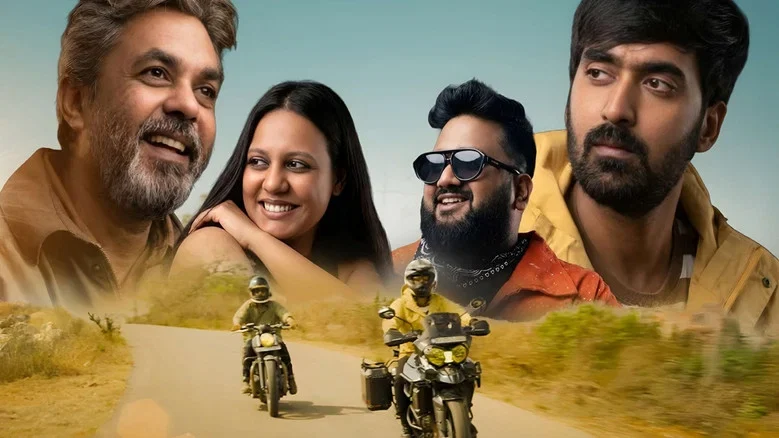
Sushant is about to become a father when his mother hands him the sentence that detonates the film: your father is alive. The road trip that follows isn’t a rescue mission or a revenge errand. It’s a man riding toward a stranger who happens to share his jawline, his temper, and his abandoned responsibilities.
Rajaram Rajendran’s Kannada-language adventure opens with that single line of dialogue and then trusts the highway to do the rest. For roughly forty minutes, it works. The Karnataka countryside unspools in wide, unhurried frames, and the bike becomes less a vehicle than a metronome for Sushant’s panic.
When The Road Already Knows How The Reunion Ends
The film’s smartest instinct is geographic. Every kilometre between Sushant and Sudheer carries the weight of twenty-odd years of silence, and the screenplay lets that distance do the emotional labor instead of forcing early confrontations. When the two men finally meet, the staging suggests the journey has already decided their dynamic, two bodies on the same asphalt, orbiting each other with the wariness of strangers who share a bloodline.
That deterministic tension is the film’s best idea. It also exposes the screenplay’s weakest habit: once the men are in the same frame, the writing stops trusting the silence. Comic interludes arrive like uninvited passengers, and the tonal engine sputters. A peer release like Arjunan Per Paththu made similar mistakes with its dramatic register, and the comparison stings because both films share the same earnestness without the discipline to sustain it.
Harshil Koushik Listens Better Than The Script Lets Him Speak
Harshil Koushik plays Sushant almost entirely in reactive mode, and that’s the correct choice. His face during the reveal scene does something difficult: it registers shock without theatrics, the jaw tightening before the eyes catch up. On the bike, he absorbs the landscape with the stillness of a man cataloguing what he was never told.
The performance recalls the physical exhaustion that anchored Toxic, where the body carried what the dialogue refused to. Koushik doesn’t have that film’s brutality to work with, but he has the same instinct for restraint. When the screenplay hands him a comic beat, he underplays it. When it hands him a monologue, he wisely treats it as an interruption rather than a climax.
Ajith Hande Withholds, And The Film Is Better For It
Ajith Hande’s Sudheer is the film’s gravitational center, and he plays the role with a deliberate refusal to explain himself. His first appearance on the road is framed as preloaded, the camera holds on his posture before he speaks, and the guilt sits in his shoulders rather than his words. He never begs for forgiveness. He simply occupies space, waiting to be either rejected or absorbed.
Samragni Rajan’s Rider Girl injects a different energy entirely, abandoning her lover “at the drop of a hat” in a role built on impulsive motion. She’s a comic counterweight, and she works when the film remembers to use her as texture rather than plot device. The supporting ensemble around the travelers varies the pacing, though few of them register as more than roadside furniture.
Where The Sentiment Curdles Into Something Softer Than Intended
The film’s critical reception has been divided, and the resistance is legible on screen. The comedy doesn’t land with the precision the premise demands, and the mockumentary-adjacent looseness that gives the first act its charm becomes a liability once the emotional stakes require compression. Scenes that should build toward confrontation instead drift, and the reconciliation arrives with less accumulated pressure than the setup promised.
The tonal instability echoes the melodrama that Ikka struggled to contain, where strong performances fought against a screenplay that didn’t trust its own gravity. Here, the father-son axis is strong enough to survive the wobble, but only just.
What the film does well is resist the temptation to turn Sudheer into a villain. There’s no antagonist here, only the accumulated weight of abandonment and the son’s expectation of an apology that may never come. That choice gives the ending a quiet dignity, even when the road there has been bumpy.
The Open Road As Confession Booth
Rajaram Rajendran’s direction is strongest when it trusts the landscape. The bike passages across rural Karnataka are the film’s visual signature, and they work because the camera refuses to aestheticize the journey into a tourism reel. The light is flat, the roads are long, and the men are small against the horizon. It’s a visual argument for how grief works: it shrinks you.
The editing, however, betrays the material in the second half. The first act’s reveal-driven momentum gives way to a looser, more reflective rhythm that doesn’t always earn its slowness. The film runs just over two hours, and the back stretch feels it. This patient character study signals a welcome tonal maturity across contemporary Kannada adventures, even if the execution doesn’t fully match the ambition.
The Reunion We Get, Not The One We Needed
By the final act, the film has made its choice: reconciliation over rupture, warmth over confrontation. Sudheer and Sushant don’t resolve their history so much as agree to stop litigating it. The road has done its work, and the film ends on an affirmative note that feels earned in theory but slightly undercooked in practice.
That’s the paradox of Father’s Day. It has the bones of a genuinely moving film, a strong premise, a committed lead performance, and a visual language that understands how geography can stand in for emotion. What it lacks is the discipline to trust its own silences. The comedy keeps interrupting the grief, and the screenplay keeps explaining what the performances have already shown.
Harshil Koushik and Ajith Hande deserve a better vehicle for their quiet, watchful dynamic. What they get here is a road trip that knows where it’s going but keeps taking detours it doesn’t need. The destination is worth reaching. The journey there is uneven, occasionally moving, and frustratingly close to something sharper.
Rating: 2.5 / 5
Somewhere on that Karnataka highway, there’s a version of this film that lets the silence between a father and son do all the talking. This isn’t quite it, but the echoes of that better movie linger long after the credits.